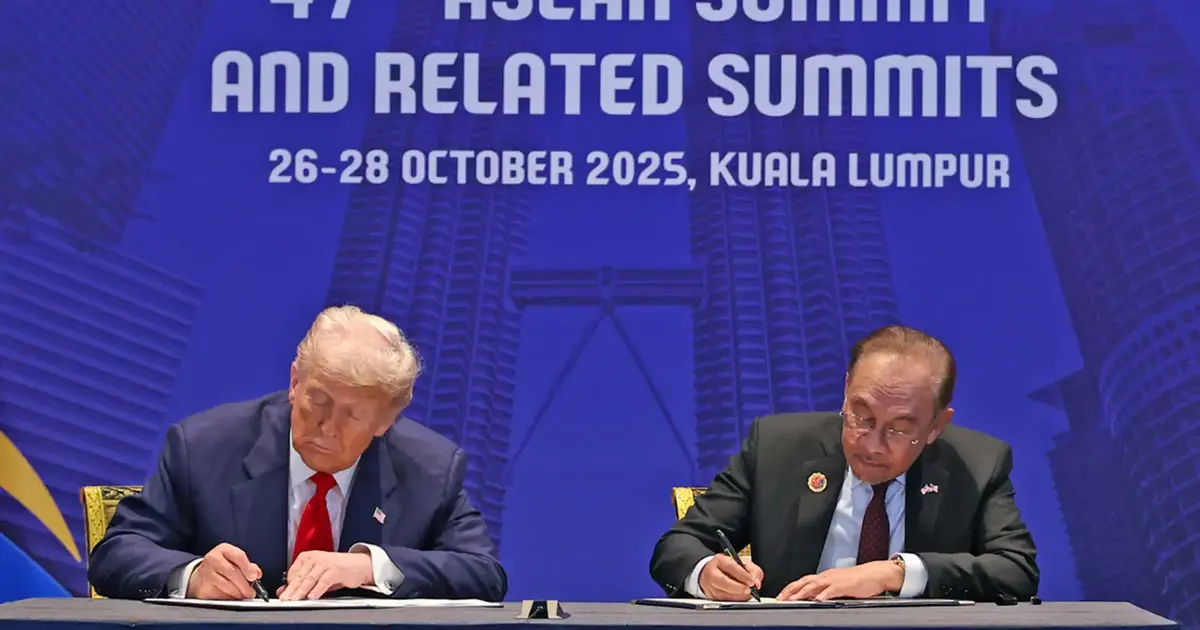
Prime Minister Anwar Ibrahim's administration has moved to have a legal challenge from opposition parliamentarians dismissed entirely, escalating a brewing constitutional dispute over Malaysia's commitment to a reciprocal trade arrangement with the United States. The applications filed by the government and Anwar himself signal an aggressive courtroom strategy designed to prevent the opposition's concerns from receiving substantive judicial examination at this stage.
The opposition MPs contesting the trade agreement have pursued a multi-pronged legal strategy that goes beyond simply attacking the deal's merits. Alongside their main lawsuit, these legislators have simultaneously filed a separate application requesting that the Federal Court address fundamental constitutional questions about the reciprocal trade pact. This two-track approach suggests the opposition believes the agreement may have violated established constitutional procedures or the separation of powers outlined in Malaysia's founding legal document.
Reciprocal trade agreements, which commit trading partners to equivalent tariff reductions and market access arrangements, have become increasingly controversial globally in recent years. For Malaysia, such commitments with the United States carry significant implications across multiple economic sectors and could affect the government's future policy flexibility on trade, investment, and regulatory matters. The fact that opposition MPs felt compelled to challenge the agreement through the courts indicates substantial concern about either the process through which the deal was concluded or its substantive consequences.
The government's decision to apply for dismissal suggests it may contest the very jurisdiction or standing of the MPs to bring such a challenge, or alternatively that it believes the plaintiffs have failed to establish sufficient grounds for the court to intervene. Strike-out applications typically succeed when the plaintiff's legal case appears fundamentally flawed as a matter of law, even before examining the facts in detail. Should the court uphold the government's application, the MPs' suit would be terminated without any judicial consideration of their underlying arguments about the trade arrangement.
The constitutional questions the opposition seeks to refer to the Federal Court likely touch upon the proper procedures for ratifying international trade agreements, the roles of Parliament versus the executive branch in approving such commitments, and potentially questions about whether Malaysia's citizens or lawmakers have rights to be consulted before the nation enters binding international commercial arrangements. These are matters of constitutional law that typically only the Federal Court, Malaysia's highest judicial body, possesses authority to definitively resolve.
This legal battle reflects broader tensions within Malaysian politics regarding executive power and parliamentary oversight. For a significant portion of the opposition and civil society, concerns about trade agreements extend beyond economics into fundamental questions about democratic governance and the preservation of national sovereignty. The decision to litigate rather than simply debate the matter in Parliament underscores these groups' conviction that the courts must enforce constitutional limits on executive discretion.
The timing of these legal maneuvers also carries political significance. Malaysia has been navigating increasingly complex international trade relationships in recent years, balancing its partnerships with traditional allies in the West against closer economic ties with regional powers and China. A reciprocal trade agreement with the United States represents a particularly high-stakes commitment that touches upon sensitive industries and domestic constituencies. The opposition's legal challenge gives voice to factions within Malaysia concerned about the government's foreign economic policy direction.
International trade law experts have noted that Malaysia, like other developing nations, must carefully evaluate the long-term implications of reciprocal trade commitments, particularly when they involve economically dominant partners. Such agreements can lock in policy choices that prove difficult to reverse and may constrain future governments' ability to implement industrial policy, support domestic businesses, or respond to economic crises. The opposition's concerns, therefore, extend beyond immediate partisan considerations to substantive questions about Malaysia's economic future.
For Anwar Ibrahim's government, defending the trade agreement through the courts carries both risks and benefits. Victory in the courts would vindicate the administration's approach to economic liberalisation and its alignment with the United States on trade matters. Conversely, if the Federal Court were to find constitutional defects in how the agreement was negotiated or ratified, it could embarrass the government and potentially force a renegotiation or parliamentary reconsideration of the arrangement.
The unfolding legal proceedings will likely establish important precedents regarding the extent to which Malaysian courts are willing to scrutinise executive agreements on trade and international affairs. Traditionally, courts in many Commonwealth nations have been reluctant to second-guess the executive's handling of foreign relations, operating under a presumption that elected leaders possess superior information and expertise in diplomatic matters. However, recent trends in several democracies suggest courts are becoming increasingly willing to enforce constitutional procedures even when foreign policy is involved.
The opposition's strategy of simultaneously pursuing dismissal defeaters while seeking constitutional referral reveals sophisticated legal planning. Even if the government succeeds in striking out the main suit, the Federal Court application could still produce important constitutional rulings about the framework governing international trade agreements. This ensures that some form of judicial examination of the trade deal's constitutional credentials will likely proceed regardless of the initial outcome.
Regional observers watching this Malaysian dispute will note its implications for ASEAN nations more broadly, as many Southeast Asian governments similarly navigate tensions between economic opening and democratic accountability. How Malaysia's courts ultimately address these tensions could influence how other regional governments approach trade agreements and parliamentary approval processes. The case therefore extends beyond bilateral Malaysia-US relations to encompass questions about the relationship between international commerce and democratic governance throughout Southeast Asia.

