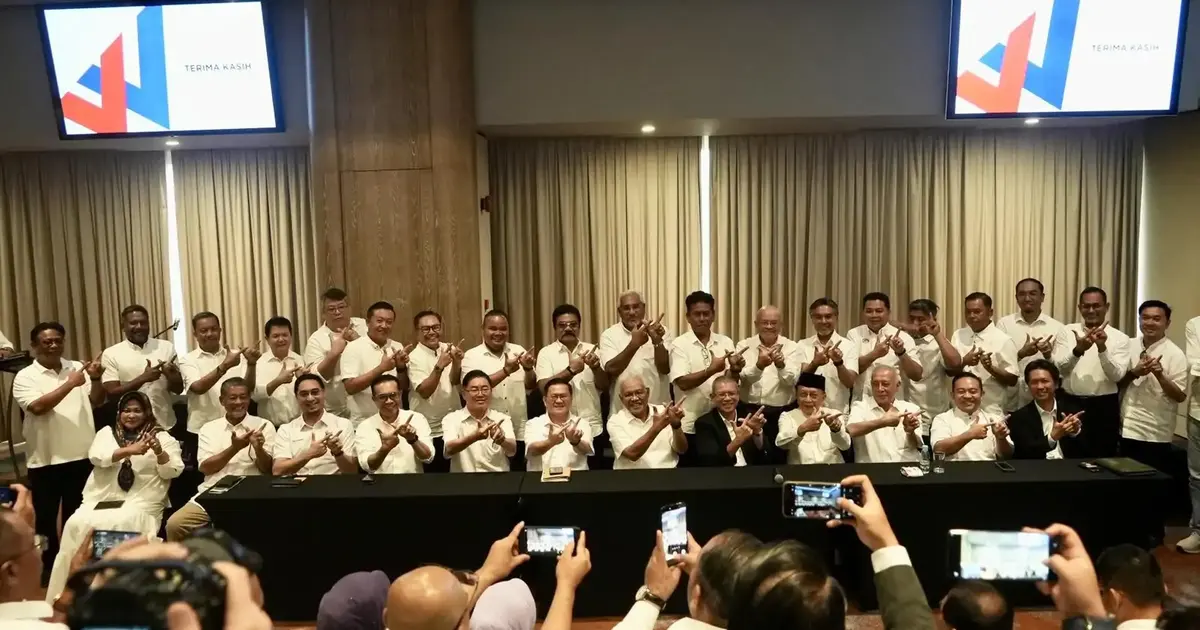
Perikatan Nasional's election director Sanusi Md Nor has confirmed that the coalition's admission of Wawasan as a member was settled through a majority vote conducted by the Supreme Council, indicating that procedural protocol was observed despite internal disagreements within the alliance. The announcement clarifies the mechanics behind one of recent Malaysian politics' more contentious coalition decisions, demonstrating how larger alliance structures manage conflicting positions among their constituent parties.
While Sanusi acknowledged that Bersatu's objections to Wawasan's entry have been formally registered and will be retained in the coalition's records, the Supreme Council proceeded with the decision after voting members expressed support for the application. This distinction between noting concerns and proceeding with a democratic ballot reflects the tension between maintaining party autonomy and exercising collective governance within multi-party alliances. Sanusi's statement suggests that despite Bersatu's vocal opposition, the coalition's decision-making apparatus ultimately prioritised the broader consensus among PN's leadership.
The Wawasan situation underscores the practical challenges facing Malaysia's evolving political landscape, where parliamentary alliances must balance the interests of larger anchor parties with the inclusion of smaller political entities seeking greater representation. PN, as a coalition comprising multiple parties with distinct ideological inclinations and regional bases, must navigate these competing interests while maintaining coherence and stability. The Supreme Council mechanism, while democratic in principle, can create friction when major coalition partners feel sidelined in the decision-making process.
Bersatu's resistance to Wawasan's admission likely stems from concerns about representation, resource allocation, and decision-making influence within the alliance structure. Smaller coalitions often grapple with questions of party parity versus proportional influence, and Bersatu's objections may reflect anxiety that Wawasan's entry could dilute existing parties' positions on key issues or committee placements. Understanding these internal dynamics is crucial for observing how PN evolves as a political force, particularly given the coalition's significance in Malaysia's post-2020 political reorganisation.
For Malaysian political observers, Sanusi's clarification carries implications beyond the immediate Wawasan matter. It signals how PN intends to govern coalition decision-making: through structured balloting at the Supreme Council level, with minority positions formally documented rather than simply overruled. This procedural approach may establish precedent for how future admission and policy disputes are handled, potentially affecting the coalition's internal stability and attractiveness to prospective members.
The timing of this announcement also reflects broader competition within Malaysia's opposition-aligned coalitions. PN has positioned itself as a distinct alternative to PH and BN, attracting parties and personalities from across the political spectrum. Wawasan's admission could represent an attempt to consolidate support or absorb political ground from smaller entities, though Bersatu's concerns suggest divergent views on expansion strategy. Such disagreements, while manageable through majority voting, hint at underlying philosophical differences about PN's trajectory and composition.
From a Southeast Asian perspective, Malaysia's coalition politics demonstrate how plural societies manage multi-party systems. Unlike more established democracies with entrenched two-party systems, Malaysian alliances remain fluid, with parties negotiating membership, portfolio distribution, and policy direction continuously. The Wawasan case exemplifies this fluidity, showing how decision-making mechanisms attempt to balance democratic process with rapid political adaptation.
Sanusi's role as election director places him at the intersection of PN's internal governance and its public representation. His statement serves dual purposes: reassuring coalition members that proper procedure was followed while signalling to external observers that PN operates according to established rules. This positioning is politically important, as it distinguishes democratic decision-making within coalitions from the perception of backroom deals that sometimes characterises Malaysian politics.
Bersatu's documented objection, even though overruled, preserves the party's negotiating position within PN. By formally registering opposition, Bersatu maintains the record that it advocated for a particular position, which could become relevant in future disputes or coalition restructuring. This tactic reflects political pragmatism: accepting the Supreme Council's majority decision while ensuring internal accountability to Bersatu's leadership and members regarding their party's stance.
Looking forward, the Wawasan precedent may influence how other parties view PN membership. Smaller political entities considering alliance with PN now understand that admission decisions rest with the Supreme Council and majority voting, not consensus. Conversely, anchor parties like Bersatu know that their reservations, while respected procedurally, may not block decisions the broader coalition supports. This clarity could either enhance PN's attractiveness as a structured alliance or deter parties fearing their interests might be consistently outvoted.
The episode also reveals tensions inherent in Malaysia's contemporary political realignment. With the traditional BN weakened and PH internally divided, coalitions like PN serve as coalition laboratories, testing different governance models and inclusion strategies. PN's Supreme Council voting system represents one approach; how it manages dissent within this framework will influence the coalition's cohesion and credibility as a potential governing alternative in future elections.

