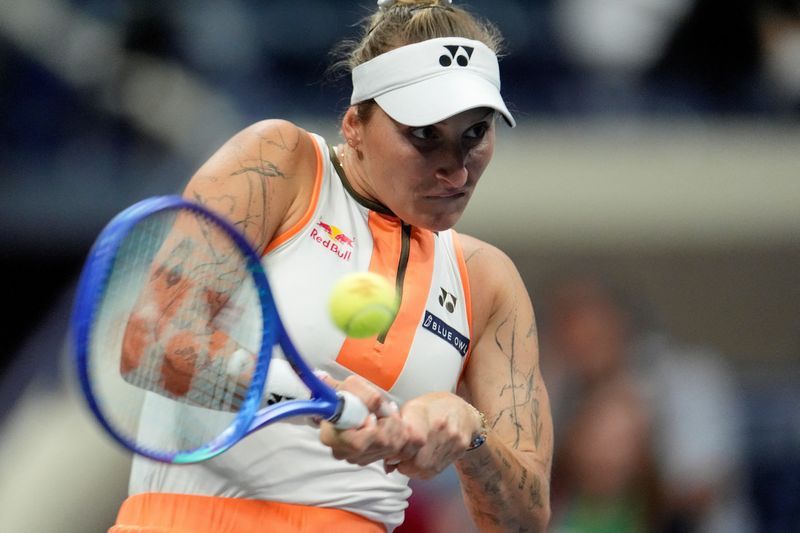
The tennis world faces renewed scrutiny over its anti-doping enforcement following the International Tennis Integrity Agency's decision to suspend former Wimbledon champion Marketa Vondrousova for four years after she refused to provide a sample during an out-of-competition test at her home in December. The Czech player, who won the prestigious grass-court title in 2023, became the latest high-profile figure to face consequences under the sport's increasingly strict testing protocols, triggering widespread debate about whether current regulations strike the right balance between safeguarding competitive integrity and protecting athletes' fundamental rights.
Vondrousova's case carries particular weight because of what the player herself has characterised as a frightening and invasive experience. When a doping control officer arrived unannounced at her residence at 8:15 p.m., she did not open the door, later explaining that the sudden intrusion by an unidentified stranger triggered deep-seated fears rooted in the 2016 knife attack on her fellow Czech professional Petra Kvitova at home. Her response highlighted how the mechanics of modern anti-doping testing can collide with legitimate personal security concerns, particularly for female athletes living alone or in unfamiliar locations. The incident raised uncomfortable questions about whether protocols designed to prevent cheating inadvertently create situations that reasonably frightened players might reasonably avoid.
The Professional Tennis Players Association responded swiftly to the decision with a carefully worded statement that avoided defending Vondrousova's specific actions while directly challenging the proportionality of the punishment. The players' advocacy group emphasised that a four-year ban imposed on an athlete who has never returned a positive test result sits uneasily with the sport's stated commitment to fairness and due process. By framing the issue around a player's complete absence of doping history rather than the merits of her individual case, the PTPA sought to elevate the discussion from one incident to a systemic concern about how anti-doping authorities calibrate consequences. The union's demand for meaningful player involvement in rule-making reflected growing frustration that athletes bear the burden of compliance without having substantive input into how those rules are constructed.
Context for this escalating tension comes from recent high-profile cases that appeared to apply the rulebook inconsistently. Italian world number one Jannik Sinner and Polish player Iga Swiatek both avoided lengthy bans despite testing positive for prohibited substances, generating perceptions of preferential treatment that contradicted the ITIA's stated principle of objective, evidence-based decision-making. These outcomes fuelled suspicions among players that factors beyond the facts of a case—including professional ranking, marketability, and legal resources—influenced outcomes. The Vondrousova decision, by contrast, imposed the maximum penalty against a player whose infraction involved administrative non-compliance rather than the ingestion of a banned substance, creating an apparent inconsistency that the PTPA found difficult to reconcile with principles of proportional justice.
Tennis's alignment with the World Anti-Doping Agency framework represents a deliberate choice to harmonise its enforcement architecture with that of other global sports. This standardisation was intended to ensure consistency and eliminate sport-specific advantages that doping athletes might exploit. However, the rigid application of universal rules to sport-specific contexts has increasingly strained under scrutiny. The PTPA's 2023 lawsuit against tennis governing bodies alleged that the current testing regime violated players' privacy rights, suggesting that the compromise struck between anti-doping integrity and athlete privacy had tilted too far toward intrusive monitoring. That litigation remains unresolved, and Vondrousova's case has reinvigorated arguments that tennis needs sport-specific accommodations that the WADA framework currently does not provide.
Karen Moorhouse, the ITIA's chief executive, defended the organisation's position by emphasising that testing unpredictability is fundamental to effective doping prevention. She contended that informed athletes could schedule their tests, the entire deterrent mechanism would collapse, as competitors could time their substance use to evade detection. Her statement acknowledged the discomfort and inconvenience that testing causes players while insisting that these burdens remain necessary costs of maintaining fair competition. Moorhouse also addressed safety concerns directly, describing the professionalism and training of testers, the requirement that testing witnesses match the player's gender, and the verification procedures available to confirm identity. These procedural safeguards, she argued, protect both athletes and testing officials from potential harm or misunderstanding.
The gender-matching requirement for testing witnesses represents one area where tennis has already made sport-specific accommodation that the WADA framework allows. However, Vondrousova's experience suggests that procedural protections on paper may feel inadequate when a stranger arrives at one's home late in the evening. For female athletes with safety concerns or trauma histories, even professional testers with proper credentials can trigger defensive reactions rooted in legitimate fear. The tension between the theoretical soundness of anti-doping protocols and their real-world impact on vulnerable athletes reveals a gap between how regulators envision testing implementation and how players experience it. Addressing this gap requires either enhanced safety protocols—such as requiring daytime testing windows or advance notice in specific circumstances—or acknowledging that some players may reasonably decline participation given genuine security threats.
Vondrousova's inability to compete since January due to a shoulder injury adds another dimension to her situation. An athlete sidelined from professional play faces particular vulnerability to testing demands because training and competition schedules no longer provide structure to anti-doping verification. Out-of-competition testing exists precisely because athletes must be monitored outside their official schedules, yet the absence of regular professional activity makes athletes harder to locate and their routines less predictable. This creates a perverse situation where injured players—already suffering the psychological and financial burdens of forced absence—face heightened testing burdens. The timing of the December test, coinciding with Vondrousova's injury rehabilitation, may have contributed to her heightened vulnerability to perceived privacy intrusions during a period of personal stress.
The regulatory framework's claim to objectivity faces legitimate challenge when outcomes appear inconsistent or disproportionate. The ITIA's assertion that cases are determined solely by facts and evidence, with player identity irrelevant, rings hollow when observers note that top-ranked players sometimes receive lighter sentences than mid-ranked ones facing comparable violations. Whether these apparent disparities reflect genuine differences in mitigating factors or reflect unconscious bias in how decision-makers evaluate evidence remains contestable. The PTPA's push for greater athlete participation in rule-making reflects understanding that procedural legitimacy—the sense that rule-makers are fair-minded and representative of affected communities—matters as much as substantive fairness in individual cases. Athletes who believe they have no voice in creating the rules they must follow experience governance as arbitrary, even when technically defensible.
Vondrousova's avenue for appeal to the Court of Arbitration for Sport offers a potential path toward reconsideration, though CAS review typically defers substantially to the original tribunal's findings and focuses on procedural correctness rather than proportionality assessments. Her four-year suspension will extend well into her career recovery period, and the outcome of any appeal remains uncertain. For Malaysian and Southeast Asian tennis players and fans, this case carries particular significance because it illustrates how global anti-doping architecture, while intended to create level playing fields, can produce outcomes that regional athletes perceive as unjust or culturally misaligned. The push for athlete voice in anti-doping rule-making has gained momentum, and whether tennis governing bodies will concede meaningful participation to the PTPA could reshape how the sport balances integrity protection with athlete welfare across the region.

