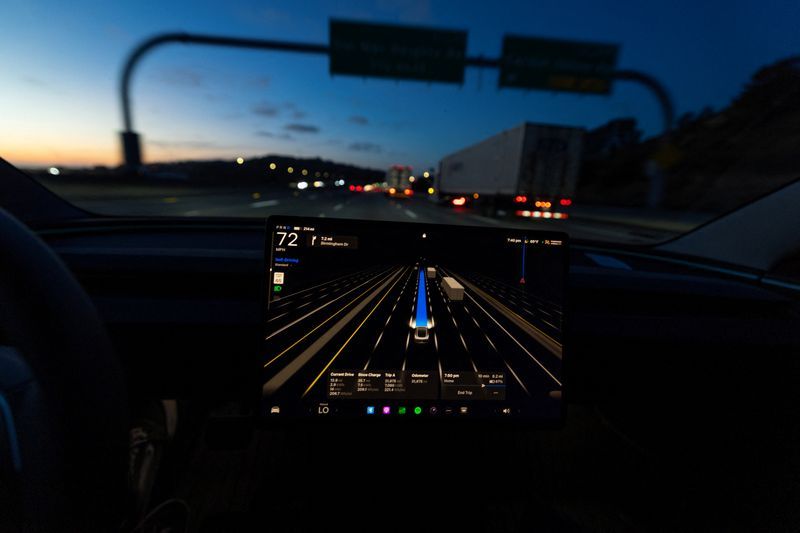
Two prominent Democratic senators have formally requested that America's traffic safety watchdog scrutinise Tesla's publicly released safety figures for its Full Self-Driving driver-assistance technology, in response to investigative reporting that documented how the electric vehicle manufacturer has systematically inflated its safety claims. Senators Edward Markey of Massachusetts and Richard Blumenthal of Connecticut directed their appeal to the National Highway Traffic Safety Administration on Monday, drawing explicitly on a Reuters examination published the previous month that exposed methodological flaws in Tesla's analysis of crash data related to its autonomous driving system.
The senators' correspondence characterises the analytical foundation underlying Tesla's Full Self-Driving safety assertions as fundamentally inadequate and deceptive, describing the situation as representing an acute threat to public safety. Their formal request establishes a deadline of July 7 for the federal safety agency to provide written responses addressing multiple critical questions, particularly whether NHTSA has independently evaluated Tesla's claims or demanded access to the raw crash information upon which the company has built its safety narrative. The letter further urges the regulatory body to implement stricter disclosure standards for manufacturers deploying self-driving or advanced driver-assistance technologies, emphasising that current oversight mechanisms leave authorities without reliable mechanisms to verify whether stated safety achievements reflect actual conditions.
Neither Tesla nor the National Highway Traffic Safety Administration offered substantive responses to inquiries about the senators' intervention. This silence is notable given the high-profile nature of the allegations and the direct challenge to the company's public statements about one of its flagship technologies.
The underlying Reuters investigation had documented a pattern whereby Tesla leadership, including Chief Executive Officer Elon Musk, have repeatedly cited statistical comparisons suggesting that Full Self-Driving functionality reduces crash risk by up to tenfold relative to human drivers. Industry researchers who examined Tesla's methodology highlighted fundamental problems with how the company constructed these comparative analyses. The primary issue stems from Tesla's selection of comparison groups: the company measures Full Self-Driving crash outcomes using incidents severe enough to trigger airbag systems, then contrasts these figures against the overall United States crash rate, which encompasses vastly larger numbers of minor collisions that do not activate such safety mechanisms.
This asymmetry in measurement thresholds introduces substantial statistical distortion. A fender-bender in a conventional vehicle counts toward the national average but would not register in Tesla's Full Self-Driving statistics under the methodology employed. The effect is mathematically inevitable—when your denominator includes minor accidents and your numerator excludes them, the resulting ratio will necessarily appear favourable, regardless of actual safety performance. Industry experts characterised this approach as misleading because it creates incomparable datasets rather than genuinely equivalent performance measures.
Another significant methodological weakness identified by researchers involves Tesla's baseline comparison vehicle. The company benchmarks its modern Full Self-Driving system against the average American vehicle on roads, which is substantially older than the typical Tesla automobile. Automotive safety has improved markedly over recent decades as manufacturers have progressively incorporated advanced protective features, collision avoidance systems, and structural improvements that systematically reduce crash frequencies. By comparing recent Teslas equipped with contemporary technology against the average age vehicle in national circulation, Tesla's analysis conflates the safety benefits of its self-driving system with the safety advantages of modern vehicle design generally. This methodological choice artificially inflates the apparent safety advantage attributable to the autonomous driving technology.
Further complicating the picture, Tesla has extended its presentation of these disputed safety figures beyond domestic regulators. The company submitted similar statistical analyses to European authorities as part of its application process seeking regulatory clearance for Full Self-Driving deployment across the European Union. This expansion of the methodology to international regulatory contexts suggests that the claims have broader implications than the American market alone, potentially influencing policy decisions in major economies considering adoption of the technology.
The Senate intervention reflects growing congressional scrutiny of autonomous vehicle safety claims at a moment when the technology sector faces increasing regulatory pressure. The timing coincides with broader debates about how federal agencies should evaluate and monitor self-driving systems, a question that has taken on heightened urgency as deployment accelerates across different road environments and use cases. The senators' specific request for strengthened reporting requirements indicates recognition that existing frameworks may be insufficient to protect public interests in rapidly evolving technological landscapes.
For Malaysian and Southeast Asian observers, this American regulatory examination carries significant implications. As autonomous driving technology development remains concentrated among American and Chinese manufacturers, the safety standards and approval processes established in major markets effectively shape the technology that subsequently becomes available globally. The Full Self-Driving controversy illustrates how regulatory gaps in advanced vehicle technologies can persist undetected until investigative journalism prompts formal scrutiny. Malaysian regulators and policymakers monitoring autonomous vehicle development may consider whether existing domestic oversight mechanisms would catch comparable methodological problems before deployment. The case also demonstrates the value of transparent data disclosure and independent verification—approaches that could inform how Southeast Asian nations structure their own frameworks for evaluating next-generation automotive technologies.

