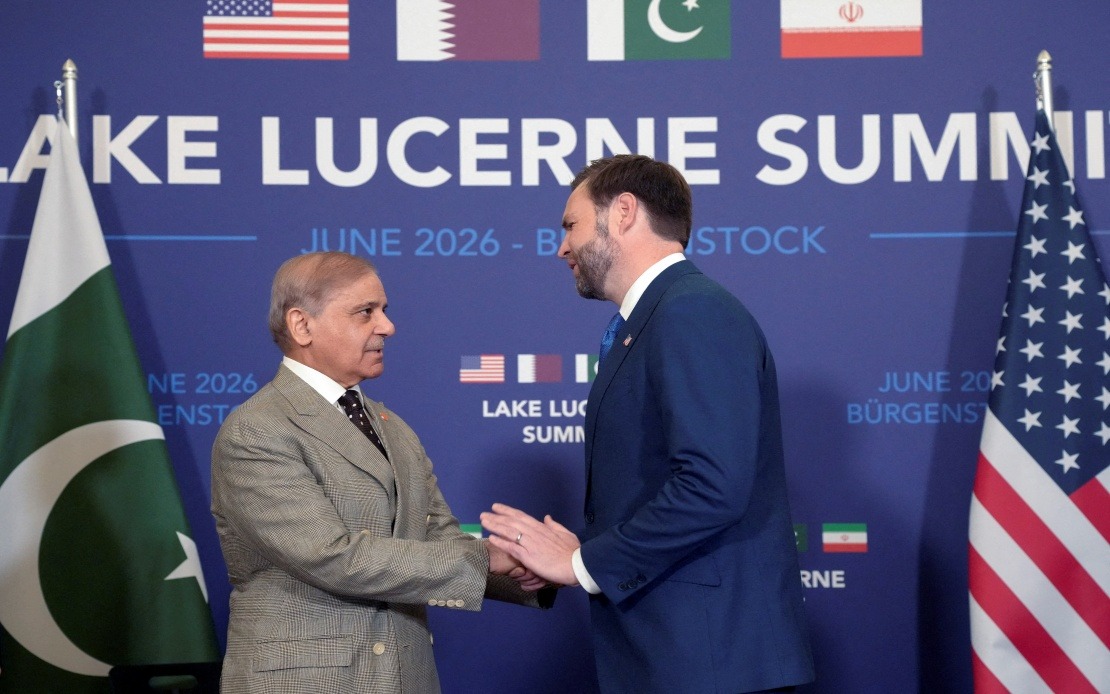
High-level representatives from the United States and Pakistan gathered at the Burgenstock resort in Switzerland on Sunday to hold strategic discussions, according to White House communications. The meeting brought together Vice President JD Vance alongside special envoys Steve Witkoff and Jared Kushner on the American side, who were received by Pakistan's Prime Minister Shehbaz Sharif and Pakistan Army Chief Field Marshal Asim Munir. The session took place amid broader negotiations involving multiple regional players addressing the longstanding tensions between Washington and Tehran.
The timing of this diplomatic engagement reflects the significance of Pakistan's role in regional geopolitics, particularly as a neighbouring state to Iran and a long-standing US ally. Pakistan's decision to send such high-ranking officials, including its top military leadership, underscores Islamabad's interest in shaping the outcome of negotiations that could fundamentally alter the security landscape across South and West Asia. For Malaysian observers, this configuration demonstrates how major powers coordinate responses to transformative agreements that extend beyond bilateral relationships to encompass entire regions.
The broader context involves technical-level talks scheduled to commence on the same day between the United States and Iran, with Pakistan and Qatar serving as intermediary nations. These discussions were designed to be conducted confidentially, reflecting the sensitivity of the negotiations and the need for candid dialogue without public pressure. The confidential nature of such talks is typical in high-stakes diplomatic processes where negotiators must explore positions that governments may not yet be ready to publicly acknowledge or endorse.
Several weeks earlier, on the night of June 18, Iran and the United States completed a historic memorandum of understanding through remote channels, marking a decisive break in their contentious relationship. This accord specifically addressed the military conflict that had erupted on February 28, establishing a framework for de-escalation and establishing concrete timelines for key actions. The document represents a formal commitment to cease active hostilities, though the underlying political and security concerns that sparked the conflict remain complex and multifaceted.
Central to the agreement are provisions governing critical maritime commerce and strategic waterways. The memorandum specifies that the United States will lift its naval blockade while Iran commits to restoring shipping operations through the Strait of Hormuz, one of the world's most crucial chokepoints for global energy markets. For Southeast Asian nations like Malaysia that depend on stable maritime trade routes and energy security, the reopening of this waterway carries significant economic implications. Disruptions to Hormuz shipping directly affect fuel prices and supply chains throughout the region.
Another cornerstone of the accord addresses nuclear programme concerns that have dominated US-Iran relations for decades. Under the terms of the memorandum, Iran has undertaken not to pursue nuclear weapons development, a commitment that responds to long-standing American security concerns and those of regional partners. However, the resolution of Iran's broader nuclear programme remains unfinished business, requiring separate and additional negotiations that both sides have committed to pursue within a defined timeframe.
The negotiating parties established a sixty-day window for completing discussions on the technical and strategic aspects of Iran's nuclear capabilities and their verification. This compressed timeline reflects both the urgency of stakeholders seeking resolution and the political pressure to demonstrate progress. The resolution framework suggests that while fundamental hostilities have ceased, substantial work remains to transform ceasefire arrangements into durable peace architecture that addresses lingering suspicions and security gaps.
From Iran's perspective, the ultimate prize in these negotiations extends beyond military de-escalation to encompass comprehensive sanctions relief. Tehran has endured extensive international economic restrictions that have crippled its oil exports, foreign investment, and access to international financial systems. The Iranian delegation views the lifting of anti-Iran sanctions as inseparable from genuine normalisation, as these restrictions continue to constrain economic activity and governance capacity even as military operations have ceased.
Pakistan's prominent involvement in these discussions reflects its complex positioning as a bridge between competing interests. Islamabad shares borders with both Iran and Afghanistan, maintaining strategic relationships across the region while also maintaining a critical partnership with the United States. Pakistan's military leadership, represented by Field Marshal Asim Munir, brings expertise in regional security dynamics and credibility with both American and Iranian interlocutors. The presence of Pakistan's Prime Minister alongside military officials signals that civilian government and defence establishment have aligned positions on this matter.
For Malaysia and other ASEAN nations, this diplomatic engagement carries indirect but meaningful implications. A sustainable US-Iran accommodation could reshape great power competition in Asia, potentially redirecting American strategic focus and resources. Conversely, any breakdown in these talks could trigger renewed regional instability, higher global oil prices, and intensified geopolitical competition that inevitably affects Southeast Asian calculations regarding strategic alignment and economic planning.
The involvement of Qatar as a second mediator reflects the Gulf state's successful diplomatic positioning and its established channels to both American and Iranian leadership. Qatar's track record in facilitating dialogue between adversaries has elevated its standing as a neutral facilitator, and its participation here reinforces patterns of regional diplomacy that have increasingly involved Gulf Cooperation Council members in solving wider Asian security challenges.
These negotiations illustrate how contemporary international relations increasingly involve complex multilateral configurations where several governments simultaneously pursue different objectives while maintaining shared interest in preventing escalation. The success of these talks will depend not merely on technical compliance with memorandum provisions but on whether underlying political grievances can be sufficiently addressed to sustain implementation over years and decades. For Southeast Asia watching from the sidelines, the outcome will shape regional prosperity and stability in ways both direct and indirect.

