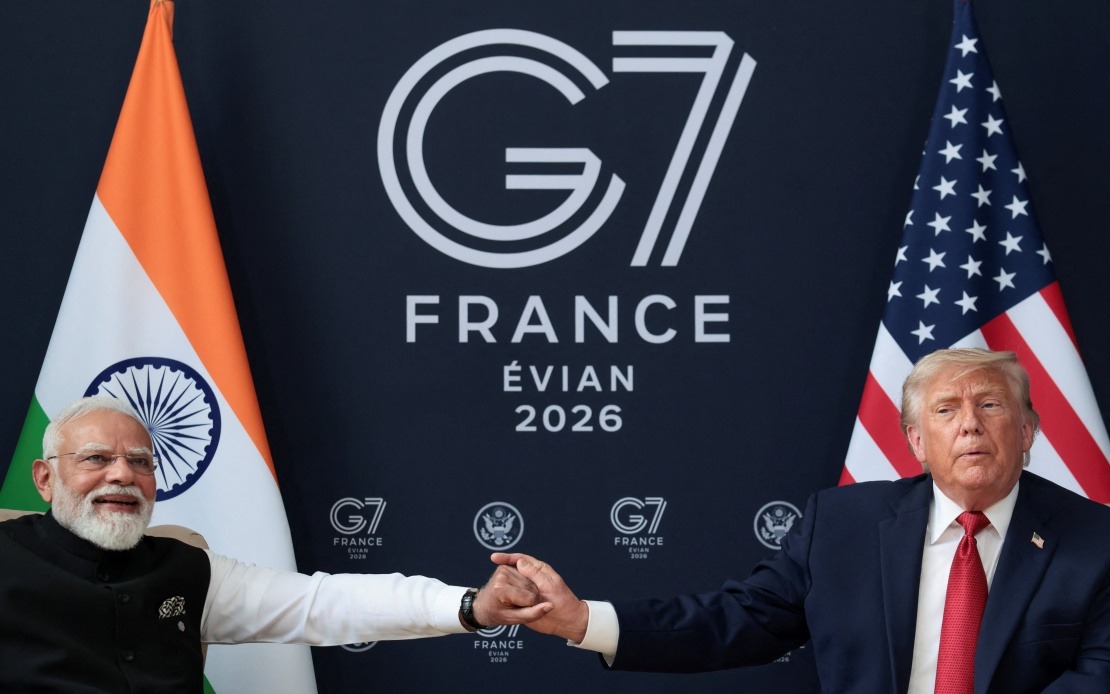
The governments of India and the United States have signalled renewed momentum in their pursuit of a substantive trade agreement, marking a turning point in discussions that have stretched across multiple administrations. The announcement emerged following bilateral talks between Indian Prime Minister Narendra Modi and US President Donald Trump held during the Group of Seven summit in Evian, France, on Wednesday, where both leaders reviewed progress on what both nations describe as a breakthrough interim arrangement. India's External Affairs Ministry framed the developments with measured optimism, noting that officials have been instructed to accelerate work toward finalising an accord that delivers genuine mutual benefit and commercial significance for both economies.
The timing of this announcement carries particular weight given the turbulent recent history of US-India trade relations. Trump's administration imposed aggressive tariff measures against India in 2025, including a 25 per cent levy on Indian goods and an additional 25 per cent penalty specifically targeting purchases of Russian oil—steps that threatened to escalate tensions between two strategically aligned nations. The fact that negotiations have progressed beyond these punitive measures suggests both sides recognise the broader importance of maintaining economic partnership despite their differences on specific policy questions. For Malaysian observers and regional stakeholders, the restoration of momentum in US-India trade relations carries significant implications for Southeast Asian supply chains and investment patterns.
A preliminary accord reached in February established a foundation upon which the current negotiations rest. That interim agreement included meaningful tariff reductions on the American side, with the US cutting its tariffs to 18 per cent on designated Indian products. This earlier accord demonstrated that despite ideological differences and occasional policy friction, both nations possessed sufficient common ground to move forward on substantive economic matters. The current round of negotiations appears designed to build upon this framework, expanding coverage and deepening commitments across a broader range of sectors and commodities that matter to both economies.
US Trade Representative Jamieson Greer's scheduled visit to India in the coming week underscores the seriousness with which both governments treat these negotiations. Such high-level visits typically signal movement beyond preliminary discussions toward the detailed technical work required to convert political agreement into binding commercial terms. Greer's presence will likely focus on identifying remaining points of divergence and developing compromise language that permits both sides to claim significant victories to their domestic constituencies. For India, achieving a comprehensive agreement with the United States would strengthen its strategic positioning within the Indo-Pacific region while delivering tangible economic benefits to exporters in pharmaceuticals, textiles, and agricultural products.
Trump's characterisation of Modi as "one of the toughest" negotiators he has encountered provides insight into the nature of these discussions and the considerable distance both sides have already travelled. The US president's remarks, while seemingly casual, reflect the fact that Modi has resisted pressure to accept unfavourable terms and has maintained India's negotiating position despite external pressure. Trump's description of the Indian leader as appearing like "an angel" while being "as tough as a killer" captures the blend of diplomatic courtesy with hard-nosed commercial negotiation that has characterised the discussions. This dynamic suggests that any final agreement will reflect genuine compromise rather than capitulation by either party.
For the broader Southeast Asian region, the outcome of these negotiations warrants close attention. India's growing integration with global supply chains has created dependencies and opportunities throughout Asia. A comprehensive US-India trade agreement could reshape investment flows and alter sourcing decisions for multinational corporations operating across the region. Malaysia, as a significant manufacturing and trading hub, could benefit from diversified sourcing strategies, though businesses operating in sectors that compete with Indian exporters may face increased competition in the US market. The agreement could also influence India's approach to its own regional trade partnerships, potentially affecting negotiations within the Indian Ocean Rim Association and other multilateral forums where Southeast Asian nations participate.
The pursuit of balanced commercial terms represents a deliberate shift in approach by both negotiators. Rather than accepting a quick agreement that favours one side, both the Indian and American leaderships have indicated their commitment to achieving what they describe as a "commercially meaningful" arrangement. This language suggests that either party would reject an accord perceived as merely symbolic or insufficient to justify the political expenditure required to secure legislative or regulatory approval. For Indian manufacturers and exporters, this approach implies that any tariff reductions or market access improvements will be substantial enough to generate genuine new commercial opportunities. For American producers and workers, it signals that the agreement will include meaningful protections and market access gains that justify acceptance of reduced tariffs.
The geopolitical context surrounding these negotiations extends beyond bilateral trade considerations. The United States seeks to strengthen economic ties with major democracies in Asia as part of a broader strategy to balance Chinese influence in the region. India, meanwhile, seeks to diversify its economic partnerships and reduce dependence on any single trading partner while maintaining its strategic autonomy. These complementary objectives have created space for productive negotiation, though differences over intellectual property protection, agricultural subsidies, and sectoral access points remain substantial. The willingness of both sides to engage seriously at this moment suggests that these remaining disagreements are viewed as manageable rather than insurmountable.
The months ahead will prove critical in determining whether this current progress translates into a final, signed agreement. Both Modi and Trump face domestic political pressures that could either accelerate or complicate negotiations. In India, various industries—from pharmaceuticals to agriculture to services—lobby intensely for favourable treatment, while American constituencies from labour unions to agricultural interests voice their own priorities. Officials on both sides must navigate these internal pressures while maintaining the momentum demonstrated at Evian. The visit by Jamieson Greer and the subsequent rounds of technical negotiations will provide the real measure of whether the current optimism reflects genuine convergence of interests or merely rhetorical positioning.