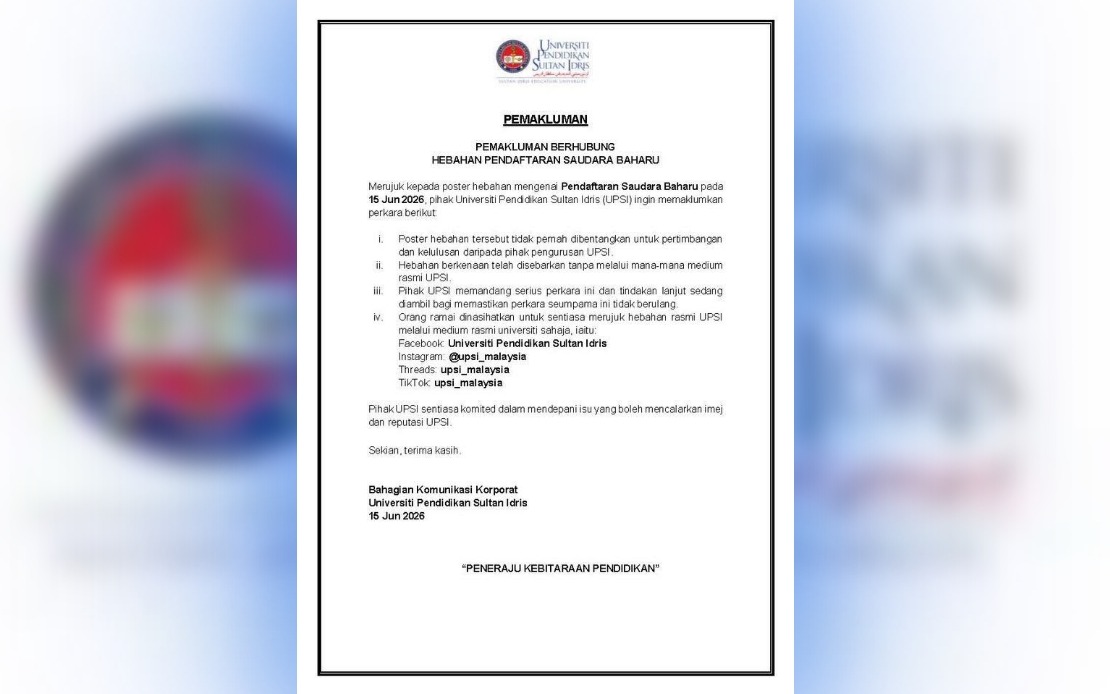
Universiti Pendidikan Sultan Idris (UPSI) has formally distanced itself from a poster concerning the registration of 'saudara baharu' or 'mualaf' that recently circulated widely across social media platforms. The institution clarified that the promotional material, which bore a June 15 date, had never been submitted to university administrators for evaluation or endorsement, nor was it disseminated through any of UPSI's official communication channels.
The university's response, issued through its own social media accounts, represents a clear attempt to contain potential reputational damage and to establish definitively that the poster originated from outside the institution. This distinction matters considerably in Malaysia's higher education landscape, where university brand management and administrative oversight have become increasingly important as institutions compete for student enrollment and maintain public trust. The need for UPSI to issue such a statement underscores how easily misinformation or unauthorized materials can damage institutional credibility in the age of rapid social media distribution.
UPSI's management indicated it is treating the matter with appropriate seriousness, pledging to implement measures designed to prevent similar incidents from occurring in future. The institution explicitly advised members of the public to rely exclusively on announcements distributed through UPSI's recognised official platforms, thereby setting clear boundaries about what materials can legitimately be attributed to the university. This guidance reflects broader concerns across Malaysian academic institutions about distinguishing authentic institutional communications from unauthorized content that may inadvertently carry institutional branding or appear to originate from official sources.
The university further reinforced its commitment to safeguarding its institutional image and reputation by addressing any issues that could potentially cause reputational harm. This language suggests that UPSI's leadership recognizes the vulnerability of higher educational institutions to having their names and logos used without permission, particularly in contexts involving sensitive topics such as religious conversion and registration procedures. The statement serves as both a public clarification and an internal signal that the institution takes governance and communications oversight seriously.
The emergence of such unauthorized materials raises practical questions about how institutions can better control the distribution of content bearing their names and logos. In Malaysia, where religious matters command considerable public attention and sensitivity, any poster purporting to represent a university's position on registration of converts could generate significant institutional liability. The fact that this poster circulated without official sanction yet still gained traction across social platforms demonstrates the challenges educational institutions face in monitoring and controlling their digital footprints.
UPSI's emphasis on directing the public to official announcement channels represents a defensive but necessary strategy in an environment where misinformation spreads rapidly. Malaysian universities have increasingly recognized that social media requires active management and clear communication protocols. When unauthorized materials do surface, as in this case, rapid institutional response becomes crucial for limiting potential misunderstanding or reputational consequences. UPSI's swift public denial and clarification thus reflects contemporary best practices in institutional communications management.
The incident also reflects the broader challenge of maintaining institutional integrity across digital platforms. Universities in Malaysia, like their counterparts internationally, must now contend with the reality that their names can be invoked by various actors without their consent, and that distinguishing between authentic and fraudulent institutional communications has become part of standard media literacy. UPSI's response effectively highlights this distinction and reinforces that only materials bearing proper institutional authorization and distributed through official channels should be considered representative of the university's positions.
Moreover, the timing and nature of the unauthorized poster raise questions about oversight mechanisms within educational institutions. The fact that such material could circulate without institutional detection or immediate response suggests potential gaps in social media monitoring or stakeholder communication protocols. UPSI's commitment to preventing recurrence likely means implementing more robust systems for identifying unauthorized use of institutional branding and establishing clearer guidelines for staff and associated individuals regarding authorized communication practices.
For Malaysian readers and the broader Southeast Asian context, this incident exemplifies the growing challenge of information verification in digital spaces. As educational institutions navigate their roles as trusted information sources, maintaining clear boundaries between official and unofficial communications becomes increasingly vital. UPSI's case demonstrates how quickly ambiguity can arise and underscores the importance of institutions establishing explicit communication protocols that stakeholders understand and follow. The university's decisive response reflects a mature approach to reputation management in Malaysia's competitive higher education sector.