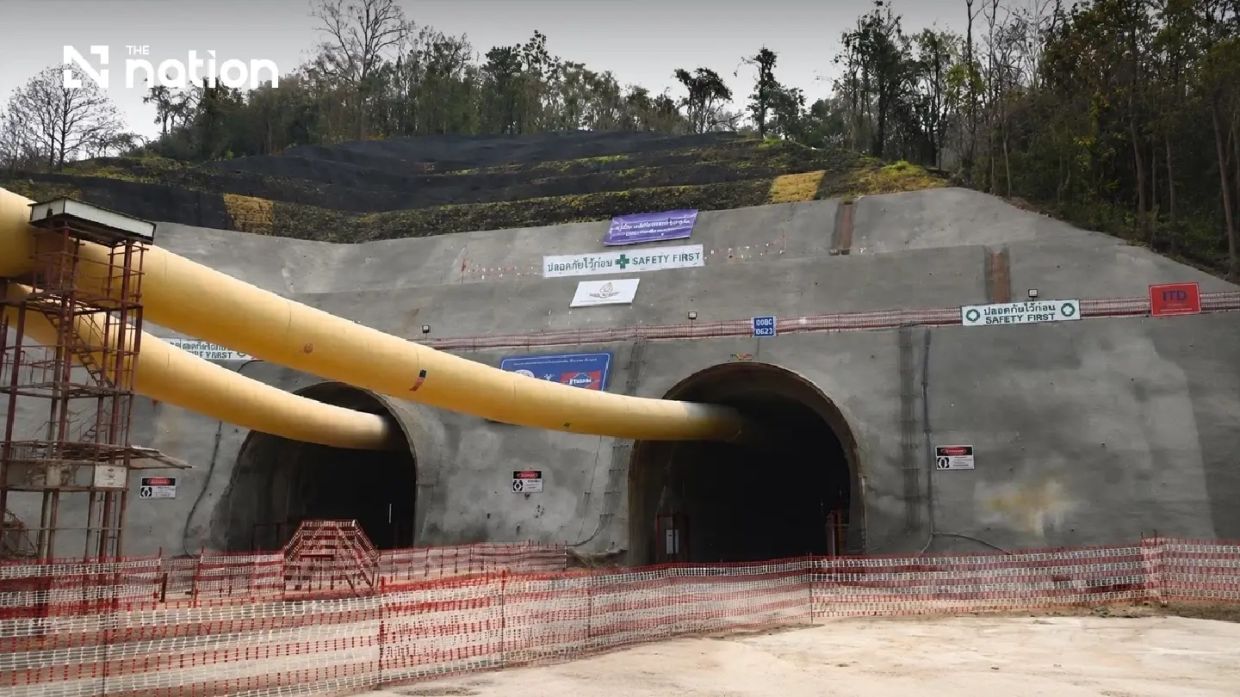
A construction accident at Thailand's Doi Luang railway tunnel in Chiang Rai province has resulted in the deaths of two workers and injuries to seven others, marking another workplace safety incident on the ambitious Den Chai-Chiang Rai-Chiang Khong railway corridor. The collapse occurred inside the tunnel on the evening of Saturday, June 20, while workers were engaged in installing waterproofing systems as part of ongoing construction activities. The incident raises fresh concerns about site safety protocols and oversight on Thailand's large-scale infrastructure projects, particularly those executed in challenging geological conditions.
Deputy Transport Minister Siripong Angkasakulkiat provided authorities' initial assessment, which traced the immediate cause to falling rocks from the tunnel wall. The deputy minister revealed that emergency responders received their first alert at 8.35pm, by which time the structural failure had already occurred and workers lay trapped or injured within the tunnel. Earlier accounts had suggested the problem originated in the shotcrete work area, though investigators subsequently refined their understanding to focus on the natural rock instability that preceded the broader collapse. The discrepancy between initial and revised explanations underscores the complexity of securing underground construction sites and the difficulties in rapidly determining causation in catastrophic incidents.
The casualty toll encompassed two confirmed deaths alongside a graduated scale of injuries requiring varying levels of medical intervention. Three workers sustained serious injuries requiring intensive hospital treatment, whilst four others experienced minor injuries. All affected personnel were transported to medical facilities for assessment and care. The swift evacuation and medical response prevented further loss of life, though the incident still represents a significant loss for families and colleagues of the deceased workers, who would have been part of the substantial migrant or regional labour force typical of Thai megaprojects.
The Doi Luang tunnel, situated in the Chiang Saen district approximately 3.4 kilometres in length, represents a critical component of the overall Den Chai-Chiang Rai-Chiang Khong railway initiative. Despite the tragic incident, the boring operation itself had been successfully completed, with the collapsed scaffolding and waterproofing systems constituting finishing works rather than primary excavation. The tunnel's completion to this stage reflects years of advancement through challenging limestone and dolomite geology typical of northern Thailand's mountainous terrain, making the interior conditions inherently hazardous for workers exposed to unstable overburden.
The broader railway corridor into which this tunnel fits represents a transformative infrastructure play for Thailand's northern region, intended to enhance connectivity between the provincial centres of Chiang Rai and Chiang Khong whilst linking southward to Den Chai. The project's total contracted value for the segment encompassing this tunnel reaches THB19.385 billion, with the Doi Luang tunnel forming part of Contract 3, the most extensive package within the scheme. This contract alone encompasses approximately 87 kilometres of railway construction spanning both at-grade and elevated track configurations, three full stations, three additional halts, signalling apparatus, telecommunications infrastructure and ancillary systems. The scale of work indicates the complexity of coordinating safety across multiple work fronts and subcontractors operating simultaneously.
Responsibility for executing this massive undertaking rests with the CKST-DC3 Joint Venture, a consortium incorporating three established Thai construction entities: CH. Karnchang Public Company Limited, Sino-Thai Engineering & Construction Public Company Limited and Chiangmai Construction Co., Ltd. Such joint venture arrangements are customary on Thai megaprojects, distributing risk and expertise across multiple firms whilst ensuring adequate capital and workforce deployment. However, this structure can sometimes complicate accountability and safety oversight when incidents occur, as responsibility becomes diffused across participating organisations and their respective management chains.
Deputy Minister Siripong emphasised that containment measures had been implemented following the collapse, with the accident zone secured and cordoned off to prevent further injuries or unauthorised access. The project's dedicated safety unit assumed direct control of the site, establishing monitoring protocols to ensure conditions remained stable before recovery and investigative work could proceed. This rapid establishment of command and control reflected standard emergency response procedures, though it also highlighted how accidents of this magnitude demand immediate intervention by senior site personnel.
The State Railway of Thailand's Special Projects and Construction Department mobilised urgently to conduct site inspections, indicating that investigations would occur at multiple administrative levels. While Deputy Minister Siripong acknowledged that preliminary assessments remained ongoing, he committed to providing further updates as the investigation matured and causation was more definitively established. This commitment to transparency appeared designed to manage public perception and maintain confidence in the project's continuation despite the tragedy.
For Malaysian observers and regional infrastructure professionals, the incident illustrates the inherent dangers of large-scale underground construction in Southeast Asia's geological contexts. Thailand's ambitious expansion of rail connectivity to provincial areas mirrors similar initiatives across the region, including Malaysia's own rail development programmes. The Chiang Rai project particularly resonates given its positioning as a cross-border economic corridor potentially linking ASEAN member states more effectively. Safety on such projects demands unwavering commitment to international standards, comprehensive worker training, and rigorous enforcement mechanisms that sometimes appear inadequate across the region despite the evident costs when failures occur.

