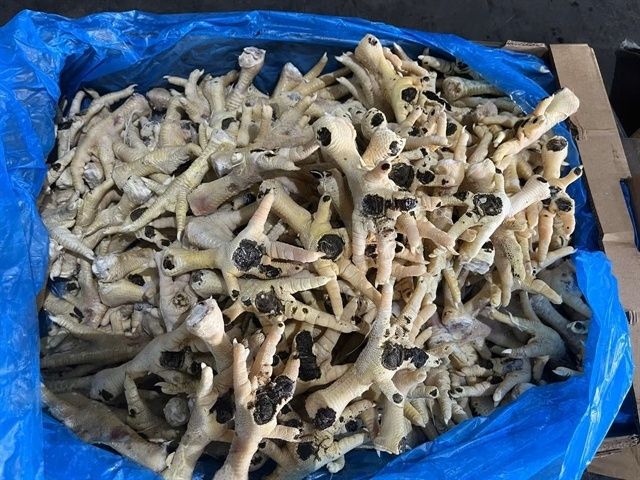
Hanoi police have formally charged two Vietnamese women with orchestrating a major smuggling operation involving hundreds of containers of frozen chicken feet valued at more than US$13 million. The investigation revealed that Nguyen Thi To Loan, 47, and Trang Tuyet Ngoc, 45, systematically bypassed customs regulations by importing poultry products from disease-affected regions under false pretences, then diverted the contraband to the domestic market in direct violation of Vietnamese law. Both suspects have reportedly confessed to all charges levelled against them.
The illegal operation centred on ABF Food Import-Export JSC, a company based in Ninh Binh Province that Loan operated directly, with assistance from Ngoc, who held a senior administrative position at An Binh Group. Between 2023 and 2026, the pair orchestrated the importation of 339 shipping containers ostensibly intended for processing and re-export only. This classification was crucial because Vietnamese law strictly prohibits the domestic sale of poultry products originating from countries experiencing active poultry disease outbreaks. Such products may enter the country solely for processing and subsequent re-export to overseas buyers, creating an essential public health safeguard against disease transmission.
Instead of honouring this legal requirement, Loan directed Ngoc to systematically distribute the imported chicken feet throughout Vietnam's food-service sector. Investigators determined that over 10,000 metric tonnes of the contraband product reached restaurants, food manufacturers, and catering establishments across multiple provinces including Hanoi, Cao Bang, Ninh Binh, and Quang Ninh. The scale of this domestic distribution was staggering, representing a prolonged and deliberate circumvention of health regulations that existed to protect Vietnamese consumers from potentially disease-infected poultry products. The total declared import value exceeded VND347 billion, equivalent to approximately US$13 million, yet no import duties were paid on these shipments.
During coordinated raids on cold-storage facilities connected to the operation, police uncovered the physical evidence of this elaborate scheme. Officers seized more than 2,000 metric tonnes of frozen chicken feet across two major warehouses. At the An Viet 2 freezer facility located in Hanoi's Quang Minh Industrial Zone, investigators discovered over 1,000 metric tonnes of product, including approximately 260 metric tonnes that had already exceeded their shelf life and displayed visible signs of contamination including mould growth and foul odours. The fact that this degraded product appeared staged for distribution suggested the operation continued operating even as quality and safety standards deteriorated.
A second enforcement action at the THL cold-storage warehouse in Lang Son Province, a northern border region, yielded an additional 1,030-plus metric tonnes of frozen chicken feet. The geographic spread of these warehouses, spanning from Hanoi to the northern frontier, indicates the network had established sophisticated logistics infrastructure to manage the distribution of contraband goods across substantial distances. This geographical diversification likely served to obscure the operation's true scale and make regulatory oversight more difficult.
The investigation has exposed serious vulnerabilities in Vietnam's customs and food safety enforcement. The fact that 339 containers could pass through official import channels under fraudulent declarations suggests gaps in verification procedures or potentially complicit customs officials. The operation's continuation across three years between 2023 and 2026 indicates that existing oversight mechanisms failed to detect the scheme despite its enormous scale. For Malaysian readers familiar with Southeast Asia's food security challenges, this case underscores the region-wide vulnerability to similar smuggling operations that exploit regulatory weaknesses across international borders.
Vietnam's poultry import restrictions exist within a broader regional context of avian influenza concerns. Southeast Asian countries, including Malaysia, have grappled with periodic outbreaks of highly pathogenic avian influenza that pose risks to both poultry industries and human health. The Vietnamese regulations requiring processing-and-export-only status for poultry from disease-affected countries represent a critical defensive measure. When such measures are circumvented, the contamination risk extends beyond Vietnam's borders, potentially affecting the entire region's food supply chains through cross-border trade networks.
The charges filed against both women invoke Article 188 of Vietnam's 2015 Penal Code, which addresses smuggling offences. This classification carries significant legal weight, distinguishing the case from ordinary customs violations and reflecting the severity with which Vietnamese authorities view the breach. The formal charges also indicate that police investigations have moved beyond the two principals to examine broader network participation. Authorities have indicated they are actively investigating other individuals and organisations potentially involved in coordinating or facilitating various aspects of the smuggling network.
This case has implications for food safety consciousness across Southeast Asia. The operation demonstrates how organised criminal networks can systematically exploit regulatory frameworks to introduce potentially hazardous products into legitimate food distribution channels. Restaurants, food manufacturers, and catering businesses across Vietnam unknowingly purchased and distributed products of dubious provenance to consumers. The public health exposure extended to potentially tens of thousands of Vietnamese diners whose meals may have included chicken feet sourced from countries with confirmed poultry disease problems.
The discovery of expired and visibly contaminated product staged for further distribution raises additional concerns about intentional deception. The mould and odour detected on 260 metric tonnes of expired chicken feet suggest operators were willing to distribute decomposed food products, indicating a complete disregard for consumer safety. This willingness to sell degraded goods alongside fresh product demonstrates the operation's purely profit-driven nature, unconcerned with any potential health consequences for end consumers.
For regional food safety officials and customs authorities, this case provides a cautionary study in how sophisticated smuggling operations can operate across extended periods despite enormous physical volume. The 10,000-plus metric tonnes distributed domestically represents a massive quantity that somehow evaded detection across Vietnam's supply chains. Malaysian authorities and other regional regulators may wish to examine whether similar operations could exploit their own verification procedures, particularly at land and sea borders where cross-border food trade volumes remain substantial.
The investigation's ongoing status suggests additional charges or expanded prosecutions may emerge as authorities trace the network further. The involvement of major commercial entities like An Binh Group, alongside the direct operation of ABF Food Import-Export, indicates the scheme may have penetrated established business structures. Understanding the full scope of complicity and whether officials were bribed or otherwise compromised will be crucial for assessing how comprehensively Vietnamese authorities can address systematic regulatory evasion in the food import sector.

