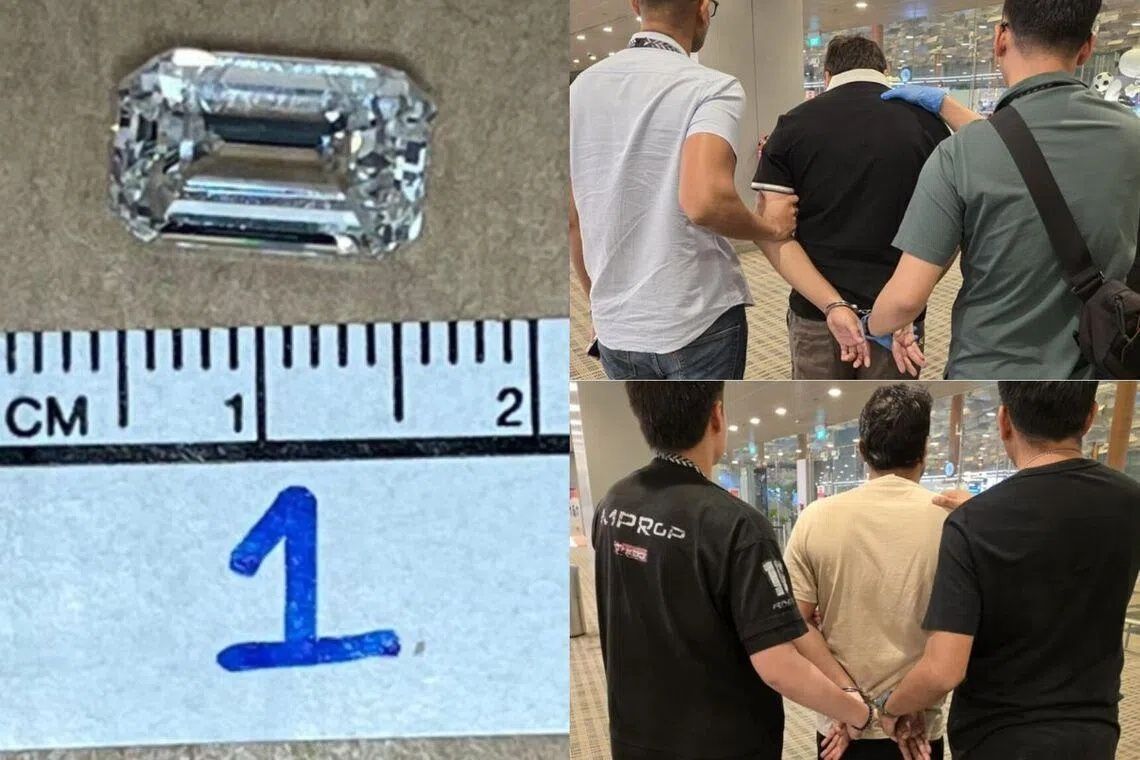
Police in Singapore have arrested two men for the theft of a high-value diamond from a jewellery store in the heart of Chinatown, marking another significant recovery in the city-state's ongoing crackdown on organised retail crime. The men, aged 30 and 42, were apprehended at Changi Airport Terminal 3 on Friday 19 June, just hours after officers responded to a theft report at a store located on Kreta Ayer Road. The stolen diamond, valued at more than S$235,000, was recovered during the arrests and has been seized as evidence for prosecution proceedings.
The sequence of events leading to the arrests began when police received an emergency call at 3.40pm on the afternoon of June 19. Store staff had discovered that a diamond on display had been replaced with a counterfeit replica, triggering an immediate investigation that would culminate in the swift apprehension of the suspects within hours. The rapid response highlighted the effectiveness of Singapore's integrated policing infrastructure, where the Central Police Division and the Police Operations Command Centre coordinated their efforts to identify and locate the culprits before they could flee the island.
Investigators deployed multiple investigative tools to track down the perpetrators, relying heavily on closed-circuit television footage from the jewellery store itself as well as footage from police surveillance cameras positioned throughout the Chinatown precinct. These technological resources, combined with traditional ground enquiries and follow-up investigations, allowed officers to establish the identities of the two suspects and anticipate their likely departure routes. The interception at the airport terminal suggests that police intelligence had successfully predicted the men's planned escape, enabling officers to intercept them before departure.
According to preliminary findings, the duo had arrived at the jewellery store ostensibly as prospective buyers, demonstrating genuine interest in the diamond and requesting to examine it closely. This pretext allowed them access to handle the precious stone while shop staff observed them during the transaction. While the diamond was in their possession, the men executed a sleight-of-hand manoeuvre, deftly substituting the authentic diamond with a counterfeit version that closely resembled the original. The deception was sophisticated enough to escape immediate notice, though it was ultimately detected when the shop assistant conducted a routine verification check after the men departed.
The suspects' subsequent behaviour proved crucial to their undoing. Rather than attempting to complete a purchase or engaging in extended negotiations, the men simply left the jewellery store without buying anything—a suspicious departure that immediately aroused the suspicion of the shop assistant. This alertness from retail staff proved invaluable, as the quick discovery of the substitution enabled police to respond while the perpetrators remained within Singapore's borders and before they could successfully dispose of the stolen gem through underground networks. The timing of the arrest at the airport suggests the men were making a direct attempt to leave the country with their proceeds.
Police have not disclosed the nationalities of the two arrested men, a common practice in Singapore law enforcement when investigations remain active or when the disclosure might compromise ongoing inquiries into related matters. Both men are scheduled to face formal charges on June 20 for theft in dwelling with common intention—a charge that reflects the serious nature of the crime and the coordinated nature of their alleged actions. Conviction on such charges carries substantial penalties: each man faces potential imprisonment of up to seven years and may also receive a financial penalty.
The case illustrates a recurring pattern in jewellery store robberies across Southeast Asia, where organised criminal networks employ trained operatives to target high-value inventory through distraction tactics and manual dexterity. The switch-and-replace method employed here is a classic confidence game adapted for retail environments, relying on the brief moment of inattention that occurs during transactions involving high-value items. For Malaysian readers familiar with similar incidents in Kuala Lumpur's jewellery districts, the modus operandi and enforcement response offer relevant insights into cross-border criminal activity and coordinated law enforcement.
In their official statement, Singapore police emphasised their zero-tolerance approach toward such criminal conduct, pledging to pursue all available investigative avenues to apprehend offenders and ensure they face appropriate legal consequences. This messaging serves both as a deterrent to potential criminals and as reassurance to the public and business community that theft—particularly organised theft targeting luxury goods—remains a priority crime category for law enforcement resources. The police furthermore extended specific guidance to all retail establishments dealing in high-value luxury items, urging shop owners and staff to remain vigilant against the particular modus operandi deployed in this case.
For jewellery store operators across Singapore and the broader Southeast Asian region, the advisory highlights practical security measures that have proven effective in frustrating similar schemes. Store owners are encouraged to implement enhanced verification protocols when customers request to examine high-value items, including the use of multiple staff members as witnesses, secure examination areas with controlled lighting, and systematic comparison checks before and after customer handling. The coordination of eye-witness testimony from alert retail staff with sophisticated CCTV analysis and airport checkpoint procedures demonstrates how layered security approaches can succeed where single measures might fail.
The recovery of the stolen diamond within hours of its theft represents a significant operational success for Singapore's law enforcement agencies and underscores the importance of swift inter-agency coordination in retail crime investigations. As the jewellery trade continues to attract both legitimate businesses and criminal syndicates across Southeast Asia, the methods employed in this case—from initial apprehension through evidence recovery to prosecution—may serve as a model for regional law enforcement agencies grappling with similar challenges. The case also serves as a cautionary reminder to consumers and businesses that organised retail crime remains a persistent threat in the region's major commercial centres.

