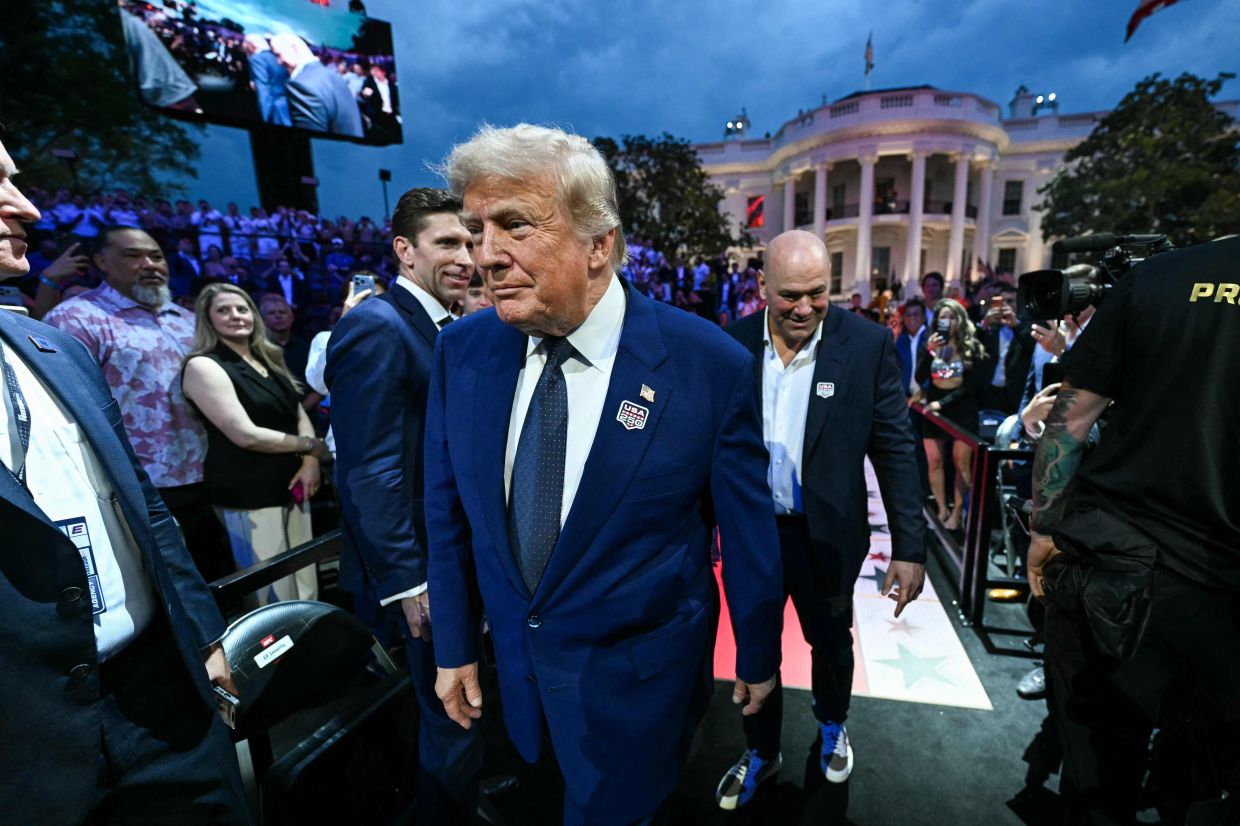
Donald Trump turned 80 by hosting the Ultimate Fighting Championship's Freedom 250 event on the White House South Lawn on Sunday evening, blending personal celebration with what officials framed as commemoration of America's 250th anniversary. The unprecedented gathering, organised by TKO Group Holdings Inc.'s UFC division under the direction of President Dana White, brought together an eclectic mix of Silicon Valley executives, military personnel, and entertainment figures for a night of competitive combat sport at the nation's most recognisable residence. The occasion marked a striking departure from the decorous events traditionally held on the presidential grounds, signalling how thoroughly Trump's return to office has reshaped the symbols and spaces of American governance.
The event's centrepiece was a colossal structure christened the "Claw," a nearly 100-foot-tall arena that dwarfed even the White House itself, containing 4,300 seats for the main fights while accommodating an additional 120,000 spectators in surrounding areas such as the Ellipse, where free tickets were distributed through a lottery system. Seven cage matches unfolded on the South Lawn beginning just before 8:30pm, with weather concerns about lightning strikes briefly delaying proceedings. The scale of the construction represented something unprecedented in recent presidential history—White House grounds, which ordinarily host family-oriented traditions like the Easter Egg Roll or the Congressional Picnic, were transformed into a sporting venue of theatrical proportions. Trump even mused in a TikTok video that the structure might be preserved permanently, comparing it to the Eiffel Tower, though administration officials later clarified through court filings that the Claw would be disassembled beginning at 10am Monday.
The guest list reflected Trump's coalition of supporters and close associates from the technology and business worlds. Meta Platforms Inc. CEO Mark Zuckerberg, Paramount Skydance Corp. CEO David Ellison, and Treasury Secretary Scott Bessent attended alongside members of Trump's family. Commentary throughout the evening came from Joe Rogan, the podcast host whose audience of young men constituted a critical demographic in Trump's 2024 election victory. Military servicemembers filled seats in the audience, and the broadcast cut to watch parties at various military installations globally, including in Okinawa, Japan, broadening the event's reach beyond Washington. Medal of Honor recipients and first responders were assigned the ceremonial duty of escorting fighters into the arena, embedding the occasion with patriotic symbolism.
The political implications of hosting the UFC at the White House are substantial, particularly given how thoroughly the Trump administration has integrated itself with the sport's infrastructure. The State Department and Federal Bureau of Investigation have both signed partnership agreements with the UFC, reflecting the administration's embrace of an organisation whose core demographic—young, primarily male sports enthusiasts—provided crucial support during the recent election. During a Friday news conference held at the Lincoln Memorial, White announced that World Liberty Financial, a Trump family venture, was providing an additional US$250,000 bonus to the top two fighters competing at the event, creating a direct financial connection between the presidency and the sport's athletes.
Despite the administration's enthusiasm, public sentiment remained decidedly lukewarm. A YouGov poll released on June 5 found that 51% of Americans disapproved of the White House fight, with only 27% expressing approval. The event faced legal challenges from the Public Integrity Project, which filed a lawsuit characterising the spectacle as a "volcano of corruption." These organisations objected not merely to the event itself but to what they perceived as the inappropriate mingling of private corporate interests with the symbolic and operational resources of the presidency. Court filings revealed that more than seven federal agencies had allocated significant resources and manpower toward staging the event, raising questions about the deployment of taxpayer-funded government capacity for what amounted to a private celebration and corporate marketing exercise.
The financial arrangements surrounding the UFC Freedom 250 event underscore the commercial dimensions beneath the patriotic veneer. The UFC stated it was covering the entire production cost, with the White House claiming to have handled no sponsorship discussions—yet prominent corporate sponsors including Crypto.com and Dodge's Ram truck brand were prominently featured on the UFC Freedom 250 website. Reports suggested UFC spent over US$60 million to stage the event, which White characterised as a money-losing proposition, though unnamed company executives suggested otherwise. The discrepancy between stated costs, actual expenditures, and profitability calculations highlights the murky economics of prestige projects executed at government facilities.
The choice of venues for preparatory events demonstrated how thoroughly the administration mobilised iconic American spaces for the occasion. The mandatory press conference for competing fighters was held at the Lincoln Memorial, the site of Martin Luther King Jr.'s "I Have a Dream" speech, transforming one of America's most significant civil rights landmarks into a backdrop for fighters exchanging insults and predictions. Locker rooms were established on the White House grounds themselves, including within the Indian Treaty Room, a space ordinarily reserved for formal state functions and diplomatic ceremonies. These decisions represented not merely logistical choices but statements about what spaces and symbols the administration regarded as available for repurposing.
The event's timing adds another dimension to its significance. Trump will depart for France this week to meet with Group of Seven leaders, bringing with him a UFC championship belt bestowed by the organisation. His journey from the White House South Lawn to negotiations with international allies encapsulates the administration's blending of entertainment, commerce, and statecraft. The 250th anniversary commemoration framework, within which the UFC event was placed, also encompasses plans for an IndyCar race through Washington's streets in August and the issuance of commemorative gold coins bearing Trump's likeness, suggesting a broader pattern of personalising and commercialising national symbols and institutions.
For Malaysia and Southeast Asian observers, the White House UFC event offers instructive lessons about democratic institutions' vulnerability to erosion through seemingly incremental decisions. The normalisation of corporate entertainment at the highest levels of government, the deployment of state resources for private celebrations, and the direct financial integration of political leaders with commercial enterprises represent concerning trends that ripple beyond American borders. As nations across the region navigate their own political transitions and economic pressures, the Trump administration's willingness to fundamentally alter the character of presidential institutions for immediate political and commercial advantage provides a cautionary example of how democratic norms can be reshaped through accumulated choices that individually might seem minor but collectively transform governance.
The structural transformation of the White House South Lawn and the mobilisation of federal resources for a sporting spectacle simultaneously reveal both the power and the fragility of institutional constraints on executive authority. When a president controls both the legislative machinery and the institutional infrastructure, traditional checks on unconventional uses of government property and resources become largely symbolic. The fact that legal challenges proved unsuccessful and that the event proceeded despite public disapproval demonstrates how formal legal authority, once concentrated, can override democratic sentiment and institutional norms. For nations observing American governance from abroad, the episode illustrates that constitutional democracies remain vulnerable to gradual transformation through the exercise of technically legal but previously unthinkable executive decisions.