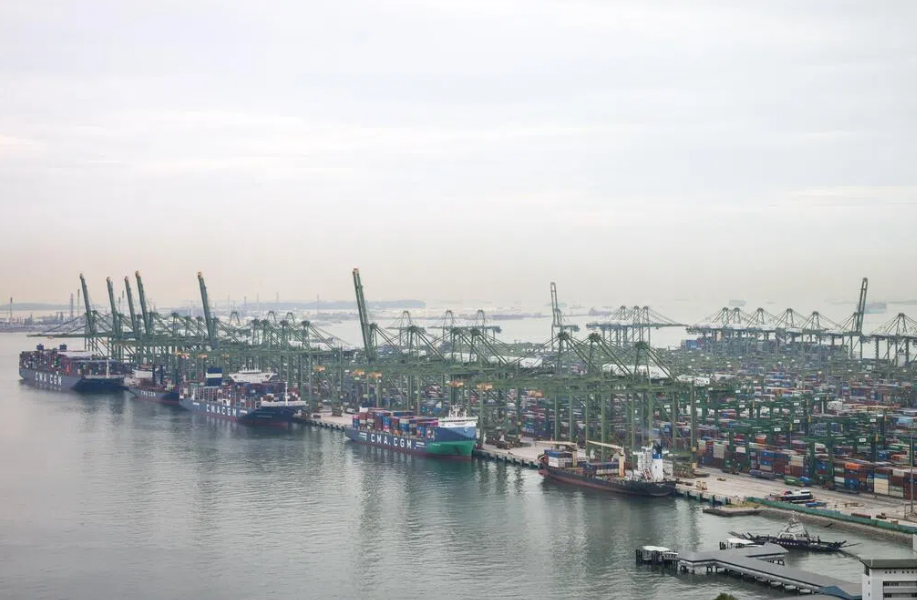
Singapore has joined dozens of nations facing heightened import duties into the United States, with the Trump administration imposing a 12.5 per cent tariff on a substantial portion of the island's exports to America. The move represents another salvo in an intensifying trade war as the White House attempts to reconstruct its tariff architecture following a major legal setback that had dismantled key elements of its earlier trade strategy.
The Office of the US Trade Representative formally announced the new levy on July 23 through publication in the Federal Register, citing findings from a probe that concluded Singapore and 44 other trading partners have neglected to establish or properly enforce bans on importing goods manufactured through forced labour. Trade Representative Jamieson Greer justified the action by pointing to America's century-old forced labour import restrictions, arguing that other nations must adopt comparable standards. The investigation, which ran from March through July this year, represents one of Washington's most aggressive attempts to weaponise labour standards as a trade tool.
The tariff structure established different penalty rates depending on whether nations have adopted forced labour restrictions. Singapore falls into the higher tier facing the 12.5 per cent duty, alongside 44 other economies deemed insufficiently committed to enforcement. A smaller group of approximately 10 trading partners, including Mexico, the United Kingdom, Canada, and India, will encounter the lower 10 per cent rate because they have at least adopted such prohibitions, though apparently not to Washington's satisfaction. Nations with existing trade agreements with America, including Japan, Switzerland, and South Korea, face the same 12.5 per cent rate but structured in ways intended to respect their bilateral arrangements.
For Singapore specifically, the economic implications are substantial though not catastrophic. Government estimates from June suggested that approximately one-third of the city-state's domestic exports to the United States would fall under the new tariff regime. However, officials acknowledge that the Federal Register notice published on July 23 revised the exemption list, requiring a recalculation of Singapore's actual exposure. The government previously identified certain categories as exempted from broader Trump tariffs, including energy products, pharmaceuticals, electronics, aerospace components, semiconductors, and precious metals. These carve-outs provide some relief to key sectors within Singapore's export portfolio, though their exact scope remains subject to clarification following the latest regulatory update.
Singapore's diplomatic response has been measured but firm. Foreign Minister Vivian Balakrishnan raised the matter directly with US Secretary of State Marco Rubio during a bilateral meeting on July 23, held on the sidelines of the Association of Southeast Asian Nations Foreign Ministers' Meeting in Manila. The Singapore government has consistently maintained that it does not engage in unfair trade practices and does not tolerate forced labour within supply chains. Officials have requested that the United States recognise Singapore's existing enforcement mechanisms and labour standards, which the nation argues are among the region's most robust.
The tariff announcement must be understood within the context of broader upheaval in Trump's trade policy. The US Supreme Court dealt a significant blow to the administration's tariff strategy in February 2026 when it struck down the legal foundation for reciprocal tariffs that had been imposed in 2025. This decision forced the White House to explore alternative legal justifications for maintaining elevated duties on trading partners. The administration responded by implementing a temporary 10 per cent global levy under Section 122, which expired this week. The forced labour investigation represents an attempt to establish a more durable legal foundation for sustained tariffs that might withstand future judicial challenge.
Experts view the use of Section 301 of the Trade Act of 1974 as particularly significant. Unlike other trade authorities that contain statutory expiration dates or percentage caps, Section 301 provides indefinite discretion and no predetermined limits on tariff rates. Historically, measures justified under this provision have proven more resistant to court challenges, making it an attractive legal tool for an administration determined to maintain protectionist policies despite legal obstacles. However, legal scholars warn that deploying Section 301 to impose blanket tariffs across dozens of countries on forced labour grounds represents a substantial expansion beyond Congress's original intent when crafting the statute, setting the stage for immediate litigation once the tariff takes effect.
Singapore faces additional uncertainty from a separate investigation already underway. The United States Trade Representative is examining structural excess capacity and production practices in manufacturing sectors, with Singapore among 16 nations under scrutiny. The timeline for concluding this parallel probe remains unclear, and officials have not provided guidance on whether findings could result in additional tariffs stacked atop the forced labour duties. Trade Representative Greer indicated that the excess capacity investigation is proceeding more slowly than the forced labour examination because the office is attempting to ensure the measure conforms precisely with applicable law, suggesting that tariffs from this probe could materialise within coming months.
The implications for Southeast Asia extend beyond Singapore's individual situation. The forced labour tariff regime establishes a precedent that could expand to other regional exporters if Washington determines they have failed to enforce adequate labour standards. Malaysia, Vietnam, Thailand, and Indonesia all maintain significant export relationships with the United States and could face similar scrutiny should the administration decide to broaden the investigation. The move also signals that Trump's second administration intends to leverage labour standards, environmental compliance, and supply chain practices as leverage points in broader trade negotiations, potentially reshaping how multinational companies source goods from Southeast Asia.
The tariff raises important questions about enforcement mechanisms and proof standards. Singapore has questioned the methodology underpinning the USTR's conclusion that it has failed to enforce forced labour prohibitions adequately. The city-state contends that its existing legal framework, port authority inspections, and supply chain monitoring represent serious commitments to preventing forced labour. The gap between Singapore's self-assessment and Washington's determination highlights a fundamental tension in using trade policy to address labour practices—there is no universally accepted standard for what constitutes adequate enforcement, leaving room for political judgment to override technical assessment.
For Malaysian stakeholders and businesses, the tariff announcement warrants close attention. Many Malaysian companies operate within regional supply chains that include Singapore as a transit hub or manufacturing centre. If additional costs are imposed on Singapore-origin goods, those expenses could ripple through interconnected production networks across Southeast Asia. Malaysian exporters who source inputs from Singapore or who compete directly with Singaporean products in the US market face indirect consequences from the tariff, either through higher input costs or competitive displacement. Government officials in Kuala Lumpur may also face pressure to explain why Malaysia has not yet faced similar tariffs, and whether the country's labour enforcement mechanisms are adequate by American standards.
The broader trajectory suggests that tariff escalation will continue as the Trump administration explores multiple legal avenues for maintaining elevated duties. With the forced labour investigation concluded and the excess capacity probe still underway, Singapore and other trading partners face mounting compliance demands and cost pressures. The question of whether these tariffs will ultimately survive judicial review remains unresolved, but their immediate economic impact is certain. For Singapore and the region, adapting supply chains and diplomatic strategies to accommodate America's shifting trade architecture has become an urgent priority.

