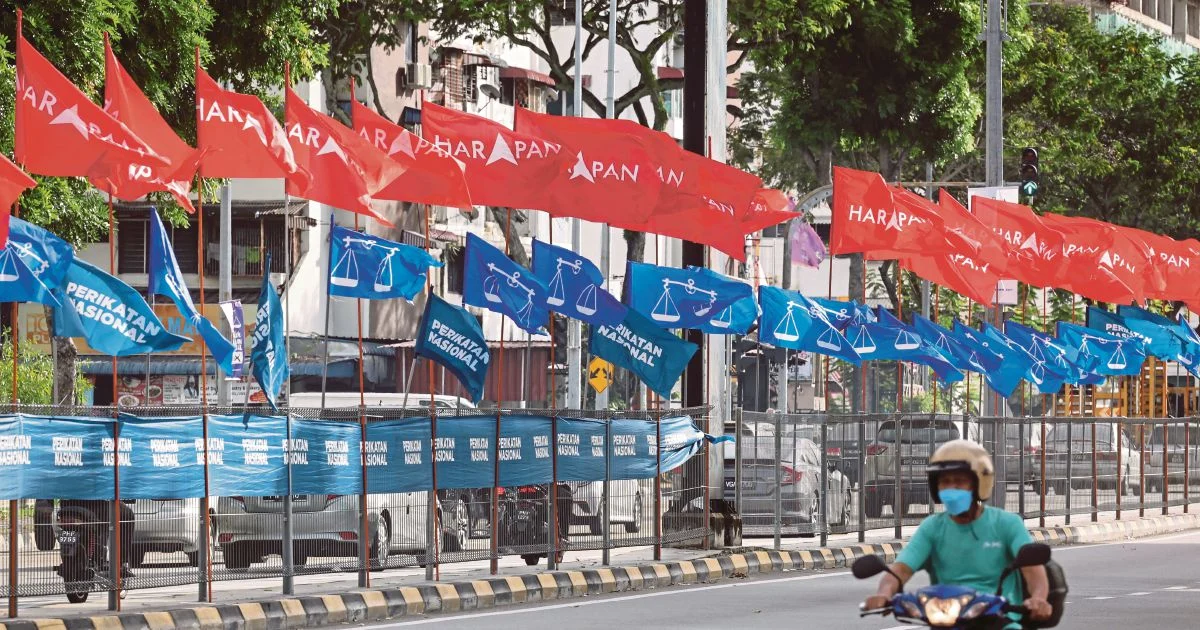
The coming Johor state election is shaping up to be a significant test of strength for Malaysia's three major political coalitions, with Barisan Nasional, Pakatan Harapan and Perikatan Nasional all fielding candidates in more than half the state's 56 seats. The convergence of all three forces in 33 constituencies promises to fragment the opposition vote and create a genuinely competitive political landscape across the state, fundamentally reshaping the electoral dynamics from previous contests where competition typically remained binary.
The presence of three-way contests in nearly 60 per cent of constituencies reflects broader shifts in Malaysian politics since the 2020 general election, when the traditional two-coalition framework collapsed and Perikatan Nasional emerged as a major national force. Johor, as the nation's second-largest state by population and a traditional BN stronghold, has taken on heightened significance in assessing the current balance of power among competing alliances. The scale of three-way battles suggests none of the coalitions can take voter support for granted, with campaign strategies now requiring consideration of vote-splitting risks.
Barisan Nasional's position in Johor carries particular weight, given the state's historical role as a reliable source of parliamentary seats and state assembly support. The coalition has long dominated Johor politics, and its performance in this election will serve as a barometer for its broader electoral viability across Malaysia. However, the emergence of substantial three-way contests indicates that voter loyalty to BN, even in its traditional heartland, cannot be assumed in contemporary Malaysian politics. The coalition must now actively campaign to consolidate support rather than relying on historical dominance.
Pakatan Harapan's substantial presence across these competitive seats reflects its strengthened standing following the 2022 general election, when it emerged as the largest coalition grouping in parliament. The opposition alliance has targeted Johor as part of a broader strategy to expand its state government footprint, and the scale of three-way contests in the state demonstrates that Pakatan Harapan is now in genuine contention across multiple constituencies. However, the presence of Perikatan Nasional in the same contests creates a challenge, as Pakatan Harapan must distinguish itself from a competitor that shares some policy positions and voter demographics.
Perikatan Nasional's extensive participation across Johor reflects its ambitions to translate its federal government role into expanded state representation. The coalition, which includes BERSATU, PAS and other parties, has made particular inroads into constituencies where it can appeal to either urban dissatisfaction with BN or to Islamic voter sentiment. The three-way contests suggest Perikatan Nasional is no longer operating as a fringe force in peninsular state elections, but rather as a mainstream coalition capable of competing directly with established players across diverse constituencies.
The distribution of three-way contests across Johor likely indicates tactical considerations by all three coalitions, with decisions about candidate placement and resources reflecting internal calculations about winnability. In constituencies where all three coalitions are present, the margin of victory may narrow considerably, and second-place finishes that would have secured seats in earlier contests could result in losses. This dynamic introduces considerable unpredictability into the election outcome and may advantage the coalition that successfully consolidates support around fewer candidates in key areas.
Voter behaviour in these three-way contests will offer important insights into the preferences of the Johor electorate and what issues are driving political decision-making. Unlike two-way races where voters face straightforward choices between incumbent and challenger, three-way contests permit voters to express preferences more granularly, potentially rewarding candidates who have successfully built personal or community followings independent of coalition branding. Alternatively, voters may continue to prioritise coalition affiliation, in which case the campaign messaging and national-level perceptions of each alliance will prove decisive.
The electoral mechanics of these contests also warrant attention from observers tracking Malaysian political trends. In constituencies where three candidates compete fairly evenly, a coalition may win with substantially less than 50 per cent of the vote, potentially distorting the relationship between seat count and actual voter preference. This outcome could raise questions about electoral legitimacy or majority mandates, particularly if the winning coalition secures fewer total votes than its combined opposition but gains seat advantage through vote fragmentation. Such scenarios have become increasingly common in Malaysian elections as the political landscape has fractionalised.
The timing of the Johor election within the broader electoral cycle also shapes its significance. Following the 2022 general election and preceding several state contests, Johor voters' decisions may influence momentum heading into subsequent elections, or alternatively, the state contest could be shaped by national-level factors and coalition reputations established elsewhere. The question of whether voters treat state elections as referenda on federal government performance or as distinct contests focused on state-specific issues remains central to understanding how Johor will vote.
For Malaysian politics more broadly, the prevalence of three-way contests in Johor signals that the era of predictable, two-coalition electoral competition has fundamentally transformed. The emergence of a genuinely competitive three-way dynamic across most of the state suggests that Malaysian voters now operate within a more complex political marketplace, where established parties cannot rely on inherited support and where coalitions must actively compete on policy, personality and performance to secure votes. The Johor election will therefore function as a crucial test of which coalition has most successfully adapted to this new political environment and which can articulate the most compelling vision for voters navigating an increasingly fragmented political landscape.

