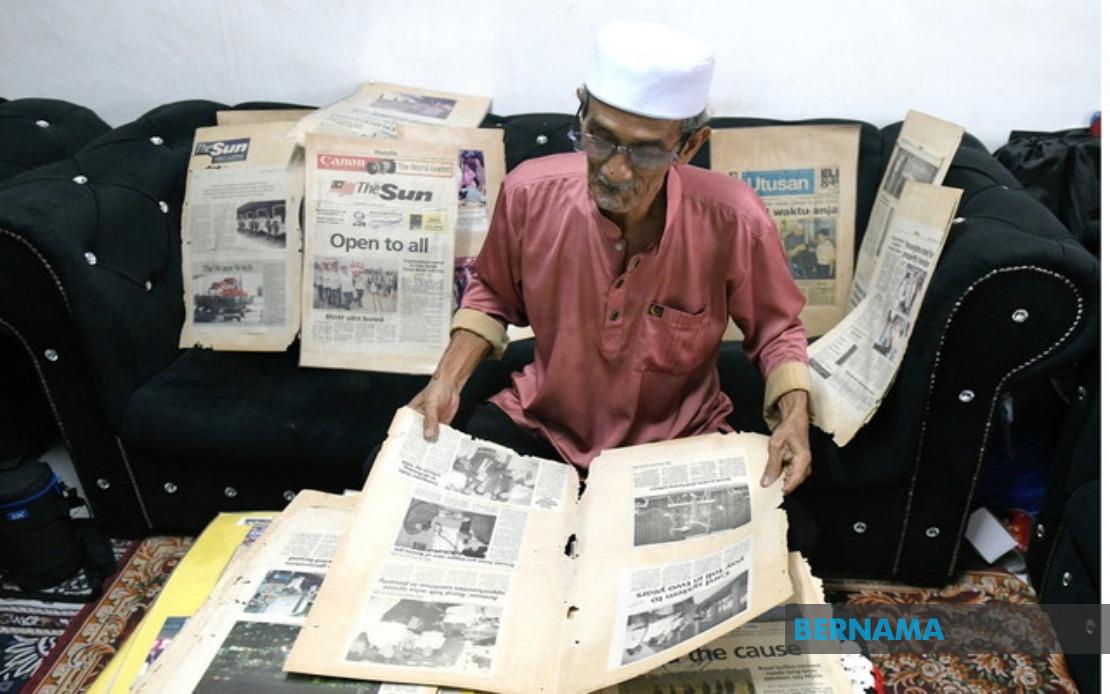
A career spanning more than three decades in Malaysian journalism has left indelible marks on Azmi Sapiei—quite literally, in one memorable instance when he was kicked and spat upon by a suspect while covering a court case around 2001. The incident, which occurred while he was working for The Sun newspaper, represents just one of the challenges that have defined his trajectory from factory worker to respected visual journalist, offering insights into the often-overlooked demands of news photography in Malaysia.
Azmi's path to journalism was unconventional. After leaving his factory job, he relocated to Kuala Lumpur to pursue his passion for photography, working independently with various agencies and women's magazines before his interest in news coverage prompted him to join Bernama in 1993. This decision marked the beginning of a transformative period in his professional life. During his nearly three years at the national news agency, he developed the discipline and standards that would characterize his entire career, learning not merely to document events but to capture their essence with journalistic integrity.
One of his most significant assignments came in July 1994 when Bernama tasked him with photographing the return of former Malayan Communist Party member Shamsiah Fakeh from China. The assignment showcased the competitive advantage of being alert and arriving early—Azmi and his accompanying journalist managed to access Shamsiah's residence in Gombak before security measures restricted entry. Armed with a film camera, he captured the moment with the methodical approach characteristic of the analogue era, shooting three rolls of film to ensure comprehensive coverage. While his supervisor initially questioned the quantity, those photographs ultimately became the lead visuals across major Malaysian newspapers the following day, validating his instinct to document comprehensively.
The analogue photography era, which dominated Azmi's early career, presented distinctive challenges that modern digital photographers rarely encounter. Every frame mattered because film was finite and expensive, and photographers could only verify their work once film was developed and processed. This created an inherent tension between capturing sufficient material and managing costs. Azmi had to develop what he describes as a "school" of discipline within Bernama—an institution that he credits with producing many quality visual journalists while emphasizing accuracy and news value above mere quantity. The responsibility extended beyond mere image capture; he also wrote photo captions for editorial review before distribution to Bernama's extensive customer base, making him responsible for contextualizing his own work.
After leaving Bernama at the end of 1996, Azmi returned to Penang and continued his career with The Sun, where the 2001 assault occurred during routine court coverage. Rather than deterring him, the incident reinforced his commitment to the profession. He subsequently transitioned to Bernama TV and eventually to Radio Televisyen Malaysia Penang as a part-time cameraman in 2003, continuing until his retirement in mid-2020. This career progression demonstrated his adaptability across different news platforms and technologies, even as the industry underwent seismic shifts.
The transition from still photography to television camerawork introduced new physical and technical demands. While the fundamental responsibilities remained similar—capturing newsworthy visuals with accuracy and immediacy—television work required substantially greater physical endurance. During his tenure with Bernama TV, Azmi worked with Betacam equipment, which crews colloquially nicknamed "junk iron" due to its substantial weight of approximately 12 kilogrammes. Carrying this burden on his shoulders during assignments, often in challenging field conditions, tested his physical stamina in ways that stationary darkroom work never could. The evolution from static film photography to mobile television reporting thus represented a fundamental shift in the nature of the work itself.
Beyond the physical toll, Azmi's reflections reveal the psychological resilience required in news coverage. The confrontation with the suspect exemplifies how journalists frequently find themselves in potentially dangerous situations while attempting to document matters of public interest. Malaysian newsrooms rarely discuss the occupational hazards their visual journalists face—the hostile subjects, the unpredictable environments, the moral ambiguity of recording suffering or conflict. Azmi's willingness to continue despite such experiences speaks to a professional commitment that transcends personal safety concerns, though it raises questions about adequate workplace protections for journalists in the field.
The profession also demanded intellectual engagement beyond technical competence. Azmi emphasizes that successful news photography required both technical skill and conceptual understanding—knowing which angles conveyed meaning, how composition could emphasize significance, and when to document extensively versus when to wait for the decisive moment. These decisions distinguished competent technicians from true journalists who understood how visual language communicated complex stories to the public. His mentorship of younger photographers prioritized not just camera operation but the philosophical and disciplinary foundations of ethical visual journalism.
Recognition came later in his career when he received the 2006 Penang State Media Award in the visual electronic media category, validating decades of often-unheralded work. Unlike bylined reporters, visual journalists rarely receive public credit for their contributions to news stories, yet they frequently determine how stories are perceived and understood. Azmi's award acknowledged this invisible labor, recognizing that his technical skill and editorial judgment had shaped public understanding of significant events.
The generational continuity in Azmi's family underscores journalism's enduring appeal despite its challenges. His second son, Muhammad Syafiq, now works as a cameraman with Media Prima Television Network, having caught the photography interest as a child watching his father transport equipment home. Rather than discouraging his son from the profession, Azmi became his mentor, transmitting not just technical skills but the discipline, ethical standards, and resilience that define serious journalism. Their relationship exemplifies how professional values pass through families, creating lineages of commitment to documenting Malaysian life and events.
Azmi's career trajectory illuminates broader transformations in Malaysian journalism. He witnessed the shift from complete reliance on film cameras to digital technology, from closed newsrooms to the internet age, from competition with other photographers to the era of ubiquitous smartphone journalism. His retirement in 2020 marked the end of an era—three decades of professional dedication to capturing Malaysia's news through multiple technological and social iterations. His legacy extends beyond his own photographs to the standards he helped establish within Malaysian news organizations and the next generation of visual journalists he has inspired.

