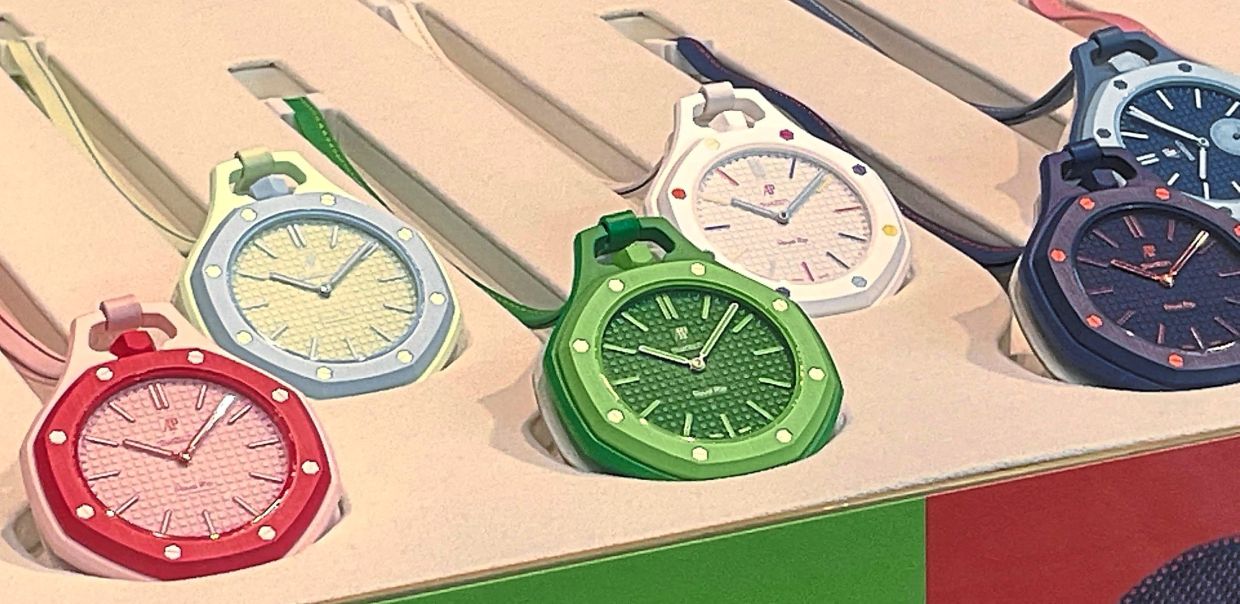
The watch industry witnessed a carefully orchestrated collision of mass-market accessibility and haute horlogerie prestige on May 16 when Swatch unveiled Royal Pop alongside independent Swiss watchmaker Audemars Piguet. The eight-piece bioceramic pocket watch collection, priced under S$600 (approximately RM1,800), created immediate pandemonium in boutiques worldwide. Yet beneath the surface buzz lay a sophisticated brand manoeuvre that speaks to shifting consumer expectations and the evolving definition of luxury itself in Southeast Asia and beyond.
The path to launch was designed to maximize anticipation. For weeks preceding the official May 12 announcement, cryptic newspaper advertisements and social media teasers promised something neither "iconic" nor conventionally expected. The deliberate vagueness invited speculation across watch enthusiast forums, with artificial intelligence generating countless mock-ups that circulated feverishly on Reddit, Instagram, and dedicated horological communities. Rigorous non-disclosure agreements and compartmentalized teams ensured that credible information remained firmly sealed until the reveal moment, transforming the wait into cultural event.
When Royal Pop finally materialized, it defied mainstream predictions. Rather than wristwatches that might directly challenge Audemars Piguet's core offerings, the collaboration delivered eight colourful pocket watches that reinterpreted Gerald Genta's iconic 1972 Royal Oak design language. The octagonal bezel, distinctive Petite Tapisserie dial pattern, and eight exposed hexagonal screws became pocket-watch signatures, available in both Lepine configuration (crown at 12 o'clock) and Savonnette format (crown at 3 o'clock with subsidiary seconds dial). The hand-wound SISTEM51 mechanical movements, deliberately minimalist rather than traditionally sophisticated, reinforced the collection's intentionally playful character.
This strategic choice reveals masterful brand calculus. Entry-level Royal Oak wristwatches command approximately S$30,000 (RM94,881), placing them squarely in ultra-premium territory. A conventional low-cost wristwatch collaboration would have directly threatened that exclusivity barrier, potentially damaging Audemars Piguet's carefully maintained positioning. By repositioning the project as a pocket-watch offering—a nostalgic, niche category entirely separate from contemporary wrist wear—the brand retained creative freedom while protecting its core business. The bioceramic cases, with their plastic-adjacent appearance, further emphasized the collection's deliberately cheeky, toy-like aesthetic, creating psychological distance from serious luxury watchmaking.
For Swatch, Royal Pop represents the natural evolution of a proven formula. The 2022 MoonSwatch collaboration with Omega demonstrated the extraordinary commercial and cultural power of pairing accessible mass-market brands with prestigious luxury heritage. That launch generated phenomenon-level demand: multi-hour queues formed globally, law enforcement deployed in multiple cities to manage crowd overflow, and secondary market resellers capitalized on scarcity by marking up watches sometimes exceeding 300 percent above retail. The lesson was unmistakable—controlled scarcity combined with brand prestige creates powerful behavioral responses, even at sub-S$400 price points.
Royal Pop elevates this playbook considerably. The critical distinction lies in Audemars Piguet's operational independence. Unlike Omega, which belongs to the broader Swatch Group ecosystem, Audemars Piguet stands apart as a family-owned independent manufacturer. This separation transforms Royal Pop beyond routine co-branding into something strategically more ambitious: evidence that Swatch aspires to function as a platform through which independent luxury houses can expand consumer reach without diluting their premium positioning. The collaboration signals a fundamental shift in how ultra-luxury brands consider their relationship with accessible markets.
The benefits for both parties extend beyond immediate sales figures. Pat Law, founder of Goodstuph, a Singapore-based social marketing agency specializing in luxury brands, articulates a crucial insight about contemporary consumer psychology: "Luxury today is not just about ownership anymore. It's about proximity." Through Royal Pop, Swatch achieves cultural elevation almost instantaneously, with plastic timepieces inheriting decades of Audemars Piguet's craftsmanship reputation, horological heritage, and the intangible prestige associated with Swiss watchmaking excellence. Ownership of a Royal Pop pocket watch becomes a tangible, affordable entry point into luxury's cultural sphere.
For Audemars Piguet, the calculus differs but remains compelling. The brand acquires relevance at scale without requiring compromises to its product architecture or brand integrity. Most young consumers in Southeast Asia and globally would never cross the threshold of an Audemars Piguet boutique, intimidated by price points and perceived exclusivity. Royal Pop provides strategic proximity to these demographics years before they possess financial capacity for traditional Audemars Piguet pieces. The brand, as Law suggests, achieves substantial "rent-free" real estate in consumer consciousness—building cultural familiarity and emotional connection without requiring direct financial commitment.
Yet this democratization strategy carries inherent risks that luxury marketing literature has long documented. Academic research on luxury brand architecture reveals a persistent tension: while temporary scarcity-driven campaigns successfully generate short-term hype and elevated sales, expanded accessibility to brand visual identity can gradually erode exclusivity perceptions. The exposure of Audemars Piguet's most recognizable design codes—the octagonal bezel, the Petite Tapisserie pattern, those distinctive hexagonal screws—across millions of affordable pocket watches potentially risks diluting the visual distinctiveness that commands premium wristwatch pricing.
The Southeast Asian context adds particular complexity. The region's rapidly expanding affluent consumer class, concentrated in cities like Singapore, Kuala Lumpur, Bangkok, and Jakarta, represents both opportunity and vulnerability for luxury brands. These emerging consumers often leap directly to contemporary brands rather than following traditional horological education pathways. Royal Pop pocket watches might prove more accessible entry points than expensive wristwatches, potentially accelerating brand familiarity. However, the pocket watch format—inherently nostalgic and divorced from modern timekeeping practice—may also create confusion about Audemars Piguet's actual product identity for consumers unfamiliar with watch collecting culture.
The queuing phenomenon accompanying both MoonSwatch and now Royal Pop reveals something deeper about contemporary luxury psychology. Consumers queue for hours without guaranteed purchase certainty, accepting potential disappointment simply for proximity to scarcity itself. This behavior transcends traditional rational economics, suggesting that the experiential and social dimensions of luxury acquisition—the story of having participated in a rare cultural moment, the Instagram documentation, the conversation value—increasingly matter as much as product ownership. Swatch and Audemars Piguet have essentially monetized cultural participation itself.
Moving forward, Royal Pop establishes a new template for how independent luxury houses might consider brand extension. Rather than pursuing direct price-point competition, strategic alternative-format collaborations offer pathways to broader audiences while maintaining core business positioning. The pocket watch represents the difference between building brand consciousness and undermining brand value—a critical distinction that other luxury conglomerates will undoubtedly study. For Malaysian consumers observing this phenomenon, Royal Pop demonstrates that accessibility and exclusivity need not represent opposing forces, but rather different expressions of luxury's evolving cultural meaning.