Thailand's police force has intensified enforcement action against foreign nationals suspected of circumventing property ownership restrictions through the use of nominee shareholders. The latest operation, conducted in the coastal resort town of Hua Hin in Prachuap Khiri Khan province, resulted in the arrest of 13 foreign nationals and the summoning of 39 Thai nationals for questioning during what authorities described as the sixth phase of a nationwide campaign targeting illegal foreign property holdings. The scale of the operation underscores Bangkok's growing determination to combat what it views as systematic abuse of corporate structures to mask foreign beneficial ownership of real estate.
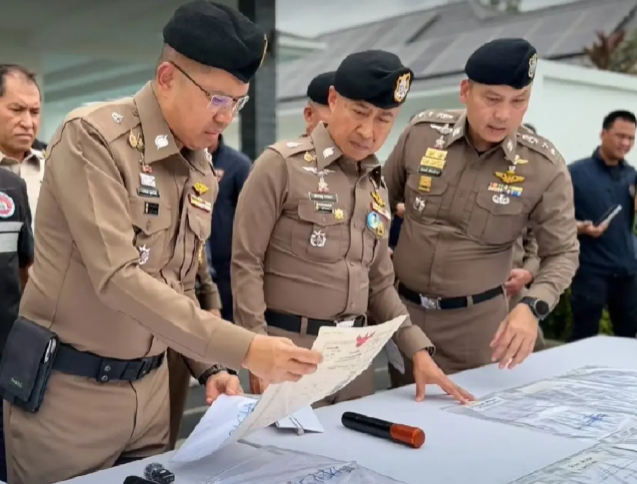
The Hua Hin raids, executed on August 10, deployed more than 200 police officers and government officials across 15 locations, focusing particular attention on a residential development of detached houses and modern pool villas in the Thap Tai subdistrict. Individual properties within the development were valued at between 10 and 20 million baht each. The operation was coordinated at the highest levels of Thailand's police hierarchy, with Deputy National Police Chief Pol Gen Samran Nuanma ordering the intervention and oversight provided by senior commanders including Pol Lt Gen Nopasil Poolsawat and Pol Lt Gen Phisit Tanprasert. Such deployment of senior leadership reflects the political priority attached to the enforcement campaign within Thailand's government structure.
According to police accounts, the arrested individuals comprised three British nationals, four Chinese nationals, and one representative each from Italy, France, the Netherlands, Austria, the Philippines, and the United States. While courts had issued arrest warrants for 45 foreign nationals in total, only 13 were apprehended during the Hua Hin operations. The remaining individuals remain at large or are being pursued through ongoing investigations. Notably, the suspects taken into custody have not yet been formally charged in court, suggesting that the investigation remains in preliminary stages with authorities still gathering evidence and conducting interviews.
The broader investigation encompasses 33 companies suspected of holding land on behalf of foreign nationals, with the total value of properties involved estimated at approximately 300 million baht. Preliminary examination of the targeted development in Hua Hin identified six companies allegedly operating as nominee vehicles, with four linked to the development's first phase and two connected to its second phase. This organizational structure suggests a systematic approach to property acquisition rather than isolated incidents, indicating that foreign investors or networks have developed sophisticated methods to acquire Thai real estate despite legal prohibitions on foreign land ownership.
Investigators have uncovered details about how these arrangements operated in practice. Foreign nationals questioned during the investigation reportedly stated that they approached law and accounting firms seeking advice on how to legally acquire and hold property in Thailand. Based on recommendations from these professional intermediaries, they established companies with Thai nationals serving as shareholders on paper. Many of the foreign nationals interviewed claimed they believed these corporate arrangements provided a legitimate pathway to property ownership under Thai law, a misunderstanding or misrepresentation that lies at the heart of the investigation.
The Thai nationals identified as nominal shareholders present a different picture in their statements to police. These individuals allegedly acknowledged that they had agreed to hold shares on behalf of foreign parties but had never actually paid for those shares and had taken no active role in managing the companies. Furthermore, they reported having no access to financial documentation or evidence of their supposed investments in these entities. Their accounts suggest a purely nominal arrangement where Thai nationals lent their names and legal status to circumvent nationality requirements, receiving compensation for their cooperation without genuine business involvement or financial commitment.
For Malaysian readers and Southeast Asian observers, this enforcement action carries particular relevance given the prevalence of similar nominee arrangements across the region. Malaysia, which similarly restricts foreign land ownership in many jurisdictions, has grappled with comparable schemes where foreign buyers utilize corporate structures or local nominees to acquire property. The Thai investigation demonstrates the sophisticated methods employed to evade regulatory frameworks and the difficulty authorities face in distinguishing between legitimate business arrangements and fraudulent nominee schemes designed solely to obscure foreign ownership.
The enforcement campaign reveals the mechanics of how these schemes operated financially. Police seized company registration documents, accounting records, computers, mobile phones, and electronic data during the raids. Investigators plan to examine this material to trace financial transactions and identify additional individuals, beneficiaries, and networks potentially involved both within Thailand and internationally. The mention of overseas networks suggests that these arrangements may involve transnational money flows and coordination with foreign entities, adding complexity to the investigation and suggesting potential links to broader patterns of illicit financial activity.
The investigation has also flagged potential corruption concerns within Thailand's own government structure. Police indicated that the inquiry would encompass examination of any government officials suspected of corruption or of improperly facilitating the activities of those involved in the nominee schemes. This dimension of the investigation suggests that authorities suspect complicity or negligence within regulatory agencies responsible for corporate registration and land administration, a concern that underscores the systemic nature of the problem and raises questions about institutional capacity and integrity.
The Hua Hin operation represents the most recent installment in a systematic campaign that began with investigations on Koh Phangan in Surat Thani province. Previous phases have expanded progressively across Thailand's primary tourist destinations, including Phuket, Phang Nga, Krabi, Chonburi, and Chiang Mai. The cumulative scope of these five earlier phases examined 233 land plots and buildings covering more than 160 rai, or approximately 25.6 hectares, with a combined estimated value exceeding 2.539 billion baht. Phase 3 operations in Phuket, Phang Nga, and Krabi alone examined 89 land plots valued at more than 1.05 billion baht, while Phase 5 investigations in Chiang Mai covered 31 companies and 29 land plots worth approximately 633 million baht.
The enforcement results from previous phases indicate both progress and continuing challenges. Courts have approved 133 arrest warrants arising from the earlier operations, while 20 cases have resulted in convictions. These statistics suggest that while authorities have successfully prosecuted some cases, conviction rates remain relatively modest compared to the scale of suspected illegal activity. The fact that 20 convictions have been secured from dozens of cases brought to court indicates that prosecutors and judges are applying relatively rigorous evidentiary standards, a positive sign for rule of law but also a reflection of the genuine complexity involved in proving fraudulent intent within corporate structures.
Thailand's authorities have emphasized that the enforcement campaign targets nominee structures and foreign-backed businesses suspected of operating unlawfully, rather than legitimate foreign investors who comply with Thai law. This distinction reflects awareness that Thailand remains dependent on foreign investment and tourism, and overly aggressive enforcement could deter genuine commercial activity. Nevertheless, the scale and intensity of the campaign demonstrate a firm governmental commitment to preventing systematic circumvention of property ownership restrictions.
The Royal Thai Police has established public reporting mechanisms to support ongoing investigations, including a dedicated hotline on 1599 available around the clock, and has invited members of the public to report suspected illegal foreign business activity to local police stations. Such transparency and public engagement mechanisms may prove instrumental in identifying additional cases and networks, particularly among communities where foreign investors interact with local intermediaries. The campaign will continue investigating suspected nominee networks and foreign-funded groups operating unlawfully across Thailand's tourist destinations and beyond.

