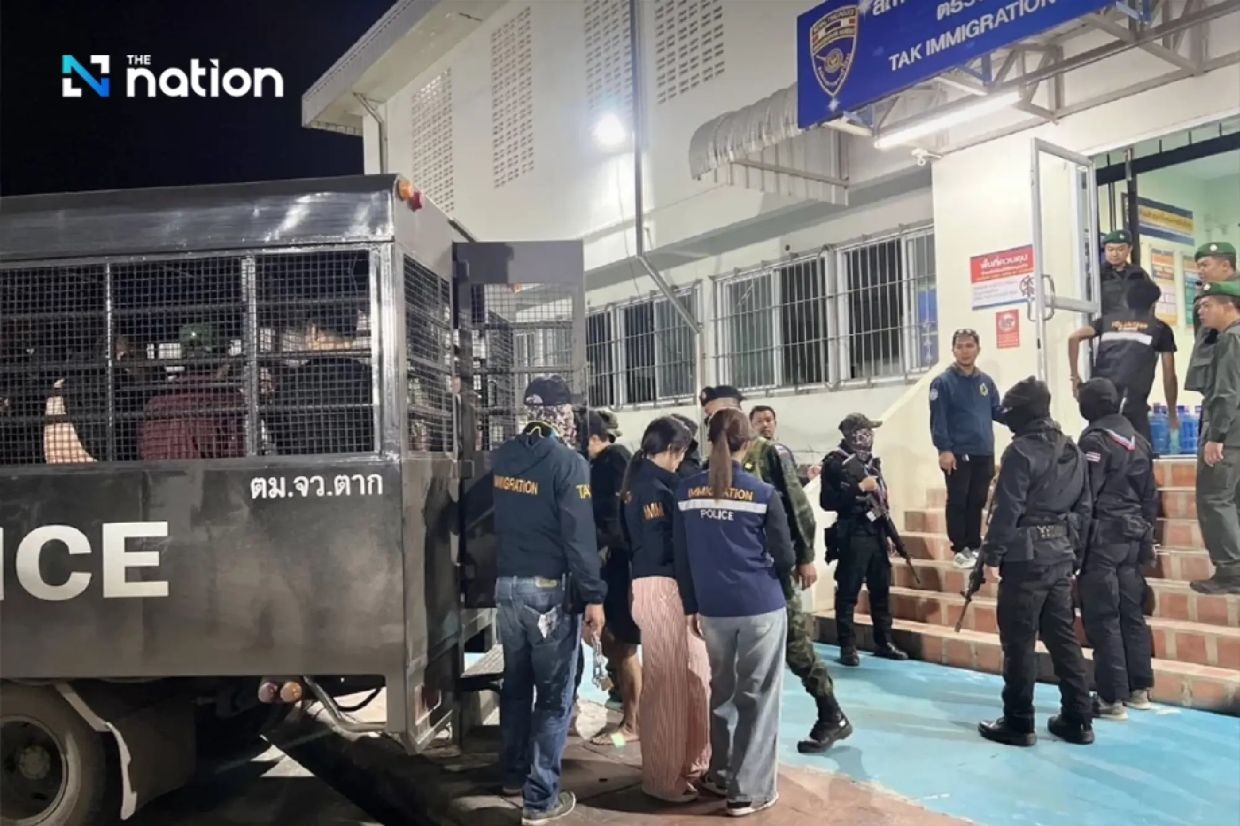
Thailand's government is moving decisively to tighten its immigration procedures with the aim of removing foreign nationals convicted of crimes far more swiftly than current legislation allows. The initiative, driven by Prime Minister Anutin Charnvirakul and overseen by Deputy Prime Minister Pakorn Nilprapunt, represents a significant policy shift toward closing loopholes that law enforcement officials say have made the kingdom an attractive base for transnational criminal enterprises. The reforms come amid mounting frustration with the slow pace of deportations under existing rules, where procedural safeguards intended to protect individual rights have inadvertently created extended stays in custody for offenders awaiting removal.
The enforcement challenges facing Thailand's authorities stem partly from the 60-day visa exemption scheme introduced in July 2024 under the administration of then-Prime Minister Srettha Thavisin. The programme permitted visitors from 93 countries and territories to enter Thailand without advance visa applications, eliminating the opportunity for Thai embassies to screen arrivals for criminal records or financial backgrounds before they crossed the border. This lack of pre-arrival vetting exposed the country to individuals with hidden criminal histories who could enter freely and exploit gaps in day-to-day enforcement.
Investigators discovered that some foreign nationals exploited the visa exemption's design flaws by engaging in what authorities call "border runs"—repeatedly crossing into neighbouring countries and immediately re-entering Thailand to reset their 60-day exemption period rather than leaving the kingdom permanently. This practice allowed individuals to establish themselves in Thailand indefinitely without acquiring formal long-term residency or work permits. The absence of proper documentation and vetting made it difficult for authorities to track these individuals or predict their movements, creating an operational advantage for organised criminal groups seeking to operate from Thai territory.
The consequences of these security gaps have materialised across Thailand's tourist and commercial hubs. Foreign nationals operating outside the law have reportedly established themselves in destinations including Pai in Mae Hong Son, Pattaya in Chonburi, Koh Phangan in Surat Thani and Bangkok, where they engage in activities ranging from illegal employment in hospitality and entertainment sectors to large-scale organised crime. Authorities have documented cases of foreign individuals acquiring property through nominee arrangements—structures that technically place ownership with Thai citizens while foreign interests maintain control—and involvement in call-centre fraud operations, money laundering schemes and grey-market financial networks that move illicit capital across borders.
Recognising the severity of these vulnerabilities, the Anutin government designated transnational crime suppression as a core national security priority in 2024 and 2025. The Immigration Bureau, Royal Thai Police and supporting agencies received directives to strengthen both entry-point screening and ongoing enforcement operations. The government implemented four complementary measures: enhanced scrutiny of travellers exhibiting patterns of frequent entries and departures without legitimate purposes; intensified vetting of visitors originating from jurisdictions designated as higher-risk for criminal activity; deeper integration of international criminal databases maintained by Interpol and Thai security agencies; and structural modifications to reduce opportunities for visa category overlaps that could be exploited for extended stays.
A watershed moment arrived in May 2026 when the Cabinet of the Anutin 2 government formally cancelled the problematic 60-day visa exemption arrangement. Thailand is reverting to bilateral, country-by-country visa negotiations, with most foreign visitors now expected to receive maximum authorized stays of 30 days unless they hold specific long-term visa categories. The government has publicly defended this reorientation by arguing that pursuing tourism volume at the expense of security vetting represents a false economy. Officials note that the 60-day exemption failed to produce commensurate increases in tourist arrivals or visitor spending while simultaneously exposing the country to demonstrably higher security risks—a trade-off the state determined was untenable.
Despite tighter immigration enforcement and accelerated arrest operations by coordinated military, police and administrative task forces, the machinery of removal remains sluggish. The core problem lies in the legal framework governing deportations. Many foreign detainees languish in state custody for extended periods because they cannot immediately return home—some lack financial resources for travel costs and depend on Thai authorities to negotiate financial support from their embassies; others exhaust appeals processes available under the Immigration Act of 1979. The legislation permits foreign nationals to file appeals within 48 hours of receiving deportation notices and request postponement or temporary stay extensions on humanitarian or legal grounds, mechanisms designed to protect against unjust removal but which, in practice, delay the return of convicted offenders to their countries of origin. In serious cases, deportations may proceed despite pending appeals, but most routine cases experience significant delays as applications work through the bureaucratic pipeline.
The specific legislative sections commanding attention in the current reform effort are Sections 54 and 55 of the Immigration Act of 1979, which establish the procedures and criteria for removing foreign nationals from Thai territory. These provisions contain multiple procedural gates, appeal mechanisms and coordination requirements with foreign ministries and embassies that, while legally sound, create bottlenecks in execution. Pakorn Nilprapunt, charged with leading the legislative revision process, is coordinating with the Interior Ministry, the Royal Thai Police and the Immigration Bureau to identify amendments that could streamline removal procedures without dismantling human rights protections. The government's stated objective is to achieve faster, more flexible and more effective deportations while maintaining full compliance with Thailand's international obligations under human rights law.
Thailand's human rights commitments introduce an important constraint on how aggressively the government can reform deportation procedures. As a member of the United Nations Human Rights Council and signatory to eight major international human rights conventions covering children's rights, women's rights, civil and political rights, economic and social rights, racial discrimination, torture prevention, disability rights and protection against enforced disappearance, Thailand must ensure that any immigration law revisions respect these treaty obligations. Detainees retain fundamental rights to petition courts, contest removal orders and request temporary release based on humanitarian grounds—protections that complicate efforts to accelerate deportations but reflect Thailand's broader commitment to rule-of-law principles.
According to Pol Lt Gen Trairong Phiwpan, Royal Thai Police spokesman, the deportation and extradition landscape involves multiple legal pathways whose complexity itself contributes to delays. If Thailand maintains an extradition treaty with the detainee's home country, the attorney-general must evaluate the case before forwarding it to the court for an extradition order; if no treaty exists, the Foreign Ministry must submit a request to the attorney-general, who then petitions the court. Each pathway involves distinct legal standards, evidentiary thresholds and procedural steps. Trairong noted that removing unnecessary procedural duplication, shortening review timelines and eliminating redundant administrative steps could significantly accelerate the process while preserving the court's ability to assess case gravity and human rights dimensions.
The spokesman acknowledged that repatriation timelines vary considerably depending on whether detainees invoke their legal rights to challenge removal. Detainees who forgo appeals and human rights petitions can be deported relatively quickly; those who exercise their full array of procedural rights necessarily extend the timeline as courts must deliberate their claims. The reform challenge lies in distinguishing between cases warranting expedited processing—such as visa overstays or petty offences—and those requiring careful legal scrutiny, such as allegations involving serious transnational crimes where evidentiary standards and due-process considerations demand thorough examination. Trairong indicated that police support legislative measures that maintain procedural rigour while eliminating redundancy.
Prime Minister Anutin has framed the government's approach as balancing Thailand's interests in welcoming legitimate foreign visitors, investors and business partners against its obligation to enforce laws decisively against those who violate them. Anutin stated that Thailand remains open to foreigners engaged in honest tourism, investment and commerce, but those who break the law or inflict damage on the kingdom must face swift legal action and removal. This rhetorical positioning attempts to separate law-abiding foreign residents and visitors from a criminal subset, a distinction that the government hopes will prevent economic sectors dependent on foreign talent and investment from experiencing collateral harm during enforcement campaigns. The political calculus reflects awareness that overaggressive implementation could alienate tourism operators, hospitality businesses and international investors who view Thailand as an attractive destination.
The coming reform phase will involve Pakorn conducting detailed consultations across government agencies to gather data on deportation processing times, identify specific points of delay, model the impacts of proposed amendments and assess unintended consequences. The Interior Ministry, Royal Thai Police, Immigration Bureau, Foreign Ministry and the attorney-general's office all maintain stakes in how the system functions and must collaborate to produce workable revisions. Any legislative amendments will need Cabinet approval and parliamentary consideration, a process likely to extend into 2026. In the interim, enforcement intensity appears unlikely to diminish, with coordinated operations targeting foreign nationals involved in organised crime, illegal employment, visa violations and financial crimes expected to continue generating arrests that will feed the existing backlog of deportation cases awaiting resolution under current law.

