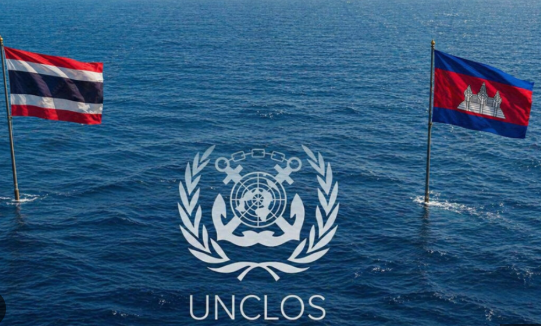
Thailand's Ministry of Foreign Affairs has formally entered into a United Nations-backed conciliation process with Cambodia to address their long-standing disagreement over maritime boundaries in the Gulf of Thailand, submitting its official response on June 19 following Cambodia's June 2 notification. The move represents a significant diplomatic development in a dispute that has simmered for decades, though Thailand has taken pains to clarify that accepting the conciliation does not constitute acceptance of binding international adjudication.
The underlying issue concerns overlapping maritime claims in the Gulf of Thailand, a strategically important body of water believed to harbour substantial natural gas reserves and other hydrocarbon deposits. Both countries have long grappled with demarcating their respective exclusive economic zones and continental shelf boundaries, a challenge that has proved intractable through bilateral channels alone. The commercial stakes are substantial, making the dispute not merely a technical cartographic matter but one with genuine economic ramifications for both nations and potential implications for regional energy security and maritime stability.
Under the 1982 United Nations Convention on the Law of the Sea (Unclos), which both Thailand and Cambodia have ratified, either party can trigger mandatory conciliation to resolve deadlocked maritime delimitation disputes. This mechanism exists precisely because bilateral negotiations sometimes stall, yet conciliation deliberately stops short of binding arbitration or litigation. Thailand's acceptance of the process therefore represents a tactical choice: engaging with an internationally structured framework while preserving its negotiating position and ultimate decision-making authority.
Bangkok appointed Deputy Prime Minister and Foreign Minister Sihasak Phuangketkeow as its principal representative (Agent) in the proceedings, with Songchai Chaipatiyut, Thailand's ambassador to Kuwait and a former senior official in the Department of Treaties and Legal Affairs, serving as Deputy Agent. This high-level delegation reflects the political sensitivity of the file. Thailand also nominated two conciliators: Judge Albert J Hoffmann of South Africa and Judge Rudiger Wolfrum of Germany, both acknowledged as international experts in maritime law. The four conciliators appointed by both countries will jointly select a fifth conciliator to chair the commission within thirty days of Thailand's formal response.
The conciliation process is structured to operate on a fundamentally different basis from litigation or binding arbitration. Thai officials have emphasised that conciliators function as neutral facilitators rather than judges or advocates, tasked with comprehending the historical context of the dispute, hearing both parties' positions, and helping identify common ground. The commission will produce a report with recommendations within approximately twelve months, extendable if both governments agree. Crucially, under Unclos Annex V, these recommendations carry no legal force whatsoever. Thailand has repeatedly stressed this distinction, noting that the report will merely serve as a foundation for resumed bilateral negotiations rather than as a binding settlement.
This insistence on the non-binding character of conciliation reflects Thailand's broader negotiating strategy. Bangkok has consistently maintained that maritime disputes are best resolved through direct bilateral engagement, not through international processes that might impose outcomes either party finds unacceptable. By framing conciliation as an exploratory rather than determinative process, Thailand preserves its flexibility to reject recommendations it deems unfavourable and to return to direct talks on its own terms. The Thai position aligns with the legal reality under Unclos but also signals to domestic constituencies that Thai sovereignty and decision-making authority remain inviolate.
A particular point of contention concerns the scope of the conciliation. Cambodia's original notification apparently encompassed not only maritime boundary delimitation but also provisional arrangements for joint resource development and equitable sharing of hydrocarbon benefits. Thailand, however, has drawn a narrower boundary around the conciliation's mandate, arguing that the process should address solely the delimitation question—that is, where each country's maritime boundaries actually lie. This disagreement over scope reflects deeper tensions about whether the dispute is purely cartographic or fundamentally about how to share the Gulf's resources. Joint development zones have long been discussed but never formalised, leaving both countries trapped between competing claims and the inability to fully exploit offshore petroleum reserves.
The backdrop to this conciliation is Thailand's May decision to terminate the 2001 memorandum of understanding (known domestically as MoU 44) with Cambodia, which had provided the operational framework for managing overlapping maritime claims to the continental shelf. Prime Minister Anutin Charnvirakul justified the termination as a consequence of stagnation—twenty-five years of cooperation had yielded no substantive progress toward resolving the fundamental disagreement. The Thai government has characterised this cancellation as a recalibration of bilateral cooperation rather than an abandonment of dialogue, positioning Unclos itself as the new common reference point for discussions. This framing allows Thailand to present the MoU's termination as a pragmatic step rather than an escalation, while opening space for a fresh negotiating framework.
Cambodia's subsequent invocation of compulsory conciliation can be read as a response to Thailand's MoU termination, signalling that Phnom Penh would not accept indefinite postponement of the dispute and sought to internationalise the issue to some degree. Cambodia explicitly framed its request as a commitment to peaceful, law-based resolution through international mechanisms. Thailand's acceptance of conciliation, then, represents a calculated response: engaging with the international process to demonstrate reasonableness and commitment to rule-based dispute resolution, while simultaneously constraining the process's scope and insisting on the primacy of bilateral negotiation.
For Malaysia and other Southeast Asian observers, this dispute carries regional significance. The Gulf of Thailand adjoins Malaysian waters, and any settlement or framework established there could set precedents for how maritime delimitation and resource-sharing are approached in the region. The conciliation process demonstrates both the utility and the limitations of Unclos mechanisms in a region where multiple overlapping claims and energy interests create complex negotiating environments. Thailand's emphasis on preserving bilateral channels even while engaging international processes reflects a broader regional preference for non-binding dialogue over definitive external adjudication—an approach that prioritises flexibility and sovereignty preservation, though it can also perpetuate unresolved disputes.
The coming months will determine whether conciliation genuinely facilitates progress or becomes another lengthy, inconclusive phase in a decades-old standoff. The conciliation commission's composition, with respected international experts leading the proceedings, could lend credibility and objectivity to the process. However, Thailand's repeated insistence that recommendations will be non-binding and that direct negotiations remain essential suggests Bangkok is preparing domestic and international audiences for a lengthy process that may ultimately yield modest, incremental movement rather than a definitive settlement. The real test will come when the commission issues its report and both countries must decide whether to accept, modify, or reject its recommendations—a moment that will reveal whether conciliation truly breaks the diplomatic logjam or merely formalises the existing impasse.

