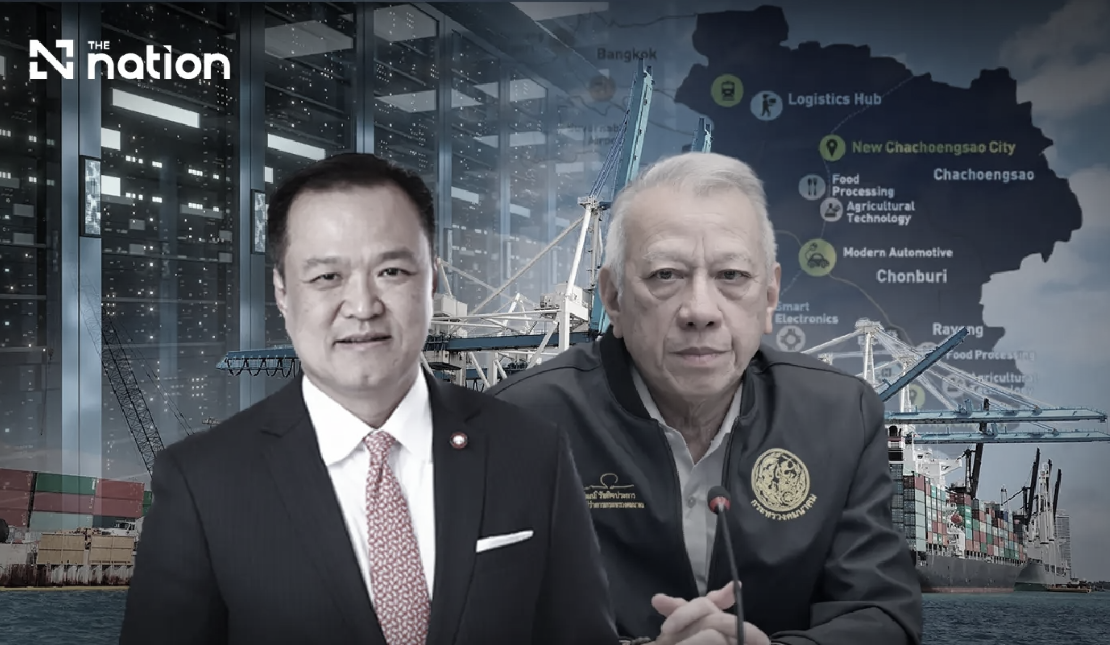
Prime Minister Anutin Charnvirakul has reassumed direct supervisory authority over Thailand's Eastern Economic Corridor, marking a significant strategic shift in how the government intends to market and develop the region to foreign investors. The decision, formalised through Cabinet orders signed on June 15, effectively strips Deputy Prime Minister and Transport Minister Phiphat Ratchakitprakarn of his previous portfolio overseeing the EEC Office and his chairmanship of the Eastern Economic Corridor Policy Committee. Government officials framed the move as a repositioning exercise rather than an internal political manoeuvre, intended to refocus the corridor as a comprehensive investment destination beyond its traditional industrial foundations.
The timing and mechanics of the leadership transition warrant careful examination for observers tracking Thai governance dynamics and regional economic strategy. Phiphat, a senior figure within the coalition government's Bhumjaithai party, reportedly learned of the restructuring only during the Cabinet session when the orders were formally acknowledged, rather than through advance consultation. Despite his public assertion that the decision did not represent a demotion or factional dispute, the abruptness of the announcement underscores the Prime Minister's determination to assert personal control over this economically significant portfolio. Government House sources characterised the arrangement as collaborative, claiming that Phiphat himself had flagged institutional friction between the EEC Office and the Board of Investment as justification for centralising oversight.
The substantive reorientation of the Eastern Economic Corridor reflects pragmatic acknowledgment of the region's physical constraints and emerging global investment trends. For years, the corridor functioned primarily as Thailand's hub for capital-intensive manufacturing and petrochemical operations, leveraging proximity to major ports and transport infrastructure. However, escalating electricity and water costs, combined with supply reliability concerns, have curtailed the economic viability of further heavy industrial expansion. Rather than persist with an increasingly strained development model, the government intends to position the EEC as a diversified investment zone capable of attracting sectors with different resource demands and higher-value-added potential.
Food security has emerged as the cornerstone of this repositioned investment narrative, reflecting both regional agricultural strengths and genuine global market dynamics. Thailand's eastern provinces possess significant livestock, fisheries, and horticultural assets that command growing international attention as geopolitical tensions and climate volatility disrupt global supply chains. The government strategy involves marketing the corridor not merely as a production base but as an integrated food security ecosystem—a concept likely to resonate powerfully with investment committees in food-importing nations across Asia and beyond. This pivot acknowledges that agricultural resilience and reliable supply networks have become strategic assets comparable to manufacturing capacity in the eyes of international corporations and governments alike.
The data centre component of the repositioned strategy reflects Thailand's recognition of digital infrastructure opportunities within regional and global technology expansion patterns. Data centres represent a fundamentally different investment class from traditional industry: they require enormous, consistent power supplies and water access for cooling, but generate relatively few direct employment opportunities and occupy modest physical footprints. The Energy Ministry's parallel initiative to establish a new electricity tariff category specifically for data centre operators—Type 9, charged at premium rates reflecting their intensive consumption—demonstrates coordinated governmental action to facilitate this transition. This pricing mechanism acknowledges that data centres should bear the full marginal cost of their exceptional infrastructure demands while remaining economically attractive to international operators seeking Asian operating bases.
The strategic implications of this reorientation extend beyond immediate investment attraction to reflect Thailand's positioning within regional and global economic hierarchies. By deliberately moving away from heavy industry towards food security and digital infrastructure, the government signals recognition that Thailand's future competitive advantage lies not in labour cost arbitrage or natural resource processing, but in geographic strategic positioning, regulatory stability, and integration into resilient supply chains. For neighbouring countries including Malaysia, this repositioning carries both competitive and collaborative dimensions—Thai success in attracting global food security investment might increase regional competition for agricultural and processing sector capital, whilst data centre development could create opportunities for cross-border digital infrastructure cooperation and integration.
The structural challenges that necessitated this strategic pivot merit particular attention for Malaysian policymakers and business observers. Thailand's eastern region has confronted a genuine supply constraint problem that reflects broader Southeast Asian infrastructural limitations. The shortage of reliable, affordable electricity and water—resources essential for both industrial production and emerging high-tech sectors—represents a shared regional vulnerability. Unlike energy-rich Indonesia or water-abundant Cambodia, Thailand must manage competing demand from established manufacturing bases whilst attempting to accommodate new sectors. This constraint-driven strategic adjustment suggests that regional economies face similar pressures to diversify away from resource-intensive models, making the Thai government's repositioning a potential harbinger of broader regional economic realignment.
The resolution of outstanding governance issues surrounding the Eastern Economic Corridor's development trajectory remains incomplete despite the leadership transition. The high-speed rail project linking Don Mueang, Suvarnabhumi, and U-Tapao airports has remained mired in contractual disputes, particularly regarding amendments to payment schedules that would shift from construction-before-payment arrangements to progressive reimbursement models. While government sources attribute Anutin's decision to retain the original contract structure to the Prime Minister's own risk assessment rather than Phiphat's advocacy, the opaque nature of this explanation suggests underlying tensions regarding major infrastructure commitments persist. The Disneyland development proposal referenced in official comments similarly illustrates how the EEC has accumulated speculative projects lacking rigorous feasibility analysis.
Anutin's personal assumption of EEC supervisory authority establishes him as the public face of Thailand's regional development agenda to international investors and potential partners. This positioning carries significant political and reputational dimensions—successful EEC repositioning under his leadership would constitute a major economic policy achievement, while prolonged underperformance or failure to attract anticipated food security and data centre investment would similarly reflect directly on his stewardship. The move simultaneously centralises accountability whilst concentrating authority in the Prime Minister's hands, a governance pattern consistent with the broader trajectory of Thai executive power consolidation during his tenure.
For regional observers and Malaysian stakeholders engaged with Thai economic developments, the EEC repositioning merits sustained attention as a case study in how Southeast Asian governments navigate resource constraints, global supply chain shifts, and technological transformation pressures. The government's pivot towards food security and data centre investment reflects genuine global trends whilst remaining grounded in Thailand's specific geographic and infrastructural circumstances. Whether Anutin's direct leadership proves sufficient to overcome institutional inertia, coordinate multi-agency implementation, and attract the calibre of international investment required remains an open question that will unfold across coming years. The Eastern Economic Corridor's evolution will substantially influence not merely Thailand's development trajectory but broader regional competition for investment, talent, and positioning within emerging global supply networks.