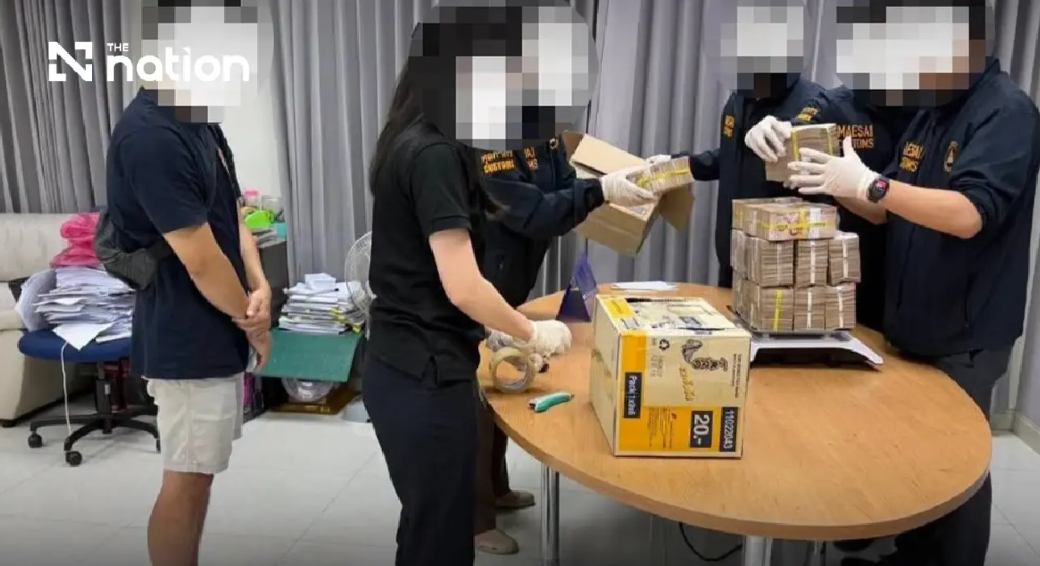
Customs officers working the outbound lane at Mae Sai's primary border checkpoint have uncovered one of the region's significant recent currency smuggling attempts, seizing 23,023,000 baht concealed within food packaging bound for Myanmar. The discovery on 23 June 2026 highlights the persistent vulnerability of Thailand's porous northern borders to money laundering and illicit financial flows, even as authorities intensify screening procedures at major crossing points. The vehicle, registered in Myanmar and driven by a 31-year-old Myanmar national, had already cleared immigration formalities when inspectors conducting routine cargo examination opened two cardboard boxes ostensibly containing fish-strip and potato products, revealing bundles of Thai 1,000-baht banknotes packed throughout.
The Mae Sai checkpoint, positioned merely 20 metres from the actual border line separating Thailand and Myanmar, serves as the final filtration point for outbound traffic before vehicles cross into Tachileik. This strategic location gives customs officials their last opportunity to intercept contraband and undeclared assets, yet the sheer volume of daily cross-border movement—comprising thousands of vehicles, traders, and workers—creates enforcement challenges. The driver's successful passage through immigration screening before customs inspection discovered the concealed currency demonstrates that border security protocols operate through distinct, sometimes disconnected procedures, potentially creating gaps that smugglers routinely exploit.
The concealment method employed in this case reflects evolving smuggling tactics designed to evade detection systems. Rather than attempting to carry cash in luggage or concealed compartments, perpetrators increasingly embed currency within legitimate commercial cargo, banking on inspectors' tendency to prioritise visible threats over the tedious examination of every parcel. The labelling of boxes as perishable food items adds another layer of misdirection, as food products typically receive cursory review to prevent spoilage delays. That officers nevertheless conducted the thorough inspection necessary to discover the cash suggests either intelligence-based targeting of this particular vehicle or a heightened alert status following previous smuggling incidents.
The regulatory framework under which authorities charged the driver encompasses multiple statutes reflecting the seriousness with which Thailand treats currency violations. The primary allegations reference Sections 242 and 252 of the Customs Act B.E. 2560, which govern unauthorized currency export and false customs declarations respectively. Prosecutors have additionally invoked Section 80 of the Criminal Code alongside Sections 8 and 8 bis of the Exchange Control Act B.E. 2485, an antiquated but still-enforceable statute governing foreign exchange movements. This layering of charges creates significant legal exposure, potentially resulting in substantial fines and imprisonment, thereby serving as both punishment and deterrent.
The absence of authorization from exchange-control officers and the complete non-declaration to customs authorities constitute separate violations compounding the driver's predicament. Thailand's exchange control regime, inherited from an earlier era of capital controls, technically prohibits taking more than limited quantities of baht across borders without specific approval. While many regional economies have liberalized such restrictions in recognition of modern financial realities, Thailand maintains these frameworks ostensibly to combat money laundering and illicit financial flows. The 23-million-baht seizure represents approximately US$700,000 at current exchange rates, a sum substantial enough to warrant serious investigation into its source and intended destination.
For Malaysian readers and Southeast Asian observers, this incident underscores the region's ongoing vulnerability to cash-based smuggling networks that exploit inconsistent regulatory frameworks and limited cross-border coordination. While Malaysia, Singapore, and Thailand have each strengthened anti-money laundering protocols in recent years, disparities in enforcement capacity and legal definitions create opportunities for sophisticated smuggling operations. The sophistication evident in this case—using legitimate-appearing commercial packaging and a hired driver—suggests organized networks rather than individual smuggling attempts, raising questions about the source of funds and their intended use across the border.
The political economy surrounding baht smuggling reflects deeper currents affecting the broader region. Pressure on Myanmar's currency, combined with restrictive banking relationships affecting Myanmar entities, creates incentive structures encouraging physical cash movement. Thai merchants and traders maintaining operations across the border may accumulate baht proceeds they cannot easily exchange or repatriate through formal channels, leading them toward informal smuggling networks. Similarly, individuals and entities in Myanmar seeking Thai currency for commerce or speculation may contract with smugglers to acquire baht outside official exchange mechanisms, paying premiums that justify the criminal risks involved.
Border regions throughout Southeast Asia increasingly resemble contested zones where state authority competes with parallel smuggling economies operating sophisticated logistics networks. The Mae Sai checkpoint, despite being a primary crossing, handles only a fraction of actual border movement. Unpaved roads, river crossings, and mountain passes throughout the Chiang Rai-Myanmar frontier enable unregulated movement of goods and currency outside official channels. Addressing such flows requires not merely interdiction at formal checkpoints but genuine regional cooperation on financial intelligence, currency tracking, and coordinated enforcement—cooperation that remains incomplete despite ASEAN-level discussions.
The arrest and detention of the 31-year-old driver initiated a legal process whose outcome remains uncertain. In practice, such cases often involve negotiated resolutions whereby drivers face lesser charges in exchange for cooperation identifying their employers and smuggling networks. Whether Thai authorities prioritize prosecution of low-level operatives or pressure the driver for intelligence regarding the smuggling organization remains to be determined. The seized currency itself will likely remain in government custody pending trial completion, though Thailand's customs and judicial procedures sometimes result in extended administrative holds.
Looking forward, this seizure exemplifies why Thailand and its neighbours require comprehensive approaches transcending border security alone. Strengthening financial intelligence sharing, harmonizing exchange control regulations, and addressing underlying economic incentives driving smuggling would achieve more lasting results than interdictions at checkpoints. For Malaysian stakeholders with commercial interests across Thailand-Myanmar borders, such incidents underscore the importance of ensuring their operations maintain complete documentation and proper exchange authorization, protecting themselves against becoming inadvertent participants in currency smuggling investigations.

