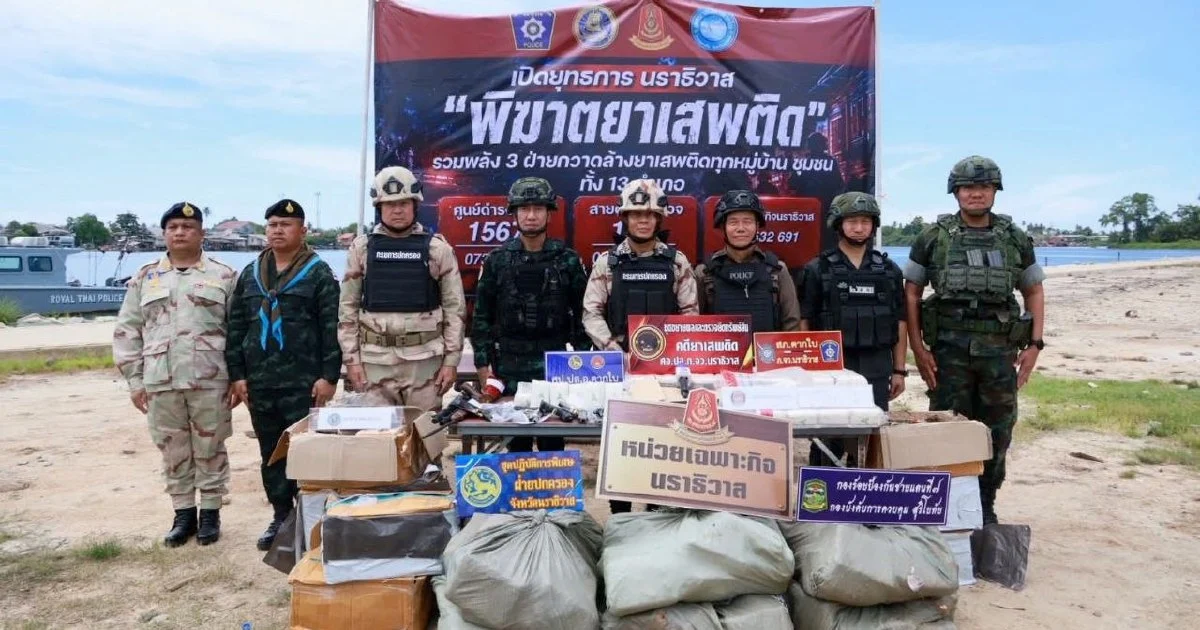
Thai law enforcement has achieved a significant breakthrough against transnational drug trafficking, arresting 233 individuals suspected of operating within organized smuggling syndicates during an intensive month-long operation centred on Narathiwat province. The scale of this enforcement action underscores the gravity of drug trafficking networks operating across the Thailand-Malaysia border region, where criminal organizations exploit porous boundaries and established smuggling routes to move contraband between countries.
Investigations into the arrested suspects have revealed troubling evidence of cross-border coordination with Malaysian traffickers, suggesting a sophisticated operational structure linking supply chains across both nations. This partnership model reflects how major drug syndicates increasingly operate as international enterprises, with specialized roles distributed across territorial boundaries. Thai authorities believe some of those detained possess direct business relationships with Malaysian-based traffickers who facilitate distribution networks and coordinate the movement of narcotics into and through Malaysian territory.
The operation represents part of Thailand's broader strategy to combat drug trafficking in its southern border provinces, which have historically served as transit zones for illicit substances moving between production centres in the Golden Triangle region and demand markets throughout Southeast Asia. Narathiwat, situated directly along the Malaysian border, occupies a particularly critical position in these trafficking networks. The province's geography, coupled with established smuggling infrastructure and population connections spanning the border, has made it an attractive operational base for criminal organizations seeking to exploit regional drug markets.
For Malaysian authorities and policymakers, this Thai enforcement action carries significant implications. The documented connections between arrested Thai suspects and Malaysian counterparts suggest that drug trafficking infrastructure within Malaysia extends beyond domestic criminal organizations to include international partnerships with foreign syndicates. This transnational dimension complicates Malaysia's own drug control efforts, as interdiction must account not only for domestic production and distribution but also for international trafficking operations that view Malaysian territory as both a transit corridor and a final market.
The method by which these Thai-Malaysian connections operate reveals the sophistication of contemporary drug trafficking enterprises. Rather than operating as chaotic or loosely affiliated groups, evidence indicates these organizations maintain structured relationships characterized by defined roles, regular communication channels, and established financial arrangements. Thai suspects arrested during this operation likely held specific positions within larger networks, whether as local procurement agents, transport coordinators, or distribution nodes managing Malaysian-bound shipments.
From a regional security perspective, the arrest of 233 individuals represents a substantial disruption to trafficking operations but does not necessarily dismantle the underlying infrastructure that enables such networks to function. Criminal organizations typically operate with redundancy built into their structures, meaning the removal of multiple operational levels still permits business continuity through alternative personnel and routes. This reality suggests that enforcement actions, while important for disrupting immediate criminal activity, must be coupled with long-term intelligence work targeting the organizational leadership and financial systems that sustain these enterprises.
The timing and scale of Thailand's crackdown may reflect intensified international pressure on Southeast Asian nations to demonstrate commitment to drug control objectives. Regional cooperation frameworks have increasingly emphasized intelligence sharing and coordinated enforcement operations against transnational trafficking networks. This Thai operation, by specifically highlighting Malaysian criminal connections, signals to both Malaysian and international audiences that Thailand recognizes and is acting upon the cross-border dimensions of regional drug problems.
For Malaysian law enforcement agencies, the Thai operation provides valuable intelligence regarding the structure and operational methods of trafficking syndicates that interface with Malaysian criminal networks. Information gathered from Thai interrogations about Malaysian partners, smuggling routes, money laundering channels, and customer bases can inform Malaysian investigative priorities and strengthen domestic interdiction efforts. Enhanced cooperation with Thai authorities in sharing this intelligence represents a significant opportunity to strengthen Malaysia's defensive capabilities against organized drug trafficking.
The documented Malaysian connections also raise questions about the capacity and resources available to Malaysian drug enforcement agencies. If sophisticated international trafficking networks have successfully established operational partnerships within Malaysia, this suggests either that Malaysian criminal organizations possess sufficient organizational capability to attract foreign partners, or that Malaysian territory has become sufficiently accessible to international traffickers that they can operate without relying entirely on local proxies. Either scenario points to challenges within Malaysia's enforcement infrastructure that warrant policy attention.
Beyond immediate law enforcement implications, this case illustrates broader regional challenges in combating drug trafficking in the age of globalized supply chains. The narcotics market operates as an international system where production occurs in certain jurisdictions, processing and refinement in others, transit through multiple territories, and final consumption across diverse markets. Malaysia's geographic position and economic development make it simultaneously a transit zone and a consumption market, complicating the policy calculus surrounding drug enforcement resource allocation.
Moving forward, the Thai arrests create both opportunities and obligations for enhanced Malaysia-Thailand cooperation. Bilateral intelligence sharing mechanisms should be strengthened to ensure that information about arrested individuals, their methods, and their Malaysian contacts flows efficiently between enforcement agencies. Simultaneously, Malaysian authorities must prioritize investigation of the Malaysian-side connections identified by Thai investigators to ensure that criminal networks identified through Thai enforcement are disrupted before they can reconstitute their operations.

