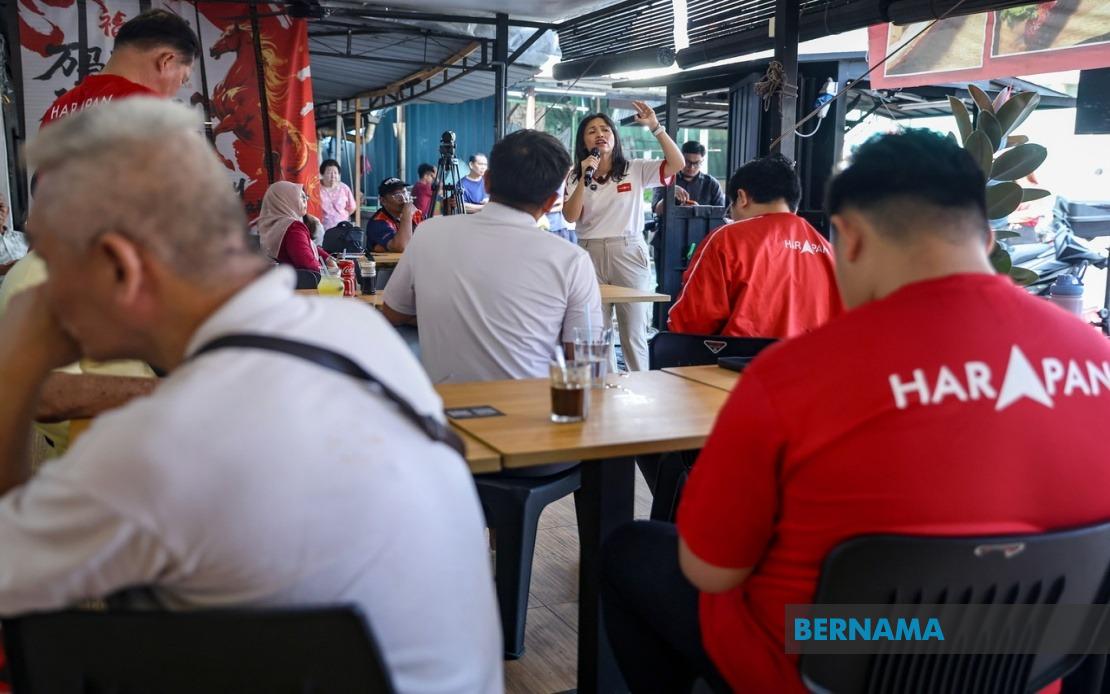
The Johor state election campaign has become embroiled in controversy over alleged misuse of a government-organised vocational education event for political campaigning, with opposition figures demanding accountability from the state administration. Johor DAP chairman and Deputy Communications Minister Teo Nie Ching has called on Menteri Besar Datuk Onn Hafiz Ghazi to publicly explain circumstances surrounding the Johor MARA TVET Roadshow, held on July 4 at the Inland Revenue Board Hall in Kluang, where the party claims students were pressured to attend and subsequently exposed to campaign messaging.
The controversy centres on allegations that technical and vocational education training students received directives to participate in the event under threat of absenteeism penalties, only to discover the programme had been transformed into a platform to solicit electoral support for the Barisan Nasional candidate. Teo raised these concerns during a public forum in Kulai, indicating that the DAP had collected formal documentation substantiating the claims, including programme schedules, attendance directives, and video recordings purporting to show the Menteri Besar making explicit references to the BN candidate's election number while addressing the gathered students.
The distinction between legitimate government activity and partisan political campaigning forms the crux of the opposition's complaint. Teo acknowledged that senior government officials attending official functions is entirely appropriate, but she questioned the appropriateness of using such platforms to explicitly promote electoral candidates. She articulated a central tension facing Malaysia's electoral framework: whether a facility managed by a government agency can legitimately host political campaign activities, and whether the blending of administrative and campaign functions constitutes a breach of electoral guidelines. The complaint reflects longstanding concerns about the potential advantages incumbent administrations hold when they control both governmental institutions and campaign resources.
What distinguishes this complaint from routine election-period accusations is the involvement of students, a demographic that cannot easily decline participation without facing potential institutional consequences. Teo deliberately shifted her framing from partisan politics to parental concern, emphasising that this matter transcends typical electoral disputes because it involves young people in an educational context facing compulsory attendance requirements. She underscored that regardless of one's political affiliation, the principle that students should not be conscripted into partisan political activities represents a fundamental governance standard that deserves protection across all administrations.
The incident also highlights the peculiar challenges facing Malaysia's semi-authoritarian political framework, where the ruling coalition controls most state governments and possesses substantial institutional resources. This structural advantage means that opposition parties must continuously monitor whether government apparatus and functions are being deployed for electoral purposes. The collection of documentary evidence by DAP—programme itineraries, written instructions to attend, and video recordings—suggests a deliberate effort to create a public record that could support formal complaints to the Election Commission should opposition candidates decide to pursue that path.
Teo's decision to emphasise her position as Deputy Communications Minister, combined with references to documentary evidence and video recordings, signals that this complaint could escalate beyond the immediate campaign context. The involvement of senior national opposition figures, including Tan Sri Lim Kit Siang, alongside local candidates such as Wong Bor Yang for the Senai seat, indicates that this issue has captured the attention of Pakatan Harapan's senior leadership. This elevation suggests the opposition views the matter as sufficiently significant to become part of a broader narrative about governance standards and electoral propriety.
The timing coincides with intensifying competition in the Johor state election, where 172 candidates are contesting 56 seats, with early voting having commenced and election day scheduled for July 11. The state election carries particular significance across Southeast Asia given Johor's position as Malaysia's most populous state and its traditional role as an electoral bellwether. The outcome will substantially influence whether Barisan Nasional can sustain dominance in a state where it has governed continuously since independence, or whether Pakatan Harapan can expand its footprint in a region where it has struggled to build consistent support.
Lim, the former DAP secretary-general and prominent opposition figure, used the occasion to advance a broader thematic argument rather than simply criticise the specific incident. He called upon Johor voters to reject what he characterised as racial politics and instead consolidate support behind his vision of a united Malaysian future grounded in equality, freedom, prosperity, and respect for human rights. This rhetorical approach attempts to connect the specific complaint about the TVET event to a larger argument about the direction Malaysia should take, positioning the election not merely as a contest between competing administrations but as a choice between fundamentally different visions of national governance.
Simultaneously, Teo addressed broader tensions between state and federal governments regarding responsibility for policy implementation and public criticism. She contested what she characterised as selective accountability, where state governments claim credit for popular federal policies while blaming the central government when policies prove unpopular. This counter-attack suggests that the opposition views Onn Hafiz's recent calls for reviewing federal government policies as politically motivated criticism that misrepresents the Cabinet's role in approving major policy initiatives. Her argument highlights the complex interplay between state and federal authority in Malaysia's federal system and the potential for political actors to exploit these divisions for electoral advantage.
The incident also demonstrates how Malaysian opposition parties have become increasingly sophisticated in documenting and publicising alleged governmental improprieties. Rather than relying solely on oral allegations, the DAP has reportedly assembled video evidence, written directives, and programme documentation that could provide material for formal complaints to the Election Commission. This documentation-focused approach potentially strengthens whatever complaint might subsequently be filed and creates a public record that journalists and observers can independently verify, moving beyond the typical claim-and-counter-claim pattern that often characterises Malaysian political disputes.
The broader context includes persistent concerns about electoral integrity and fairness in Malaysian elections, where government resources and administrative machinery have traditionally favoured incumbent coalitions. International observers and domestic civil society organisations have repeatedly raised questions about the potential for government institutions to be deployed for partisan purposes. This specific complaint, if sustained through formal investigation, could contribute to an emerging body of evidence about the mechanics through which such institutional advantages manifest during electoral campaigns.
As the Johor election enters its final campaign phase, the controversy over the TVET event illustrates the granular nature of modern electoral competition in Malaysia. Rather than focusing exclusively on ideological differences or major policy platforms, parties increasingly scrutinise specific incidents where they believe institutional rules have been breached. The Election Commission's response to any formal complaint filed by opposition candidates will provide an indication of how seriously the electoral authority treats allegations involving the compulsory participation of students in government-organised events subsequently repurposed for campaign activities. This incident will likely become a reference point in broader discussions about electoral standards and institutional propriety in Malaysian politics.

