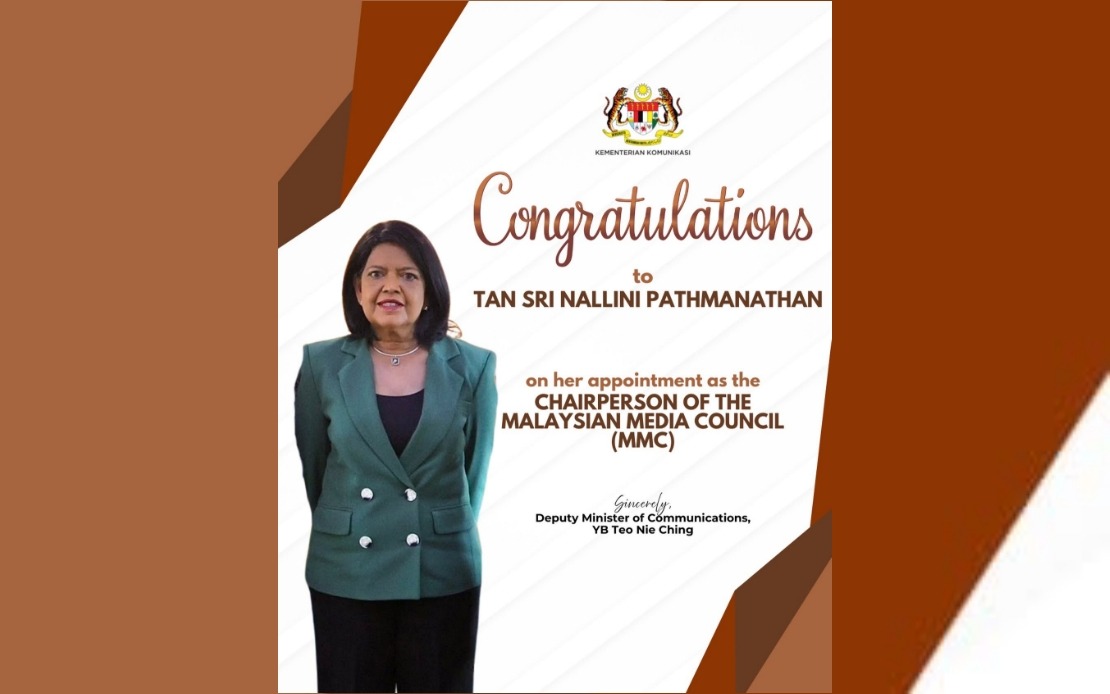
Deputy Communications Minister Teo Nie Ching has thrown her support behind Tan Sri Nallini Pathmanathan's appointment as chairperson of the Malaysian Media Council, emphasising the former Federal Court judge's demonstrated commitment to protecting press freedom and advancing constitutional rights through her judicial work. Teo's endorsement comes as the newly established self-regulatory body, created under the Malaysian Media Council Act 2025, begins operations under Nallini's leadership following her unanimous appointment by the MMC Board on May 26.
In articulating her confidence in Nallini's suitability for the role, Teo highlighted specific instances from the judge's tenure on the bench that she believes signal an alignment with principles essential to media regulation. She described Nallini as a jurist of the highest calibre, one who throughout her career demonstrated not merely technical legal expertise but also a humanitarian orientation toward judicial interpretation. This combination, Teo suggested, positions her well to oversee an institution tasked with balancing industry interests with public accountability.
One case Teo pointed to involved a contentious citizenship matter in which Nallini dissented from a 4-3 majority decision. The case concerned citizenship rights for a child born to a Malaysian father and foreign mother, an issue that turned on the interpretation of constitutional provisions governing citizenship. Rather than applying a narrow, literalist reading of the relevant statutes, Nallini's dissenting opinion advocated for what legal scholars term a purposive approach—one that prioritises the underlying intent and humanitarian dimensions of constitutional law. This interpretive philosophy, Teo argued, demonstrates the kind of forward-thinking judicial temperament needed to navigate the complexities of modern media regulation.
Equally significant in Teo's assessment was Nallini's dissenting judgment in a landmark case involving an online news portal. In that matter, the central legal question concerned whether the portal operator bore liability for comments posted by subscribers on its platform. Nallini's ruling rejected the notion that the portal should be held accountable for user-generated content, a position that has profound implications for digital media operators and the viability of online news platforms. Her stance reflected a nuanced understanding of how internet-era technologies function and the potential chilling effect that sweeping liability rules could impose on editorial operations and, by extension, on the broader right to publish.
The appointment of Nallini to lead the MMC represents a symbolic moment for Malaysia's media landscape, as the council itself embodies a significant shift in governance philosophy. For five decades, stakeholders in the journalism and publishing sectors advocated, petitioned, and engaged in policy dialogues for the establishment of a self-regulatory mechanism. The creation of the MMC under the 2025 legislation marks the culmination of these sustained efforts. Teo underscored that this achievement reflects a hard-won consensus that self-regulation, rather than state-directed oversight, offers the most credible pathway for maintaining media integrity while preserving editorial independence.
Teo's public backing of the appointment also signals official commitment to the principle that the council must operate as a genuinely independent entity insulated from government pressure. She articulated a philosophical position often advanced by press freedom advocates: that journalists occupy a unique constitutional space as what is often called the fourth estate, distinct from the executive, legislature, and judiciary. Because of this role in democratic accountability and informed citizenship, any appearance of state control risks delegitimising media scrutiny and public interest journalism. Self-regulation, from this perspective, becomes not merely a procedural choice but a structural necessity.
The deputy minister further developed this argument by acknowledging the inherent tension between regulation and freedom in the media context. Any system of oversight, whether state-administered or industry-led, carries the potential for abuse. However, Teo contended that industry self-regulation mitigates this risk by placing governance authority in the hands of practitioners with professional stakes in maintaining journalistic standards and public credibility. When the regulated parties also constitute the regulating body, incentive structures theoretically align toward upholding standards that enhance rather than undermine sector legitimacy and public trust.
For Malaysian readers and Southeast Asian observers, Nallini's appointment carries particular weight given the region's mixed record on press freedom and judicial independence. Several regional democracies have grappled with tensions between government prerogatives and media autonomy, with courts frequently called upon to adjudicate disputes that pit national security or public order concerns against the right to publish. Nallini's track record of judicial reasoning that accommodates complexity, resists simplistic majoritarianism, and prioritises fundamental rights suggests an approach to MMC leadership that may prove instructive for other Southeast Asian jurisdictions considering media governance models.
The institutional context surrounding the MMC's establishment also warrants attention. Self-regulatory bodies in the media sector have operated in various democracies with varying degrees of success. Some have achieved substantial industry buy-in and public credibility; others have struggled with conflicts of interest or insufficient enforcement mechanisms. The success of Malaysia's council will likely depend on factors including industry participation, transparency in disciplinary processes, remedy mechanisms for complainants, and the council's ability to maintain credibility amid pressure from political or commercial interests. Nallini's judicial background and her demonstrated openness to rights-protective interpretations of law may provide important institutional anchoring.
Looking forward, observers will watch how Nallini navigates the inherent tensions between self-regulation and accountability. The council must establish standards and mechanisms for addressing complaints about journalistic conduct without either becoming a toothless advisory body or morphing into a tool for suppressing legitimate editorial judgment. Her appointments of other council members, the adoption of procedural rules, and the handling of early disciplinary cases will signal whether the MMC is likely to fulfil its mandate as a credible, independent arbiter of media ethics. Teo's confidence in Nallini's ability to guide this emerging institution reflects broader official faith that judicial temperament and rights-conscious reasoning can successfully bridge the gap between industry self-interest and public interest in maintaining media standards.
The establishment of the Malaysian Media Council under Nallini's leadership also positions Malaysia within broader global conversations about appropriate models for media governance in an era of rapid technological change and declining trust in institutions. As digital disruption fragments audiences and traditional business models for news organisations face existential pressure, questions about who regulates the media and according to what standards become increasingly urgent. Whether the MMC can emerge as a model for effective self-regulation that other democracies might learn from, or whether it will encounter the pitfalls that have challenged similar bodies elsewhere, remains to be determined. Teo's endorsement of Nallini's appointment signals official optimism that a judge with her record of principled, humanity-centred interpretation can lead the council toward its best possible iteration.