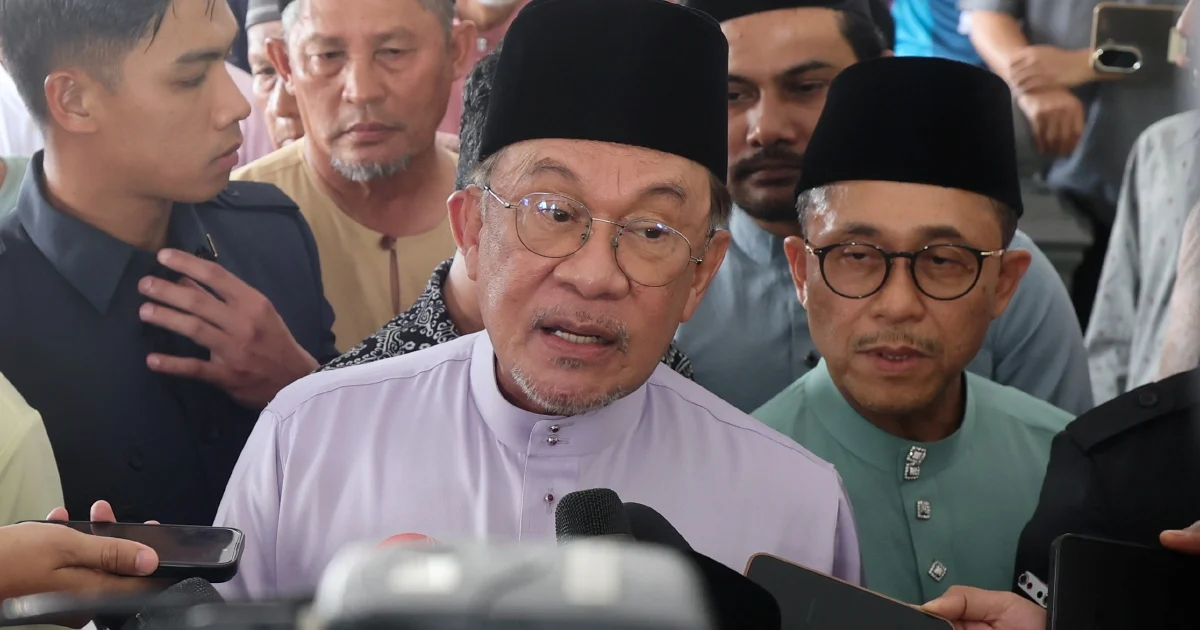
Prime Minister Datuk Seri Anwar Ibrahim has moved to calm concerns over Malaysia's plans to strengthen its Syariah court system, declaring that such initiatives will preserve the constitutional protections that safeguard non-Muslims' freedom of religious practice. The statement comes as the government pursues structural improvements to Islamic judicial institutions, a priority that has drawn scrutiny from minority religious communities seeking reassurance that their fundamental freedoms remain inviolate.
The elevation of Syariah court status forms part of a broader agenda to enhance Islamic administrative and judicial institutions in Malaysia, reflecting the government's commitment to strengthening Islamic governance frameworks. These efforts encompass proposals to expand the institutional capacity and jurisdictional clarity of Syariah courts, which handle matters of family law, inheritance, and religious discipline for Muslims under Malaysia's federal structure. The push to modernise and elevate these institutions has generated discussion across diverse communities about the appropriate balance between religious autonomy and secular constitutional guarantees.
Anwar's reassurance directly addresses apprehensions held by Christian, Buddhist, Hindu, and other minority religious communities that expanded Syariah court authority might indirectly restrict their ability to practise faith according to their respective doctrines. In Malaysia's plural society, where Muslims comprise approximately 70% of the population, the intersection of religious law and secular constitutional frameworks requires careful management. The Prime Minister's clarification signals an intent to pursue institutional reform without diluting the constitutional architecture that has historically enabled multiple faith communities to coexist.
The Malaysian Constitution contains explicit protections for religious freedom under Article 11, which grants every person the right to profess, practise, and propagate religion. This constitutional guarantee applies equally to all faiths and restricts state authority from prohibiting the free exercise of religion. Anwar's statement implicitly reaffirms that government actions respecting Syariah courts will operate within these established constitutional boundaries rather than seeking to expand state religious authority beyond Islamic jurisprudence.
The government's efforts to strengthen Syariah institutions reflect long-standing proposals within Malaysian legal circles to clarify jurisdictional boundaries and improve administrative efficiency. Advocates for reform argue that enhanced Syariah court procedures could reduce backlog, improve access to justice for Muslim litigants, and modernise Islamic legal practice to meet contemporary challenges including digital commerce and family arrangements. Such improvements potentially benefit Muslim citizens while remaining compartmentalised within religious law domains that do not directly affect non-Muslim communities.
However, the relationship between secular and Islamic law in Malaysia remains constitutionally complex. Certain provisions allow state legislatures to determine the scope of Syariah court jurisdiction within their territories, creating variations across Malaysia's thirteen states. Some jurisdictions have attempted to expand Syariah legal reach into areas touching public conduct and expression, occasionally generating constitutional tensions with civil rights guarantees. Anwar's affirmation that reforms will respect non-Muslim rights represents an assurance that the federal government will maintain these constitutional boundaries amid institutional strengthening.
The timing of the Prime Minister's statement reflects heightened sensitivity regarding religious and minority rights in Malaysian political discourse. Recent years have witnessed public debates over religious enforcement, apostasy law, and the scope of Islamic authority in secular contexts. These conversations have sometimes fractured political coalitions and mobilised civil society organisations concerned with maintaining constitutional protections. By explicitly affirming that Syariah court elevation poses no threat to minority religious freedom, Anwar seeks to position the government as committed both to Islamic institutional development and constitutional pluralism.
Regional observers note that Malaysia's approach to integrating Islamic law within a secular constitutional framework differs significantly from approaches adopted in neighbouring countries such as Brunei, which applies Islamic law more comprehensively. Malaysia's bifurcated system, where Islamic law governs personal matters for Muslims while civil law addresses other domains, has enabled decades of religious plurality despite tensions. This distinctive arrangement reflects constitutional compromises negotiated during Malaysia's independence era, which balanced Muslim majority interests with guarantees for minority communities.
The government's institutional reforms must navigate considerable complexity in practice. While Syariah courts derive authority exclusively from Islamic jurisprudence, Malaysian courts have occasionally intervened to prevent Syariah judgments from infringing constitutional guarantees of fundamental liberties. Cases involving apostasy, religious conversion, and freedom of expression have seen civil courts assert constitutional supremacy where Syariah proceedings threatened to violate protected rights. Anwar's statement appears calculated to assure courts, minority communities, and international observers that institutional elevation respects these established judicial hierarchies.
For Malaysian businesses and communities with non-Muslim constituencies, the clarification carries practical significance. Religious minority groups have expressed concerns that expanded Syariah institutions might create regulatory burdens or compliance complexities affecting commerce, education, or social provision in states where Islamic law jurisdiction expands. The Prime Minister's reassurance suggests that any reforms will confine themselves to matters historically within Syariah competence rather than encroaching into secular economic or civil administration affecting diverse populations.
The government's balancing act reflects Malaysia's distinctive position as a Muslim-majority nation committed constitutionally to protecting minority rights. This commitment distinguishes Malaysia's governance model within the broader Islamic world and influences its standing within regional forums addressing human rights and religious freedom. Anwar's statement therefore carries implications extending beyond domestic constitutional architecture to Malaysia's international human rights obligations and regional reputation.
Moving forward, the substance of Syariah court reforms will ultimately determine whether institutional elevation substantively preserves non-Muslim protections or merely provides rhetorical assurance. Legal and constitutional scholars will likely scrutinise specific legislative proposals and court procedures to assess alignment with Anwar's pledge. The effectiveness of the Prime Minister's reassurance ultimately depends on transparent governance processes, consistent judicial practice, and the government's demonstrated commitment to maintaining constitutional boundaries that have historically enabled Malaysia's religious pluralism to function.

