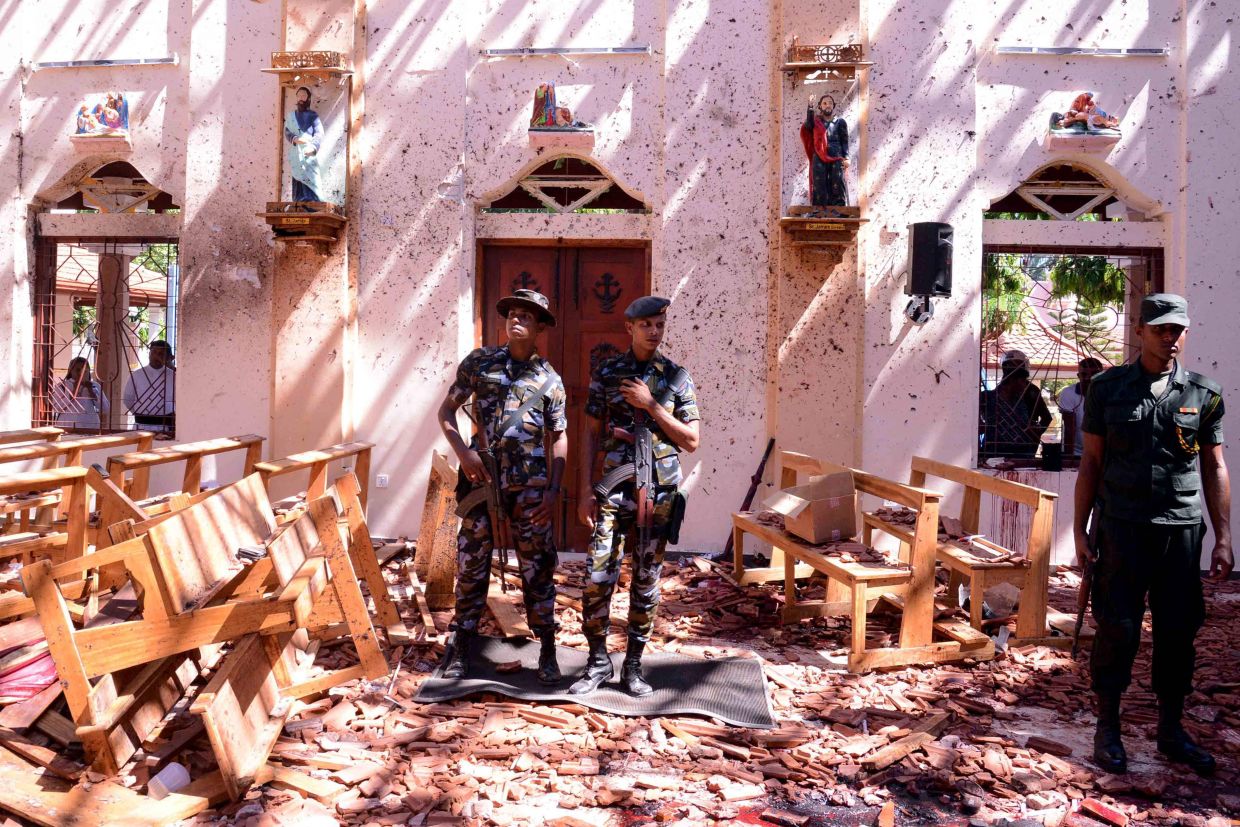
Suresh Sallay, a retired major general with an impressive track record addressing global security forums, has become the central figure in one of South Asia's most controversial and unresolved security crises. The former Sri Lankan spy chief, who lectured the Pentagon and the United Nations on counterterrorism and the dangers of online radicalisation, found himself behind bars in February this year after being arrested under anti-terrorism legislation. The government has levelled an extraordinary accusation against him: that he strategically masterminded and directed the Easter bombings of April 21, 2019—the deadliest terrorist attack on Sri Lankan civilians in modern history.
The Easter Sunday coordinated strikes left 279 people dead and more than 500 wounded in one of Asia's most shocking acts of violence. The attacks targeted three luxury hotels and three churches across Colombo, carried out by seven Sunni Muslim suicide bombers reportedly inspired by the Islamic State group. The death toll included 45 foreign nationals—tourists and visitors from Australia, Britain, China, Denmark, the Netherlands, Japan and the United States—making it an international tragedy that drew global attention and condemnation. Yet more than five years after the bombings, the official explanation has undergone a seismic shift, transforming from a straightforward militant attack into an alleged state conspiracy.
What makes Sallay's case particularly significant is how it exposes deep fractures in Sri Lanka's security establishment and raises uncomfortable questions about the relationship between state intelligence agencies and the very militant networks they claim to combat. When the attacks first occurred, the narrative was clear: Islamic State sympathisers had struck in coordinated fashion, taking advantage of intelligence gaps and security lapses. However, investigations have since uncovered troubling connections between the bombers and at least two state intelligence agencies, suggesting a far more complex picture than initially acknowledged. These revelations have prompted investigators and critics alike to reexamine the fundamental premise of how and why the attacks succeeded.
Public Security Minister Ananda Wijepala provided the most explicit government accusation to date when he told parliament in June that Sallay was the "mastermind" who "conspired with and strategically directed Islamic extremists until they carried out the attacks." According to Wijepala's account, just three weeks before the bombings, Sallay met with Muslim men to gather details about potential attack locations—a detail that, if verified, would fundamentally implicate the state's intelligence apparatus in the planning stages. This testimony represents a dramatic escalation in official blame, moving the focus from external terrorist threats to alleged internal conspirators within the security hierarchy itself.
The theory now circulating in security circles and among investigators suggests a darker purpose behind the attacks. According to this narrative, the violence was deliberately cultivated and permitted to unfold as part of a broader political strategy. The alleged plot was designed to create conditions of chaos and fear that would position a strong military leader—specifically Gotabaya Rajapaksa, who won the 2019 presidential election—as the only capable administrator able to restore order and crush Islamist militancy. Drawing parallels with Rajapaksa's previous military success against Tamil separatists during the civil war, the theory proposes that orchestrating and allowing the bombings served a calculated political purpose. British broadcaster Channel 4 reported in 2023 that a whistleblower alleged precisely this: that the Easter attacks were permitted to occur to help Rajapaksa secure electoral victory on a hardline security platform.
Sallay's own background makes the accusations against him particularly striking and incongruous. He is a Muslim married to a Buddhist woman, reflecting the religious pluralism that characterises modern Sri Lanka where Buddhists comprise nearly 70 per cent of the 22 million population, alongside significant Hindu (12 per cent), Muslim (10 per cent) and Christian (7 per cent) communities. His Catholic mother has made public appeals to the Vatican seeking his release, underscoring the family's desperation and the complicated personal dimensions of the case. Professionally, Sallay had cultivated an impressive international profile, serving in Sri Lankan diplomatic missions in France and Malaysia, studying at India's prestigious National Defence College and University of Madras, and attending Britain's University of Bradford. These credentials positioned him as a sophisticated security thinker engaged with global counterterrorism discourse.
Indeed, Sallay's public statements on security matters reveal a man seemingly devoted to combating extremism rather than enabling it. The Colombo Institute of National Security Studies records that he delivered a 2003 speech to the Pentagon titled "Suicide Terrorism and its Impact," establishing himself early as a serious analyst of militant violence. More recently, in 2023, he spoke at United Nations headquarters about terrorism as "one of the greatest challenges" facing international security, noting how social media and digital platforms amplified radicalisation. His articulate warnings about the dangers of online extremism stand in jarring contrast to accusations that he orchestrated a real-world terrorist massacre.
Yet Sallay's career also demonstrates how closely intertwined security officials became with the Rajapaksa political dynasty. He prospered significantly under their rule, eventually becoming the first military officer to head the State Intelligence Service after Gotabaya Rajapaksa's 2019 electoral victory. This appointment itself raises questions about the relationship between intelligence apparatus and political leadership. Moreover, Sallay's role in detaining Muslim human rights lawyer Hejaaz Hizbullah in 2020 on charges of being the Easter bombing "mastermind" adds another troubling layer. Hizbullah was released after 22 months when authorities failed to produce credible evidence, suggesting a pattern of suspect detention practices and potentially vindictive prosecutions within Sri Lanka's security establishment.
The historical context of Sri Lanka's use of militant proxies further complicates the narrative. Previous Rajapaksa administrations openly acknowledged funding jihadist networks during the 1983-2009 civil war, officially claiming these groups gathered intelligence on Tamil separatists. However, officials insisted the militants subsequently betrayed their state handlers and independently carried out the Easter attacks. This historical precedent—where the government explicitly cultivated dangerous extremist networks—provides uncomfortable context for allegations that state actors may have once again manipulated or directed militant violence for political purposes.
Sallay remains unarrested without formal charges as of his last scheduled court hearing in July, continuing to deny all allegations of wrongdoing. The case presents Sri Lanka with a profound institutional and moral challenge. If credible evidence emerges that state intelligence agencies either facilitated, directed, or knowingly permitted the Easter bombings to advance political objectives, it would represent not merely a security failure but a catastrophic breach of the state's fundamental responsibility to protect its citizens. Conversely, if the accusations against Sallay prove baseless, they would demonstrate how a nation traumatised by mass violence can weaponise its justice system against inconvenient figures from previous administrations.
For regional observers in Malaysia and across Southeast Asia, the case illuminates broader vulnerabilities in how security establishments can become politicised and how intelligence agencies might be captured by particular political factions. Sri Lanka's experience suggests that robust oversight mechanisms, transparent investigative processes, and genuine judicial independence become essential safeguards against such abuses. The Easter bombing investigation, rather than providing closure and accountability, has instead opened uncomfortable questions about the boundaries between legitimate security operations and state-orchestrated violence. Until those questions receive thorough and credible answers, the tragedy of April 21, 2019, will remain not merely a terrorist attack but a symbol of institutional crisis within Sri Lanka's security apparatus.

