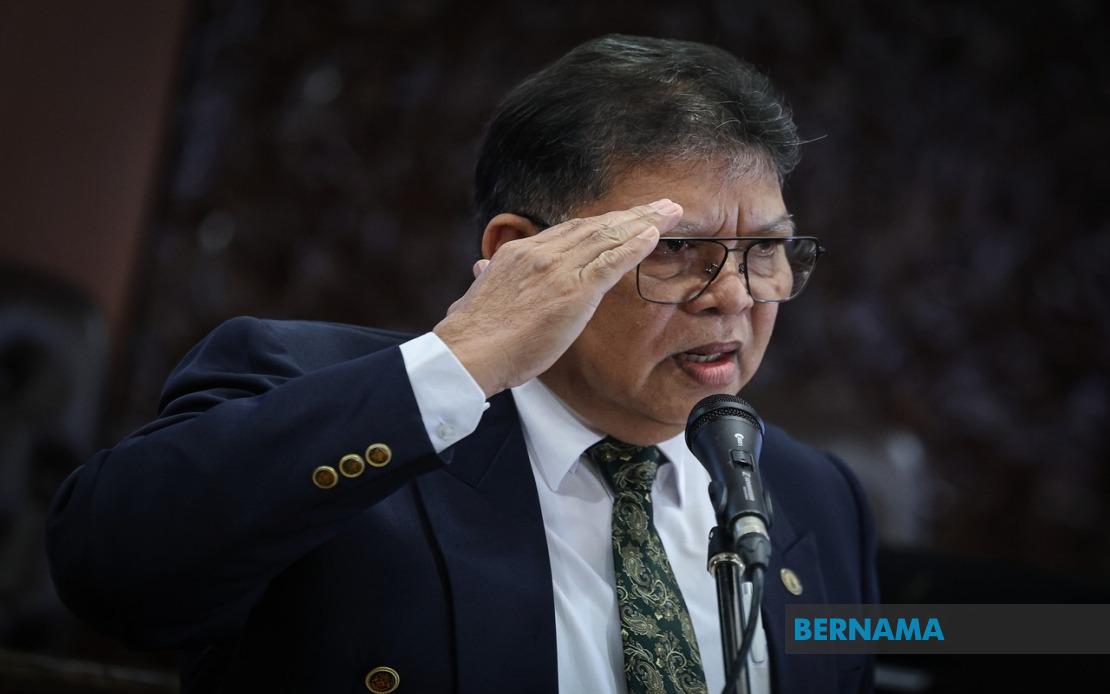
Dewan Rakyat Speaker Tan Sri Johari Abdul has proposed a fundamental shift in Malaysia's electoral system, advocating for proportional representation as a mechanism to preserve minority representation in Parliament amid rapidly shifting demographic realities. Speaking at the Harmony Symposium held at the Parliament building in Kuala Lumpur on June 26, Johari articulated concerns that the current electoral architecture may inadvertently marginalise minority voices as the nation's population composition changes dramatically over the coming decades.
The speaker's intervention touches on one of Malaysia's most sensitive and complex political questions: how to maintain effective representation for all ethnic communities within a constitutional framework designed decades ago when demographic projections were fundamentally different. Johari's proposal emerges as policymakers grapple with the implications of population forecasts suggesting that Bumiputera Malays will account for 77 per cent of the Malaysian population by 2050, a projection that carries profound implications for electoral outcomes and parliamentary composition under the existing first-past-the-post system.
Johari emphasised that the current electoral model, whereby constituency-based representation predominantly favours larger demographic groups, creates structural disadvantages for minorities seeking parliamentary seats. Under the present arrangement, constituencies where minority communities form voting majorities become increasingly scarce as their proportion of the national population declines. This mathematical reality, he suggested, threatens to gradually erode the political voice and influence of minority groups who currently hold parliamentary seats primarily in constituencies where they constitute local majorities. The speaker framed this not merely as a technical electoral issue but as a fundamental democratic challenge with potential consequences for social cohesion.
His remarks reflect growing recognition among Malaysian political leaders that demographic change necessitates institutional adaptation. The proportional representation system Johari advocates would allocate parliamentary seats based on each party's nationwide vote share rather than winner-take-all constituency outcomes. Such a mechanism would theoretically enable minority-backed candidates to secure representation even in constituencies where they do not form local majorities, provided their parties achieve sufficient overall vote share. This approach has been implemented successfully in various democracies grappling with minority representation questions, though it carries its own operational complexities.
Johari stressed that considerations of national harmony must transcend immediate political cycles and extend across multiple decades. He highlighted Malaysia's extraordinary ethnic diversity, home to 77 distinct ethnic groups navigating a shared political space. Rather than focusing narrowly on contemporary grievances or historical disputes, Johari called for forward-looking dialogue that positions minority representation within a longer strategic timeframe. His emphasis on long-term thinking reflects recognition that reactive policymaking responding to immediate tensions often proves insufficient for addressing structural electoral questions with decade-spanning implications.
The speaker's concern about diminishing minority voices carries weight within Malaysia's political context, where minority representation has traditionally been viewed as essential to maintaining the inclusive character of Parliament and ensuring that diverse communities feel invested in democratic institutions. When minorities perceive themselves as systematically excluded from meaningful parliamentary participation, research suggests this can contribute to disaffection with democratic processes and weaken social cohesion. Johari's framing implicitly warns that allowing minority representation to decline through demographic drift could generate precisely these negative outcomes.
Symahredzan Johan, chairman of the Malaysia Cross-Party Parliamentary Group on Racial and Religious Harmony (KRPPM-KKA) and Member of Parliament for Bangi, supported the symposium's objective of elevating harmony and representation discussions into parliamentary discourse. The KRPPM-KKA explicitly aims to translate discussions on racial and religious harmony into concrete policy recommendations and legislative mechanisms that Parliament and government ministries might implement. This institutionalisation of dialogue reflects recognition among senior lawmakers that harmony questions require sustained attention rather than episodic intervention during periods of elevated tension.
The proposed approach undertaken by KRPPM-KKA encompasses policy and legal reforms alongside broader efforts to build cooperative networks spanning Parliament, government agencies, civil society organisations, and educational institutions. This multi-stakeholder framework recognises that electoral system change, should it occur, would need to be complemented by broader efforts to strengthen cross-community understanding and institutional inclusivity. Educational institutions in particular represent crucial sites for fostering the intercommunal relationships that proportional representation alone cannot generate.
For Malaysian readers, Johari's proposal invites consideration of how electoral mechanics intersect with democratic representation and social stability. Proportional representation systems carry distinct advantages and disadvantages compared to Malaysia's current constituency-based model. While such systems might enhance minority representation, they typically produce more fragmented parliaments requiring coalition-building and potentially complicating executive governance. Implementing proportional representation would require constitutional amendment, a substantive undertaking requiring supermajority support that extends across racial and political lines.
The proposal also resonates throughout Southeast Asia, where several nations grapple with minority representation questions within diverse, multi-ethnic democracies. Indonesia, for instance, employs regional proportional representation systems designed partly to accommodate ethnic diversity, while Thailand has experimented with various hybrid electoral mechanisms. Malaysia's contemplation of proportional representation thus occurs within a regional context where neighbouring democracies are actively managing similar tensions between majoritarian principles and minority inclusion.
Johari's intervention suggests that senior Malaysian political figures increasingly recognise electoral architecture as a legitimate subject for public discussion and potential reform. Previously, such fundamental constitutional questions often remained confined to elite political circles. Opening these discussions to broader public engagement, as the Harmony Symposium attempted, may facilitate more informed deliberation about the relationship between voting systems and social cohesion. Whether Malaysia's political system will ultimately move toward proportional representation remains uncertain, but Johari's prominence ensures his proposal will shape ongoing conversations about how electoral design might accommodate changing demographics while preserving minority representation.

