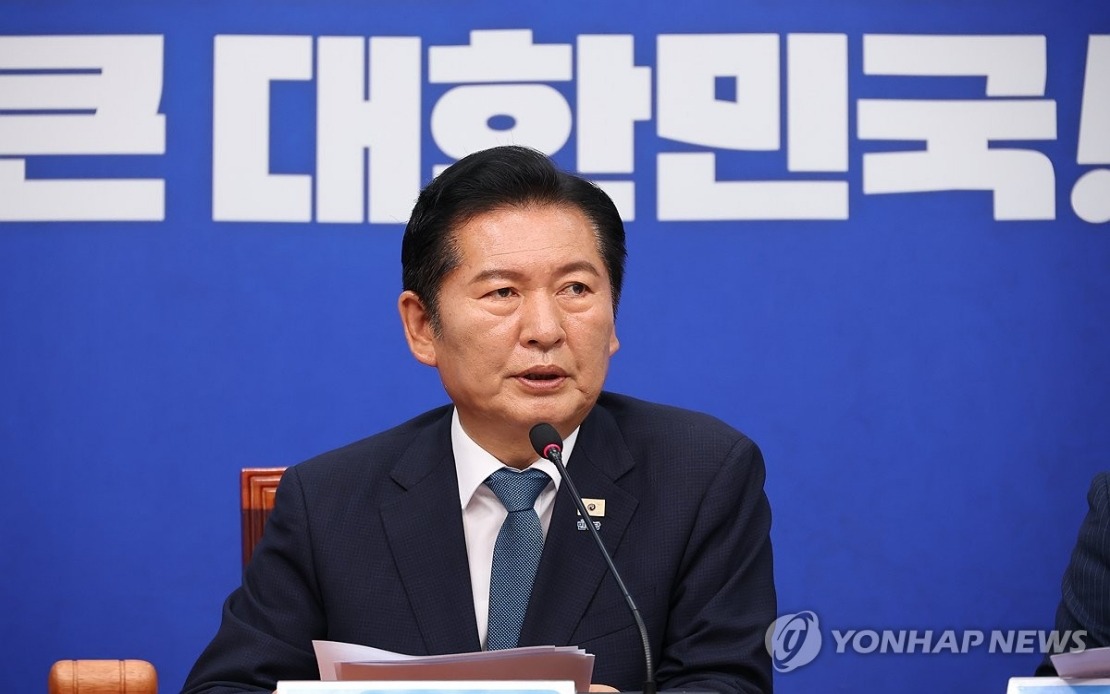
South Korea's ruling Democratic Party witnessed a significant leadership transition on Wednesday when Chairman Jung Chung-rae announced his resignation, a strategic manoeuvre widely interpreted as positioning himself for the party chairmanship race at the upcoming national convention. The Seoul-based lawmaker made his announcement during a meeting of the party's supreme council at the National Assembly, setting the stage for what promises to be a closely contested internal election that will shape the party's direction in coming months.
Jung's departure from the chairman's post comes at a pivotal moment for the ruling coalition, as the party grapples with internal divisions that have complicated its ability to function as a cohesive political force. In his resignation statement, Jung reflected on the personal toll of his leadership tenure, describing the emotional weight of constant scrutiny and internal opposition. He highlighted his commitment to supporting President Lee Jae Myung's administration throughout his period in office, emphasising that he had consistently worked to ensure seamless coordination between the ruling party, government apparatus, and presidential office.
The chairman's remarks carried undertones of frustration regarding the challenges he has encountered from various quarters within and outside party structures. Despite acknowledging the relentless nature of resistance and the absence of peaceful moments during his tenure, Jung maintained that he had fulfilled his responsibilities without complaint or wavering commitment. This narrative of steadfast service, delivered at a formal party meeting, appears designed to establish Jung as a principled figure prepared to lead the party through its competitive internal selection process.
However, Jung's leadership has attracted considerable criticism from factions aligned with President Lee, who contend that his approach prioritises the interests of his own political base rather than advancing the president's agenda. These pro-Lee party members have expressed concern that Jung's direction diverges from the collaborative approach the administration requires from its parliamentary representatives. This fundamental disagreement over party strategy and priorities has created substantial friction within ruling coalition structures, undermining the unified front that Jung claimed to have maintained.
The upcoming party convention on August 17 will feature a three-cornered contest among formidable political competitors. Jung faces challenges from Prime Minister Kim Min-seok, who represents the Lee administration's preferred candidate and enjoys significant political capital from his position in government. The third contestant, Song Young-gil, a former DP leader, brings considerable parliamentary experience and a separate constituency within the party. This configuration ensures that the convention will function as a genuine competition rather than a coronation, with each candidate representing distinct factional interests and policy orientations.
Song Young-gil's entry into the race carries particular significance given his reported communication with President Lee regarding his candidacy intentions. According to statements made by DP lawmaker Park Jie-won during a radio interview with broadcaster CBS, Song has floated the possibility of consolidating his campaign with Kim's candidacy, a strategic manoeuvre that could reshape the competitive dynamics. Such alignment would potentially marginalise Jung's position by concentrating non-Jung support behind a unified alternative, though negotiations between Song and Kim regarding actual merger possibilities remain fluid.
With Jung's formal departure from the chairman position, DP floor leader Han Byung-do assumes temporary leadership responsibilities, serving as acting party leader until the convention concludes. This interim arrangement ensures continuity in party management while the membership engages in the selection process for permanent leadership. The two-month interval between Jung's resignation and the convention vote provides candidates with adequate time to mobilise support, articulate their visions for party direction, and build coalitions among the party's grassroots membership and parliamentary representatives.
The internal turmoil within South Korea's ruling party carries implications extending beyond organisational matters. Party leadership directly influences legislative priorities, budgetary allocations, and the government's capacity to advance its policy agenda through parliament. A fractious internal environment weakens the ruling party's negotiating position relative to opposition forces and complicates the coordination necessary for effective governance. For Malaysia and other Southeast Asian democracies observing South Korean politics, the Democratic Party's struggles illustrate how factional competition within ruling coalitions can undermine governmental effectiveness and parliamentary stability.
Jung's resignation strategy, though formally presented as a step toward leadership renewal, fundamentally represents a calculated political manoeuvre designed to reset his standing within the party hierarchy. By voluntarily stepping down rather than awaiting pressure to resign, Jung transforms a potential vulnerability into a narrative of principled sacrifice, positioning himself as the candidate willing to subject his leadership to democratic party processes. This approach contrasts with the alternative of maintaining the chairman's position while simultaneously campaigning, which could have generated accusations of using institutional power to advantage his candidacy.
The Democratic Party convention will ultimately determine not merely who leads the party apparatus, but which factional vision prevails within South Korea's ruling coalition. Jung's vision emphasises independent party authority and attention to grassroots concerns, while Kim represents continuity with presidential administration priorities and governmental coordination. Song's candidacy introduces an additional variable, potentially representing party members seeking alternative leadership untainted by recent controversies. The convention's outcome will reverberate through South Korean politics for years, influencing parliamentary dynamics, legislative productivity, and the government's capacity to maintain internal coherence as it navigates economic challenges and regional security concerns affecting the broader East Asian geopolitical landscape.

