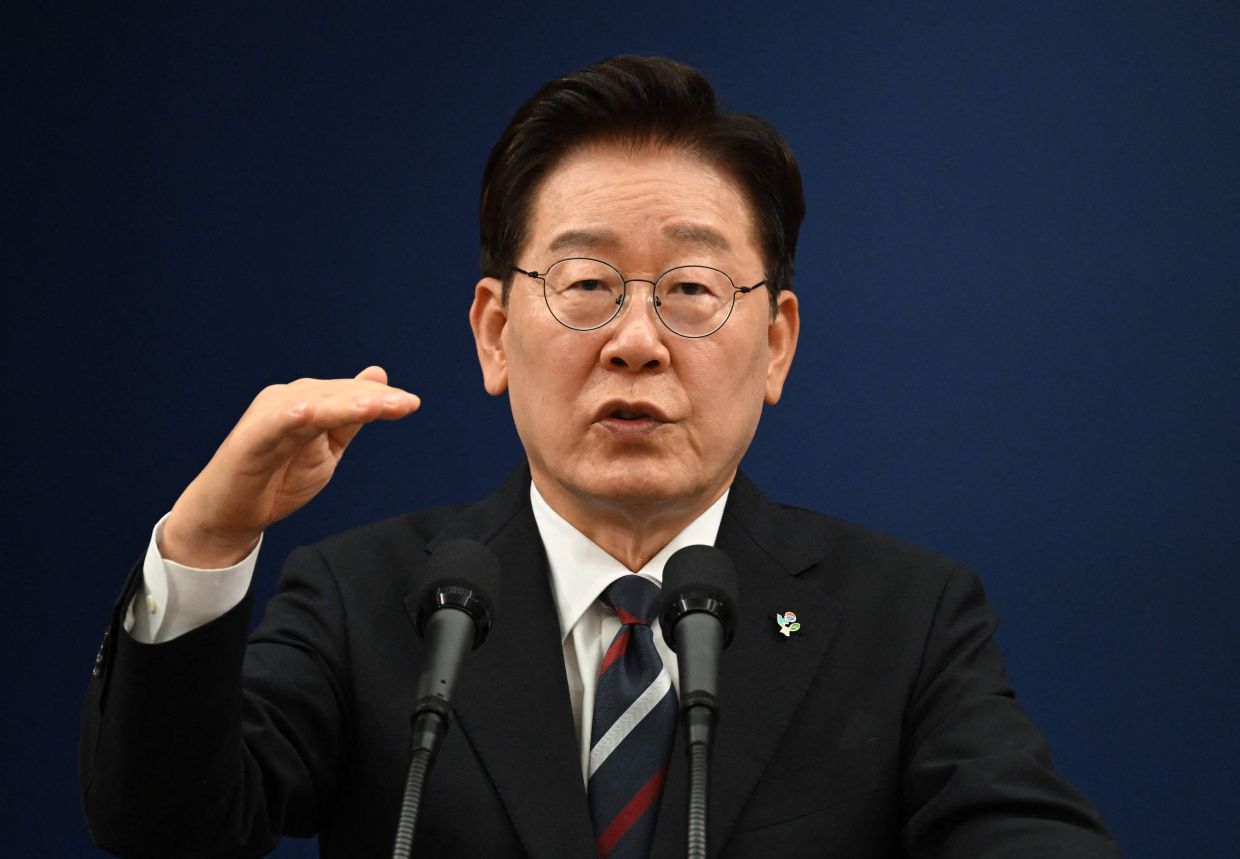
South Korean President Lee Jae Myung faces a significant political challenge as his approval rating has collapsed to 46.7 per cent, marking the first occasion since assuming office on June 4, 2025, that disapproval has overtaken approval among the electorate. A Realmeter survey released on June 22 revealed that negative assessments of his performance reached 49.7 per cent, a historic crossover that underscores deepening public dissatisfaction with the administration barely three weeks into its tenure.
The trajectory of Lee's approval has been steeply downward across successive weeks, beginning from a respectable 60.5 per cent in mid-May before progressively weakening to 51.5 per cent by mid-June. The latest reading represents a decline of 4.8 percentage points in a single week, suggesting accelerating public disengagement rather than a gradual cooling of support. While the 3 percentage point margin between approval and disapproval falls within the survey's margin of error, the symbolic significance of crossing below the 50 per cent threshold during the critical early weeks of a presidency carries substantial weight in South Korean political dynamics.
Two major domestic crises have precipitated this dramatic reversal in fortune. The immediate trigger involves widespread ballot shortages that marred the June 3 local elections, an administrative failure that has sparked intense debate over whether to conduct a full election rerun and the future of early voting mechanisms. Compounding this electoral management fiasco is escalating factional warfare within Lee's ruling Democratic Party of Korea, as various factions position themselves ahead of an August 17 party convention intended to select a new chairman. These overlapping institutional failures have created a narrative of governmental incompetence that has resonated across the electorate, according to Realmeter's analysis.
Geographic variations in the rating decline reveal important fault lines in Lee's coalition. His support has collapsed most dramatically in traditionally conservative regions that form the bedrock of centre-right political power. In Daegu and North Gyeongsang Province, typically reliable conservative strongholds, his approval plummeted 9.9 percentage points to just 34.6 per cent—a signal that even his natural base has grown restless with his administration's handling of the election crisis. The capital Seoul and surrounding regions, which lean more progressive, also recorded substantial losses of 7.6 percentage points each, suggesting that dissatisfaction is geographically widespread rather than concentrated among opposition-leaning voters.
The demographic breakdown provides additional insight into which voter segments are abandoning the administration. Support among moderate voters fell 4.9 percentage points to 47.5 per cent, indicating that centrist swing voters—typically decisive in South Korean elections—are drifting away. Perhaps more concerning, liberal voters, who should theoretically oppose a conservative president, remain at 80.4 per cent support, suggesting that Lee retains considerable backing among those ideologically distant from his party. Conservative voters, by contrast, show tepid approval of only 19.8 per cent, a decline of less than 1 percentage point, implying that core conservatives are simply withholding strong endorsement rather than actively opposing him.
Economic and asset market concerns have further eroded the president's standing, particularly among middle-class voters in the Greater Seoul metropolitan area. Realmeter analysts identified widening disparities in asset valuations as a source of discontent among moderate voters, a subtle indication that Seoul's historically expensive real estate market and disparities in wealth distribution are entering the political conversation. Paradoxically, certain positive developments—including Lee's well-received European diplomatic tour and a surge in the Kospi index above the 9,000-point mark—have been insufficient to offset the negative momentum generated by administrative missteps and party dysfunction.
Comparative historical context suggests that Lee's rapid approval decline, while significant, does not necessarily presage catastrophic political damage. His predecessor, Yoon Suk Yeol, saw disapproval overtake approval within six weeks of taking office in 2022, substantially faster than Lee's three-week trajectory. Former presidents Park Geun-hye and Moon Jae-in experienced similar crossovers around 16 and 19 months into their respective terms, indicating that approval-rating volatility during early presidencies is not unusual in South Korean politics. However, the speed of Lee's decline raises questions about whether the administration can stabilise public confidence before further deterioration becomes entrenched.
The presidential office responded to the polling data with carefully calibrated humility, issuing a statement pledging to heed public concerns and acknowledge both economic conditions and broader governance challenges. This measured response, attributing rating fluctuations to public assessment of economic and administrative performance, represents an attempt to depersonalise the crisis and position the administration as responsive to electoral feedback. However, such statements carry limited political weight if underlying policy failures persist or if party infighting continues to dominate news cycles.
Parallel Realmeter polling indicates that Lee's Democratic Party of Korea faces competitive pressure from the conservative opposition People Power Party, despite gaining 2.1 percentage points to reach 40.1 per cent support. The People Power Party maintained a slight 2.3 percentage point lead at 42.3 per cent, though this advantage has narrowed considerably. The party's approval rating has declined particularly sharply among younger voters, falling 10.5 percentage points to 48.6 per cent among those in their twenties and 5.1 percentage points among those in their thirties—suggesting that Lee's administration is hemorrhaging support among generationally important demographics.
The Democratic Party's modest polling recovery appears tied to its adoption of a crisis-management posture following a bipartisan agreement to launch a National Assembly investigation into election administration failures. By emphasising party unity and positioning itself as accountable to public concern, the ruling coalition has managed to stabilise support among its ideological base, though factional tensions over party leadership remain unresolved. This temporary stabilisation reflects South Korean voters' appreciation for institutional accountability mechanisms, but the underlying fragmentation within the Democratic Party suggests that relief could prove ephemeral.
For Southeast Asian observers, South Korea's political turbulence offers instructive lessons about the fragility of early-presidency approval ratings and the capacity for administrative mismanagement to rapidly erode public confidence. Lee's experience demonstrates that competent campaign performance does not automatically translate into governmental effectiveness, and that regional allies must prepare for extended periods of internal political distraction in Seoul. The parallel concerns over asset price disparities and wealth inequality resonate across the region, where similar anxieties about housing affordability and economic fairness have triggered political realignments in countries from Thailand to Indonesia.
The critical question for Lee's administration involves whether recent developments represent a temporary adjustment to the realities of governance or the beginning of a sustained erosion of public legitimacy. The August 17 party convention presents both opportunity and risk: successful leadership transition could signal renewed institutional coherence, whilst visible factional conflict could deepen public perception of a ruling coalition unable to manage its internal affairs. Similarly, the government's response to the electoral management crisis—whether through administrative accountability, procedural reform, or bipartisan consensus—will substantially determine whether public confidence stabilises or continues deteriorating in subsequent months.

