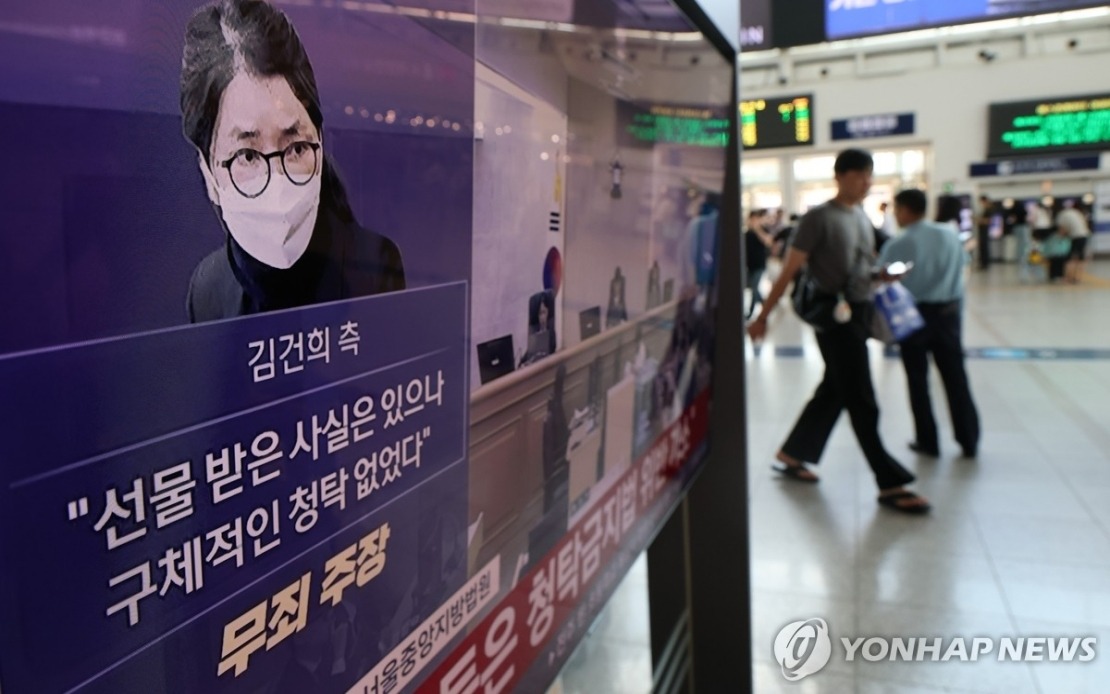
The fall from grace of South Korea's former first lady reached a significant milestone on Friday when the Seoul Central District Court handed down a seven-year prison sentence to Kim Keon Hee, wife of ousted President Yoon Suk Yeol, for orchestrating a systematic scheme to profit from her position of power and influence. The convictions represent a dramatic turn of events for a woman who, until recently, occupied one of the nation's most prominent roles, illustrating the precarious nature of political prominence in South Korea where corruption allegations can rapidly transform former allies into defendants facing serious criminal charges.
Kim's conviction stems from an extensive pattern of accepting valuable gifts totalling approximately 300 million won in exchange for mediation services that ranged from securing government employment to facilitating business opportunities. Among the luxury items she received were a Van Cleef & Arpels necklace, a Vacheron Constantin watch, a Dior handbag worth 5.4 million won, and a painting by renowned artist Lee Ufan. The most significant transaction involved jewellery valued at over 100 million won, presented by a construction company chairman in return for her assistance in obtaining a government position for his son-in-law.
During the televised proceedings, presiding judge Cho Sun-pyo delivered a scathing assessment of Kim's conduct, emphasizing that she had fundamentally betrayed the public trust associated with the first lady position. The judge noted that rather than serving the nation, Kim had deliberately weaponized her official status to advance purely personal financial interests, demonstrating a conscious disregard for the ethical obligations that accompany such a high-profile governmental role. This characterization reflects growing societal frustration in South Korea with persistent patterns of elite corruption that undermine public confidence in institutions.
The timeline of Kim's transgressions spans the period when her husband held presidential office, from May 2022 until his dramatic removal in April 2025. This overlap is particularly significant, as it suggests that Kim capitalised directly on the power and access afforded by her position as the sitting president's wife. Several of the gifts were presented during the early months of Yoon's presidency, when his political capital remained substantial and his ability to influence governmental decisions and appointments was at its zenith. The prosecution meticulously documented the quid pro quo nature of these exchanges, tracing the flow of gifts and the corresponding favours granted.
Amongst those who benefited from Kim's interventions was Lee Bae-yong, former head of the National Education Commission, who provided a golden turtle ornament in April 2022 in exchange for appointment to his position. The apparent ease with which such high-ranking government posts could be influenced through personal gift-giving underscores vulnerabilities in South Korea's institutional safeguards against nepotism and patronage. Additionally, a pastor donated a Dior bag the same year, while another businessperson presented an expensive watch in September 2022, each transaction representing a discrete instance of influence peddling.
When investigators began scrutinizing her activities, Kim employed defensive tactics that the court found particularly incriminating. She attempted to return some gifts once investigations commenced and claimed that certain items had been personal purchases rather than gifts received in exchange for favours. Judge Cho emphasized that these evasion strategies actually strengthened the prosecution's case by demonstrating her conscious awareness of wrongdoing. The judge noted that her attempts to conceal the transactions and retroactively construct alternative explanations for the gifts themselves proved that she fully understood the illegality of her conduct.
Special counsel Min Joong-ki's investigative team, which had sought a more severe 7½-year sentence, expressed satisfaction with the court's ruling, viewing it as appropriately stringent given the circumstances. However, Kim's legal representatives immediately signalled their intention to pursue appeals, suggesting that prolonged litigation lies ahead. This appeals process will likely keep the case in public consciousness and may result in further delays before any final determination regarding her incarceration.
Beyond this bribery conviction, Kim faces additional serious legal jeopardy. An appellate court has already sentenced her to four years imprisonment in a separate corruption case, a verdict that creates the prospect of consecutive or concurrent sentence obligations. The cumulative sentences could substantially extend her potential time in custody, compounding the gravity of her overall legal predicament. Such layered convictions are uncommon even for high-profile figures in South Korea, reflecting the breadth and depth of the charges against her.
Yet another legal cloud looms over the former first lady. She is scheduled to stand trial regarding allegations that she participated in a scheme wherein members of the Unification Church were allegedly coerced into joining the People Power Party prior to the 2022 presidential election. This alleged plot aimed to manipulate the outcome of the party's primary election process to favour her husband's candidacy. Should she be convicted on these additional charges, her legal situation could deteriorate further, adding potential sentences to those already imposed.
The convictions against Kim highlight systemic vulnerabilities within South Korea's political and administrative structures that allow those with proximity to power to leverage their access for personal enrichment. The case serves as a cautionary tale regarding the necessity for robust institutional checks on executive privilege and comprehensive oversight mechanisms. For observers across Southeast Asia, the proceedings illustrate how even wealthy, well-connected political figures ultimately cannot escape accountability when sufficient evidence accumulates and judicial systems remain sufficiently independent to pursue high-profile cases.
The court also handed down supplementary sentences to various co-conspirators. The construction company chairman who gifted the expensive necklace received a one-year suspended prison sentence, while the businessman who presented the watch faced a ten-month suspended sentence. A pastor involved in one transaction was assessed a fine of 8 million won. These proportionally lighter sentences compared to Kim's substantial prison term reflect the court's view that she bore primary responsibility as the receiving party who actively solicited and leveraged her official status to exact these gifts.
Kim's conviction represents one of South Korea's most significant corruption prosecutions involving a former first lady in recent history. The case underscores the country's commitment, at least at the judicial level, to holding even the most prominent figures accountable when evidence of wrongdoing emerges. Whether this conviction ultimately leads to imprisonment depends on the appeals process and her legal team's ability to challenge the evidence and sentencing determination. Regardless of the outcome, the case has already damaged the reputation of the Yoon administration and raised uncomfortable questions about the nature of power and privilege within South Korea's elite circles.

