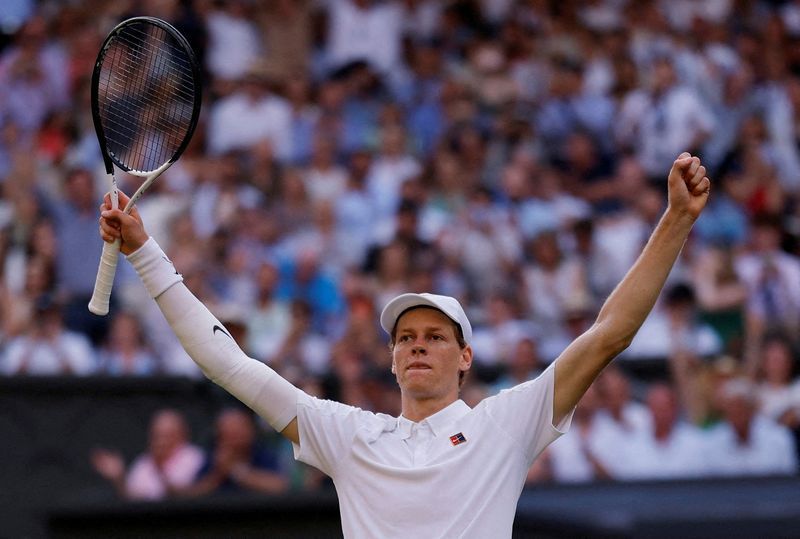
Jannik Sinner's arrival at the All England Club this week carries a different air than the imperious form that crowned him champion last summer. The Italian defending champion comes to Wimbledon with his reputation for dominance genuinely tested, arriving on grass after a troubling exit from the French Open left questions swirling about his durability when Grand Slam pressure mounts. The world number one must now prove he possesses not merely the talent to win major tournaments, but the resilience to reclaim his fortress when the surface changes and the competition sharpens around him.
Sinner's journey into this Grand Slam tells a story of excellence giving way to exhaustion. Through the early months of 2024, he assembled a 30-match winning streak primarily on the red clay circuit, establishing himself as the player to beat across consecutive tournaments. Yet when Roland Garros arrived in late May, the accumulation of matches and limited recovery time took their toll. His exit in the second round represented a stunning reversal of fortune, snapping not merely his run of victories but also the psychological certainty that had defined his recent ascendancy. The question now reverberates through the sport: can the 24-year-old compartmentalise this setback and reassert control on a surface that traditionally favors different technical approaches than those that brought him continental success?
Wilander, the Swedish great who has won seven Grand Slam tournaments, offered perspective on Sinner's situation while also sounding a note of caution about the unforgiving nature of grass. Speaking to La Gazzetta dello Sport, Wilander attributed the Paris debacle to cumulative fatigue rather than fundamental flaw, noting that Sinner's schedule in the weeks before Roland Garros left insufficient opportunity for serious preparation or mental refreshment. The veteran suggested that Sinner's current rest period should restore him to competitive sharpness, yet simultaneously warned that grass courts present unique tactical challenges that even the most dominant players cannot take for granted. His assessment reveals a truth many overlook: recovery alone does not guarantee success at the sport's highest level when tournament conditions demand new technical solutions.
The vacuum created by Sinner's vulnerability has attracted hungry challengers, none more prominent than Novak Djokovic. The Serb's movement and return-of-serve capabilities remain tailor-made for grass court tennis, where these attributes carry particular weight. At 39 years old, Djokovic confronts a diminishing window of opportunity to achieve dual historical objectives—capturing an eighth Wimbledon crown to match Roger Federer's unmatched tally, and securing an unprecedented 25th Grand Slam title overall. The French Open may have eliminated him early, yet that early exit paradoxically strengthens his Wimbledon candidacy by providing additional rest before this particular fortnight.
Andy Roddick, the American who reached three Wimbledon finals during his career, articulated this reality with particular clarity during his recent podcast commentary. Roddick emphasized that Djokovic should view Wimbledon through the lens of a final realistic opportunity to achieve tennis immortality on the sport's most prestigious stage. While acknowledging Sinner's continued stature as favorite, Roddick suggested that Djokovic's grass expertise and current absence of serious physical limitations create a genuine pathway to the title. The perspective that Roddick offered essentially frames this fortnight as a decisive moment in the twilight of Djokovic's extraordinary career—a moment where experience, surface aptitude, and urgency converge.
Alexander Zverev arrives at Wimbledon with momentum that should not be underestimated. The 29-year-old German's victory at Roland Garros represented his first Grand Slam championship, a breakthrough that arrives at an age when many players begin accepting that such glory may elude them entirely. Zverev's powerful serve, which yields roughly 130 miles per hour regularly, provides the kind of advantage that translates particularly well to fast grass surfaces where holding serve becomes increasingly difficult for opponents. Boris Becker, the six-times Grand Slam champion and fellow German, offered emphatic assessment of Zverev's prospects, stating that with Alcaraz absent through injury and Sinner's form uncertain, Zverev effectively becomes the tournament favorite.
Becker's confidence in Zverev rests on technical rather than purely speculative reasoning. A dominant serve provides entry into almost every match, and when combined with the aggressive baseline play Zverev displayed throughout his Paris campaign, the combination creates formidable obstacles for traditional grass court specialists. The analytical observation that a power server can reach the semi-finals almost by default on grass understates neither the difficulty of that achievement nor the distinct advantage such weaponry provides. For Zverev, the challenge lies in psychological carry-over—converting clay confidence into grass proficiency without mechanical adjustment becoming so complex that it impedes rather than enhances performance.
Carlos Alcaraz's absence from the Wimbledon draw represents the tournament's single most significant absentee factor. The Spanish champion won Wimbledon in both 2023 and 2024, establishing himself as the premier grass court player of this generation and among the finest ever to master that particular surface. His injury removes what many considered a formidable obstacle between Sinner and title retention, simultaneously opening unprecedented pathways for challengers positioned lower in the draw structure. Tournament theorists understand that while Sinner's removal would reshape competitive dynamics, Alcaraz's absence creates genuine vacuum rather than mere opportunity adjustment.
Beyond the elite tier, several American players have cultivated weaponry sufficient to trouble establishment names on grass. Ben Shelton, Taylor Fritz, and Frances Tiafoe each possess serve-and-volley capabilities, court aggression, and specific grass court competencies that previous American generations lacked during similar developmental phases. Flavio Cobolli, the Italian who reached the French Open final, enters Wimbledon as the most prominent representative of an ascending cohort of challengers who have demonstrated significant Grand Slam readiness. These players do not carry the weight of title expectation that burdens Sinner, Djokovic, or Zverev, a freedom that occasionally translates into extended runs when top players experience distraction or mechanical inconsistency.
The broader narrative arc of this championship reflects a transitional moment in elite professional tennis. Federer's retirement, Nadal's diminished role due to injury, and Alcaraz's current absence have created competitive space precisely when generational change might naturally occur. Sinner, despite his setback, remains the youngest and most physically gifted challenger among the elite tier. Yet Wimbledon's particular characteristics—the bounce patterns, the grass wear, the tactical nuance—have historically favored experience and technical subtlety alongside physical dominance. Djokovic's knowledge of this surface, accumulated across four decades and multiple championships, provides counterweight to Sinner's superior athleticism and contemporary training methods. Zverev's emergence from Grand Slam obscurity adds further dimension to a draw that suddenly appears dramatically more wide-open than it seemed six weeks ago.
Sinner's path to successful title defense runs fundamentally through restored confidence and physical certainty. The opening matches will prove crucial in establishing whether the French Open setback represented temporary weakness or harbinger of deeper fragility. His decision to bypass tune-up tournaments before Wimbledon—while economically rational and physically prudent—deprives him of competitive rhythm-building that might otherwise steadie his approach. Against this backdrop, the All England Club's opening days will determine whether Sinner rebuilds dominance or whether Djokovic, Zverev, and the chasing challengers capitalize upon a champion rendered temporarily vulnerable by the cruel mathematics of modern professional sport.

