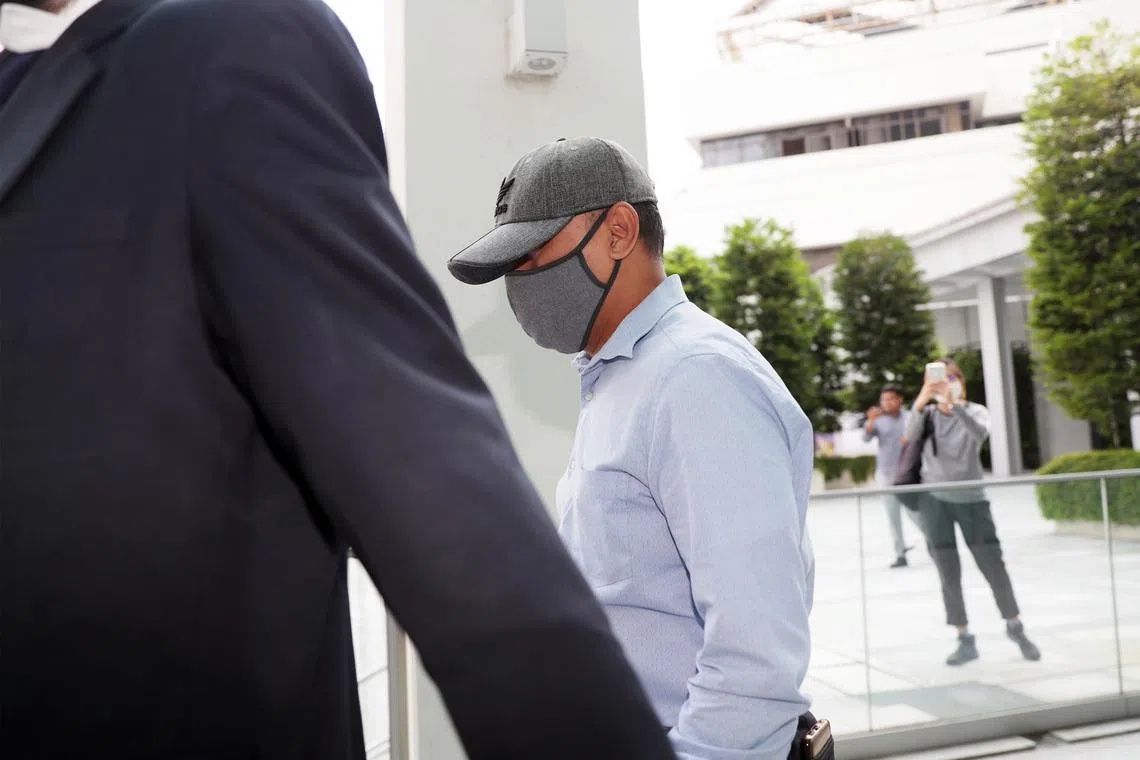
A senior official at Singapore's Islamic Religious Council has been sentenced to 14 months imprisonment for abuse of his position to benefit a construction company operated by an associate, marking a significant case of graft within Singapore's religious institutions. Abdul Rahim Mawasi, 59, held the role of executive chairman at both Darul Aman Mosque along Jalan Eunos and Sallim Mattar Mosque in MacPherson at the time of the offences, while simultaneously serving as a senior officer with the Islamic Religious Council of Singapore, commonly known as MUIS, on a secondment basis to the two houses of worship.
The corruption scheme unraveled through an arrangement between Mawasi and Mohd Mustaqim Kam, also known as Kam Hock Beng, who directed Zeal-Con Engineering, a construction firm. The two men had maintained a friendship spanning over a decade before entering into what prosecutors described as a calculated corrupt bargain. Beginning in July 2018, the pair conceived a joint venture to establish a travel company focused on organizing pilgrimage trips, with Mawasi contributing no initial capital. Instead, Mawasi would leverage his institutional position to steer lucrative construction contracts toward Zeal-Con, and profits from those projects would subsequently fund the travel venture in which Mawasi held a concealed financial stake through his son.
The mechanics of the corrupt arrangement became evident through documentation presented during court proceedings. When Darul Aman Mosque advertised for construction vendors to undertake yard renovation work in 2018, Zeal-Con submitted its initial quotation on August 20 at S$128,600. Following what prosecutors characterized as extensive discussions facilitated by Mawasi, who supplied crucial pricing intelligence to Kam, the company submitted a substantially revised quote three weeks later on September 12 for S$118,000—undercutting the nearest competing bid from another contractor at S$125,500. The mosque's management board subsequently awarded the contract to Zeal-Con on September 26 without awareness that their own chairman had orchestrated these price negotiations behind the scenes.
A parallel pattern emerged at Sallim Mattar Mosque, where similar manipulation occurred with comparable consequences. In September 2018, Zeal-Con initially quoted S$115,700 for restoration work covering multiple areas of the building including the roof and reception facilities. By July 2019, after further consultation with Mawasi, the company reduced its quote to S$105,000 for identical scope. Sallim Mattar Mosque subsequently issued contract awards in August 2019 aligned with this lowered pricing. The court heard compelling evidence demonstrating that Mawasi had specifically counseled Kam to reduce quotation figures strategically to secure contract awards, transforming his official authority into a personal financial advantage.
To obscure his financial involvement and prevent detection, Mawasi orchestrated the ownership structure through a third party. In November 2019, Kam converted an existing dormant company into Amal Travel and Tour, capitalizing it with S$100,000. Rather than registering shares directly under his own name, Mawasi arranged for his adult son to receive 25,000 shares valued at S$1 each, effectively concealing the executive's beneficial ownership. This layered approach was specifically designed to evade scrutiny by MUIS leadership and prevent disclosure of his commercial interests in a venture directly funded by construction work he had improperly facilitated.
During trial proceedings, Mawasi's legal counsel, represented by lawyer Satwant Singh Sarban Singh, mounted a denial strategy regarding any involvement with Amal Travel and Tour. Mawasi claimed complete separation from the travel company's operations, maintaining he held no shares whatsoever. These denials proved ultimately unconvincing to the presiding judge, particularly given the documentary evidence linking his son to shareholding contemporaneously with the contract awards and the testimony regarding his active price-coaching role with Kam. The court found sufficient evidence of guilty knowledge and deliberate participation in a scheme designed specifically to conceal his financial interest.
The sentencing decision issued on June 26 reflected the judiciary's assessment of the seriousness inherent in public sector corruption, particularly within religiously significant institutions where public trust carries heightened moral weight. Deputy Public Prosecutor Bryan Wong argued successfully for substantial imprisonment, emphasizing that while the actual construction work performed by Zeal-Con met satisfactory standards and the mosques sustained no demonstrable financial loss through inflated pricing, the nature of the corruption itself—an official weaponizing institutional authority for personal enrichment—constituted gravely serious misconduct. The prosecution characterized Mawasi's conduct as premeditated and deliberately concealed abuse of a trusted position.
Mawasi's co-conspirator faced lighter consequences through the justice system's sequential prosecutions. Kam Hock Beng, then 66 years old, had already received a six-month jail sentence in February 2025 following his own conviction on corruption charges related to the identical scheme. The disparity in sentences reflects Mawasi's position as the institutional insider whose breach of duty proved particularly culpable. As the executive chairman responsible for fiduciary obligations to both mosques and as a senior MUIS officer, Mawasi held substantially greater responsibility for the scheme's conception and execution than Kam, who merely profited from opportunities presented by the official.
During sentencing submissions on June 26, Mawasi's defense counsel requested leniency, petitioning for a maximum term of six months imprisonment and emphasizing his client's previously unblemished record. The judge ultimately rejected this appeal, imposing the 14-month custodial sentence as a calibrated response to the offence's gravity. Bail was subsequently set at S$30,000, and Mawasi was permitted to remain free pending the commencement of his sentence on July 10. This case carries particular resonance for Southeast Asian governance observers, as it demonstrates the vulnerability of religious institutions to insider corruption schemes and underscores the importance of institutional checks regardless of an organization's non-commercial mission.
The conviction and imprisonment of a senior MUIS official sends a meaningful signal about accountability standards within Singapore's religious administration infrastructure. For Malaysian observers monitoring governance practices across the region, the case illustrates how seemingly modest contract values—S$223,000 representing a relatively modest institutional expenditure—can conceal sophisticated schemes involving share allocations, generational wealth transfers, and elaborate concealment architectures. The prosecution's success in unraveling layered ownership structures and establishing premeditation through documented price discussions provides instructive precedent for anti-corruption enforcement efforts throughout Southeast Asia, where similar vulnerabilities may persist in religious and charitable institutions operating with limited external oversight.

