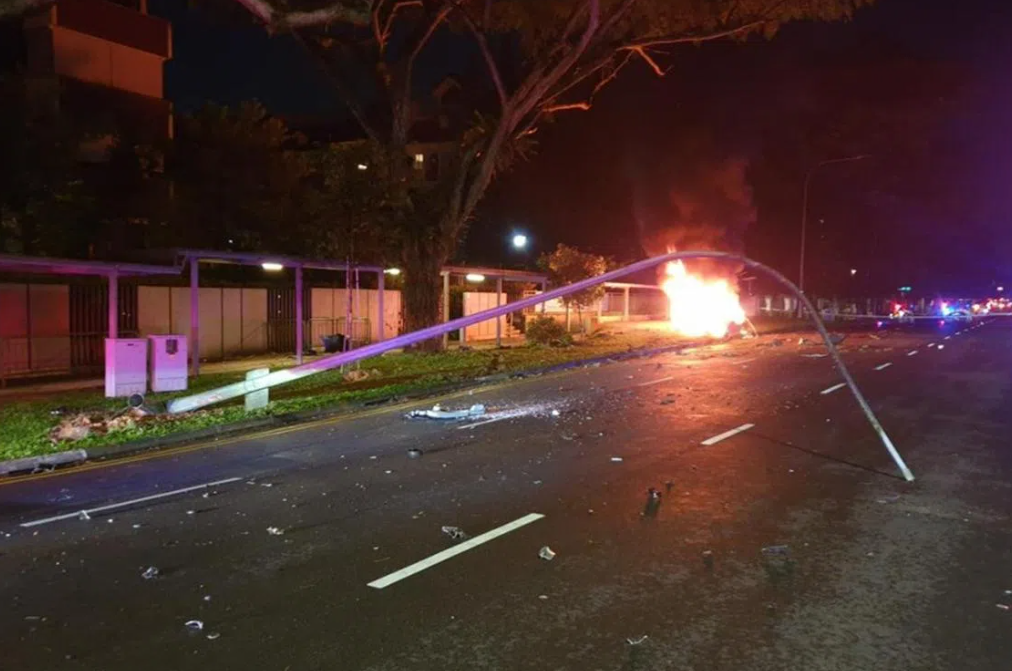
A reckless early-morning drive in Singapore has landed a 29-year-old man facing serious legal consequences after his vehicle collided with a school bus, leaving two children requiring hospital treatment. Aaron Tan Yao Cong appeared in court on Thursday, June 18, to face five criminal charges stemming from the March 6, 2024 incident on roads near Bukit Timah, one of Singapore's busiest residential areas. The charges paint a picture of escalating dangerous behaviour that endangered multiple road users and passengers, particularly the young students aboard the private bus he struck.
According to court documents, Tan's blood alcohol level reached approximately 148 milligrams per 100 millilitres of blood—nearly double Singapore's legal driving limit of 80 milligrams per 100 millilitres. More troubling still, he refused to cooperate with a breathalyser test when first arrested, a decision that itself constitutes a separate criminal offence. His previous conviction for drink-driving in 2019 now makes him a repeat offender facing significantly harsher penalties under Singapore's road safety legislation, which treats recidivism with particular severity given the public dangers involved.
The incident began at 5:50 am when Tan failed to comply with traffic directions on Cavenagh Road near its intersection with Bukit Timah Road. Rather than proceeding straight as instructed by road signage, he negotiated a left turn and drove directly towards oncoming traffic. He initially came to a halt on the left side of the two-lane Cavenagh Road, but this was merely the prelude to a more alarming sequence of events. Tan had three passengers travelling with him at the time, all of whom would later escape the vehicle before it became engulfed in flames.
Within minutes of the initial traffic violation, police began pursuing the vehicle. At 6:16 am, officers spotted Tan accelerating along Bukit Timah Road toward Upper Bukit Timah Road, weaving dangerously between other cars. Throughout this stretch between Coronation Road and Anamalai Avenue, he maintained an average speed of 114 kilometres per hour—excessive for urban roads where safety requires careful vehicle control. His aggressive manoeuvres placed every road user in his vicinity at immediate risk of collision.
The situation deteriorated catastrophically at the junction of Sixth Avenue, where Tan allegedly ran a red traffic signal while a private bus was executing a lawful U-turn. The resulting collision was severe enough to disable his vehicle and cause it to strike a lamp post with such force that the car immediately caught fire. Emergency responders who arrived at the scene found Tan and his three companions had managed to escape, as had the bus driver and his two young passengers, both aged between nine and ten years old.
All seven individuals involved—the four from Tan's vehicle, the bus driver, and the two schoolchildren—were transported to hospital for treatment. While the bus occupants' injuries ultimately required medical intervention, underscoring the real physical danger posed by Tan's actions, the psychological impact on the young passengers of being struck by another vehicle cannot be overlooked. For many Singaporeans, such incidents reinforce concerns about impaired driving despite decades of public education campaigns.
The five charges Tan faces represent distinct aspects of his culpability. Drink-driving as a repeat offender carries potential imprisonment of up to two years and fines reaching $20,000. The dangerous driving charge that caused hurt to other persons carries up to two years' imprisonment and fines to $10,000, with repeat offender penalties climbing to $20,000. Additionally, he faces charges for leaving his vehicle in a dangerous position, failing to provide a breath specimen when required, and driving against the flow of traffic—the latter potentially resulting in up to six months' jail and $2,000 fines for repeat offenders.
Tan is scheduled to return to court on July 16 for further proceedings, and he has not yet indicated whether he will enter guilty pleas to any charges. His legal status as a repeat drink-driver substantially complicates his position, as Singapore's courts have demonstrated increasing intolerance for habitual traffic offences. The severity of available sentences reflects the jurisdiction's determination to deter dangerous driving through meaningful custodial terms.
For Malaysian and regional observers, this case exemplifies the escalating enforcement posture across Southeast Asian traffic authorities. Singapore's approach—combining high base penalties with dramatically enhanced sentences for repeat offences—contrasts with varying regulatory stringency elsewhere in the region. The incident also highlights an uncomfortable reality that affects parents across Malaysia and Singapore alike: the vulnerability of young passengers in vehicles when other road users behave recklessly. Schools, parents, and transport operators must all grapple with the reality that institutional safety measures cannot fully protect children from the consequences of impaired or aggressive driving by third parties.
The case underscores why many transport operators have invested in advanced safety features and driver monitoring technology. Beyond the immediate consequences for Tan, this incident will likely feature in road safety presentations and public awareness campaigns throughout Singapore. It demonstrates how a single individual's decision to drive whilst intoxicated and refuse compliance testing can translate into a cascade of serious charges, hospitalizations, and potential years of imprisonment. For Southeast Asian societies working to reduce road fatalities and injuries, such cautionary examples serve as important reminders of why strict enforcement and significant penalties remain necessary policy tools.