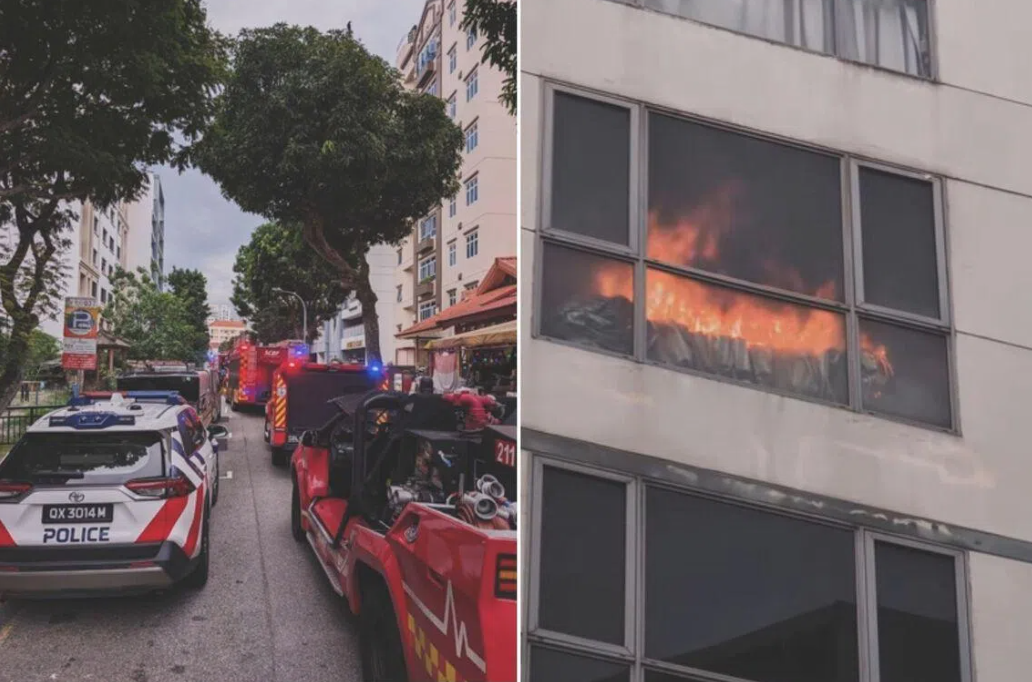
A residential fire in Singapore's Geylang district has reignited concerns about the safety practices surrounding power-assisted bicycles and other active mobility devices. The blaze, which broke out in a seventh-floor unit at Casa Aerata condominium on 9 Lorong 26 Geylang on Sunday afternoon at 5.35pm, saw five people evacuated from adjacent units as a precautionary measure, though no injuries were sustained in the incident.
The Singapore Civil Defence Force determined that the fire originated from a power-assisted bicycle battery that had been left charging unattended in the living room of the affected unit. Emergency responders deployed conventional firefighting equipment, including a hosereel and a compressed air foam backpack, to extinguish the flames. The preliminary investigation confirmed the fire was of electrical origin, stemming directly from the power-assisted bicycle and its charging system. The incident underscores a pattern of electrical fires linked to active mobility devices that has become increasingly visible across residential neighbourhoods in the city-state.
MP Cai Yinzhou, representing Bishan-Toa Payoh GRC, responded quickly after witnessing smoke and hearing emergency sirens from the building. He proceeded to clear residents from the area beneath the burning unit in anticipation of potential window failure, which subsequently occurred when the intense heat shattered the glass. His swift action illustrates how residential fires can escalate rapidly and endanger multiple households when safety protocols are not observed, particularly in high-density housing where units are in close proximity.
The SCDF has seized the opportunity to reinforce critical safety messaging to the public regarding the storage and maintenance of active mobility devices. The authority specifically cautioned residents against purchasing or using non-original batteries as replacements for power-assisted bicycles and personal mobility devices. Counterfeit or third-party batteries often lack the safety certifications and quality controls built into manufacturer-supplied components, creating elevated fire risk. Additionally, the SCDF stressed that both power-assisted bicycle and personal mobility device batteries should never be charged overnight or for prolonged periods, as extended charging cycles generate excess heat and increase the likelihood of thermal runaway conditions.
Statistical data collected by the SCDF reveals a complex safety landscape concerning active mobility devices in Singapore's residential environment. During 2025, active mobility devices were involved in 49 fire incidents at residential premises, a decline from 67 cases in 2024. However, this aggregate figure masks troubling trends within specific device categories. The number of personal mobility device fires has actually increased significantly, rising from 25 incidents in 2024 to 31 in 2025, suggesting that safety interventions may be having uneven effects across different device types.
For Malaysian readers, these developments carry particular relevance given the growing adoption of power-assisted bicycles and personal mobility devices across major urban centres in the region. Cities like Kuala Lumpur and Selangor have witnessed expanded use of micro-mobility solutions as residents seek convenient and environmentally conscious transportation alternatives. However, the regulatory and safety frameworks governing these devices remain inconsistent across Malaysian states, and public awareness regarding proper charging and battery maintenance lags significantly behind actual device proliferation.
The broader context reveals that active mobility devices represent a relatively recent consumer category that has outpaced the development of comprehensive safety standards and public education campaigns. While manufacturers have generally incorporated safety features into original equipment, the secondary market for replacement batteries has flourished with minimal oversight. Many users, seeking to reduce costs or extend device functionality, purchase non-certified batteries from online marketplaces without understanding the associated risks. The Geylang incident exemplifies how individual choices regarding device maintenance directly impact community safety, particularly in multi-unit residential buildings where fire can rapidly spread to neighbouring properties.
The pattern of unattended charging remains a critical vulnerability in household fire prevention strategies. Many users have developed the convenience-driven habit of plugging devices in overnight while sleeping, reasoning that modern batteries include basic protection circuits. However, charging systems can deteriorate over time, and counterfeit components often lack adequate thermal protection, creating conditions where modest electrical faults escalate into fires. The combination of flammable lithium-ion chemistry, insufficient ventilation during overnight charging, and proximity to furnishings and other combustibles creates a perfect storm for rapid fire development.
Singapore's regulatory approach to active mobility devices has evolved considerably, with authorities implementing licensing and safety certification requirements that are more stringent than many neighbouring jurisdictions. Yet residential fire incidents continue to occur despite these frameworks, suggesting that regulatory compliance among manufacturers does not automatically translate into safe user behaviour. The Geylang fire occurred despite Singapore's relatively mature regulatory environment, indicating that even in well-regulated markets, individual negligence and the prevalence of counterfeit products create persistent hazards.
For residents throughout Southeast Asia considering the adoption of power-assisted bicycles and personal mobility devices, the Singapore experience offers practical guidance. Users should exclusively purchase replacement batteries from authorised retailers or manufacturers, maintain awareness of charging times and never leave devices unattended while plugged in, and store devices in well-ventilated areas away from flammable materials. Building managers in multi-unit residential properties should consider establishing storage areas specifically designed for active mobility devices, potentially incorporating fire-rated compartments or regular inspection protocols.
The incident also highlights the importance of community vigilance and rapid emergency response. The prompt action taken by emergency services and the local Member of Parliament in evacuating residents demonstrates how preparedness and awareness at the neighbourhood level can prevent casualties when fires occur. Malaysian residents living in condominiums and apartment complexes should familiarise themselves with evacuation procedures and consider raising these safety concerns with building management, particularly in light of growing device adoption and the regional context of evolving safety standards.
Looking forward, the divergence between overall active mobility device fires and the rising trajectory of personal mobility device fires in Singapore suggests that different device categories present distinct safety profiles. Research and targeted public education campaigns should address these category-specific risks rather than treating all active mobility devices uniformly. For Malaysia, where such devices are proliferating faster than regulatory frameworks can accommodate, learning from Singapore's experience and investing in public awareness campaigns before incidents become widespread could prevent the emergence of a significant safety crisis in residential areas.

