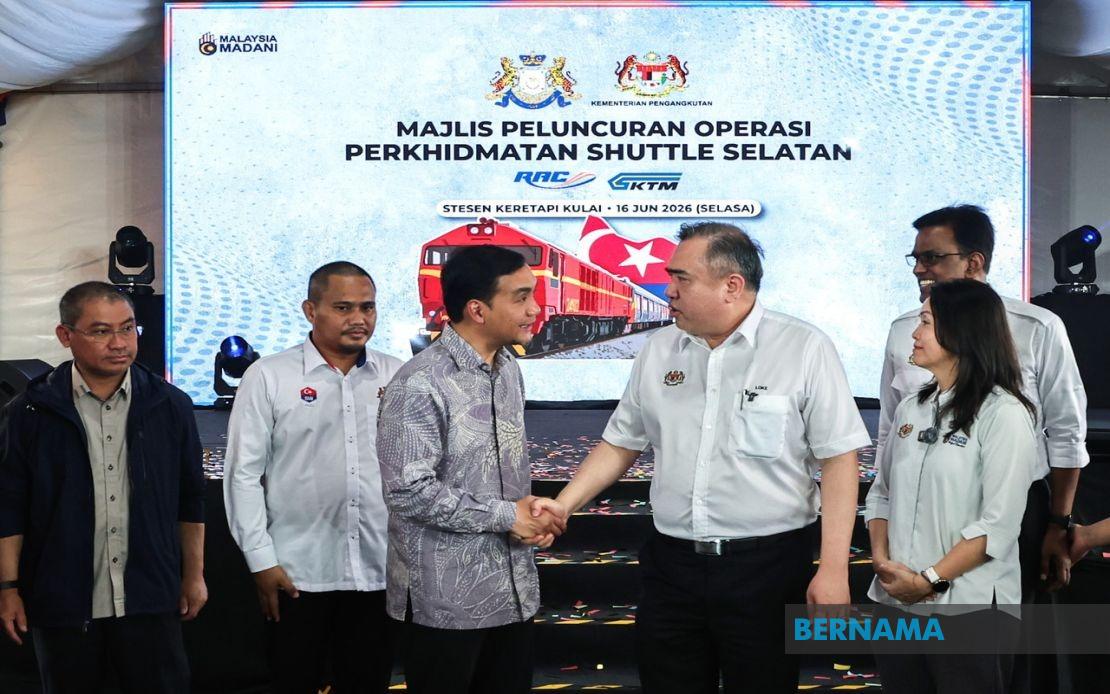
Transport Minister Anthony Loke unveiled the Shuttle Selatan service in Kulai on June 16, marking a significant milestone in Johor's evolving public transport infrastructure. The rail shuttle, which connects three major population and commercial centres, is designed to accommodate the region's rapidly expanding population and economic activity. Officials project that the service will directly benefit more than two million commuters spread across Kulai, JB Sentral and Pasir Gudang, making it one of Johor's most anticipated transport initiatives in recent years.
The inaugural phase of Shuttle Selatan operates along two primary corridors: Kulai to JB Sentral and back, and Kempas Baru to Pasir Gudang and return. These routes have been strategically selected to connect residential zones with the state capital and major industrial precincts. Transport planners positioned the service to address critical connectivity gaps that have hindered commuter flows in southern Johor, where congestion on road networks has become increasingly problematic as the region continues its industrial and residential expansion.
Minister Loke outlined an ambitious roadmap for future expansion, revealing plans to extend the network from Paloh through to Kulai via the station stops at Kluang, Renggam and Layang-Layang. This extension would significantly broaden the service's geographical reach and integrate communities currently underserved by rail-based public transport. The ministry's vision reflects recognition that Johor's ongoing growth—particularly in manufacturing, logistics and port operations—demands corresponding improvements to transport capacity and efficiency to prevent gridlock and support business competitiveness.
Three additional stations have been earmarked for future development: Taman Daya, Bandar Baru Sri Alam and Pasir Putih. These new facilities are intended to increase accessibility for residents in emerging residential clusters and reduce dependency on private vehicles for daily commuting. By distributing stations across a wider geographic footprint, authorities aim to make rail transport a genuinely convenient option for a broader cross-section of the population, not merely those living within walking distance of major transport hubs.
Journey times represent a key competitive advantage for the new service. The Kulai to JB Sentral route requires approximately 40 minutes, while the Kempas Baru to Pasir Gudang leg takes between 40 and 45 minutes. These durations position rail travel as an attractive alternative to private cars for many commuters, particularly when traffic congestion on parallel road routes is considered. For time-conscious workers and students, the predictability of rail schedules offers reliability that road-based commuting cannot consistently deliver during peak hours.
The government has implemented a comprehensive supporting infrastructure to maximize the service's utility and appeal. Complementary feeder bus services coordinate with Shuttle Selatan timetables, while Bas.My route integration ensures seamless transfers between different public transport modes. A dedicated shuttle service operates from Kempas Baru station, and park-and-ride facilities at AEON Bandar Dato' Onn enable drivers to abandon private vehicles and transfer to rail for the remainder of their journey. This multi-modal approach recognizes that most commuters cannot board trains directly from home and require intermediate transport options to reach stations.
To accelerate adoption, the Transport Ministry introduced the Commuter MADANI Shuttle Selatan Card, a promotional travel pass initially distributed free to 3,000 residents of Johor. The card, priced at RM50, grants unlimited rides on Shuttle Selatan for a designated period. Through this subsidy programme, the Railway Assets Corporation allocated over RM150,000 to incentivize modal shift from private vehicles to rail transport. Such initiatives acknowledge that behavioural change requires both infrastructure improvements and financial encouragement, especially when established commuting habits are deeply entrenched.
Johor Menteri Besar Datuk Onn Hafiz Ghazi and state officials attended the launch ceremony, underscoring the political priority assigned to transport modernization at the state level. Their presence reflected Johor's strategic importance as one of Malaysia's fastest-developing regions, where industrial expansion, port growth, educational institutions and cross-border trade create unprecedented demand for efficient movement of goods and people. The state government's commitment signals that transport planning will remain central to economic development strategy.
The Shuttle Selatan project represents coordinated effort among multiple stakeholders: the Ministry of Transport, Keretapi Tanah Melayu Berhad and the Railway Assets Corporation. This institutional collaboration demonstrates acknowledgement that modern transport systems require sustained partnership between government agencies and statutory bodies. Such coordination has historically been challenging in Malaysia's transport sector, making successful joint implementation a noteworthy achievement that may establish a model for future regional rail initiatives elsewhere in the country.
For Malaysia's broader context, the Shuttle Selatan launch underscores accelerating investment in rail-based public transport as congestion and environmental concerns intensify across major urban corridors. Johor's initiative complements similar projects in the Klang Valley and other metropolitan areas, suggesting a systemic shift in transport policy toward rail connectivity. However, success ultimately depends on sustained service reliability, fare affordability and integration with other transport modes—factors that will determine whether this initiative genuinely achieves its target of shifting two million journeys from road to rail.
The economic implications for Johor are substantial. Improved transport efficiency reduces business costs through faster, more predictable supply chains and worker mobility. Better connectivity between residential and employment areas enhances labour market flexibility and may attract investment in knowledge-intensive industries requiring access to diverse talent pools. Reduced congestion and modal shift also generate environmental benefits through lower transportation emissions, supporting Malaysia's sustainability commitments. These cumulative advantages position Shuttle Selatan as strategic infrastructure investment rather than merely a subsidized passenger service.

