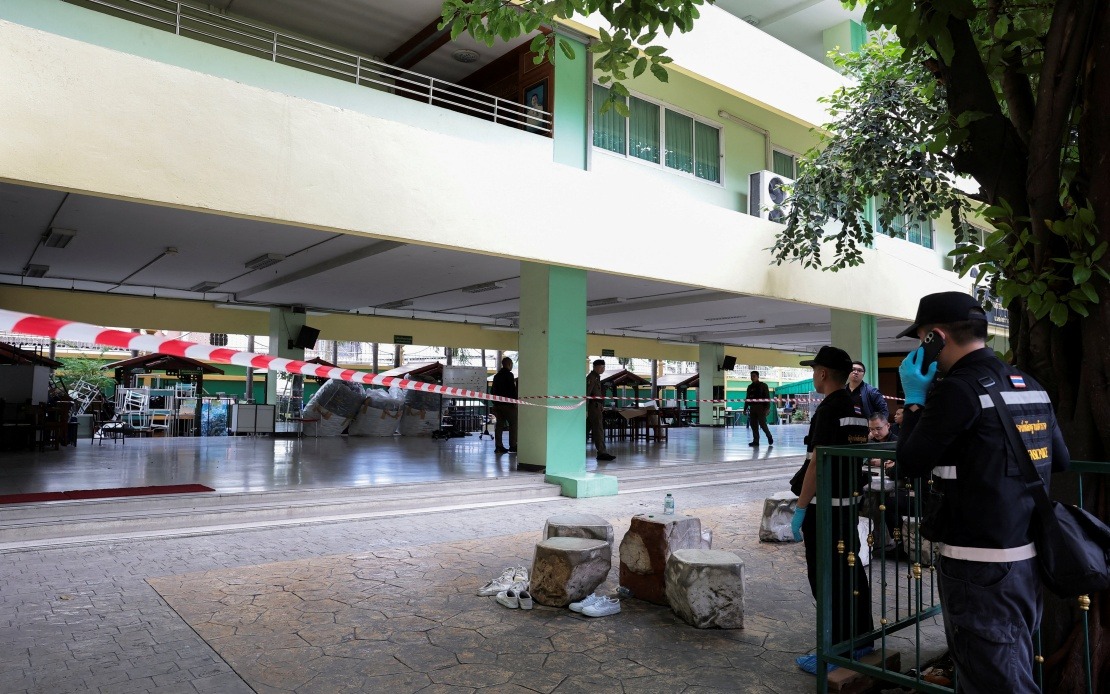
A deadly shooting at a school northwest of Bangkok has left seven dead and 15 injured, marking the second such incident in Thailand within six months and intensifying scrutiny of the country's firearm regulations. The violence erupted at Debsirin Nonthaburi School in Bang Kruai district on Friday morning around 10 am, when a student opened fire on staff and fellow pupils. Among those killed were three teachers, three students, and the gunman himself, according to Lieutenant General Trairong Piwpan, deputy inspector-general and spokesperson of the Royal Thai Police.
The swift response by authorities resulted in 15 wounded individuals being transported to hospital facilities, with two classified as critically injured. Trairong disclosed that investigators recovered a 9mm handgun and 34 rounds of ammunition from the scene. The weapon originated from the suspect's grandfather, a detail that has drawn attention to loopholes in how firearms are secured within households and transferred between family members.
Emergency protocols moved quickly into effect as teachers and students sheltered at neighbouring Chanrat Wittaya School. Parents began arriving to collect their children as authorities coordinated evacuation efforts and secured the campus. The national police leadership subsequently mandated that the Police General Hospital deploy trained psychologists to offer trauma counselling and psychological support to survivors and witnesses affected by the morning's carnage.
Prime Minister Anutin Charnvirakul, who holds concurrent responsibility as interior minister, arrived at the scene to survey the damage and express official condolences to bereaved families. His statement reflected the gravity of the tragedy, describing the incident as "terrible" whilst pledging government commitment to assist the injured and mobilise relevant agencies. Anutin's remarks carried a pointed policy message, linking the tragedy directly to the administration's stance on firearm licensing and renewal procedures.
The premier used the shooting to reinforce his government's position on restricting gun ownership, stating that the refusal to renew permits for civilian firearm possession and carrying had been justified precisely by incidents of this nature. This framing represents an attempt to position the government's regulatory approach as preventive, though the fact that the weapon belonged to a family member rather than the shooter himself complicates the narrative around personal licensing restrictions.
The timing of this tragedy carries particular weight given Thailand's recent history with school violence. Fewer than six months prior, in February, an 18-year-old gunman opened fire at a school in Hat Yai, located in Songkhla province in Thailand's south. That incident resulted in the death of a school director and injuries to others before police apprehended the suspect. The recurrence within such a short window suggests systemic vulnerabilities that exceed simple permit renewal policies.
The pattern of school shootings in Thailand mirrors broader global concerns regarding firearm access and mental health support systems. Both incidents involved young perpetrators with access to weapons, raising questions about oversight of firearms stored in private residences, particularly where adolescents may be present. The grandfather's legal possession of the 9mm handgun highlights a critical gap between individual licensing requirements and the security measures applied to stored weapons.
For Malaysia and other Southeast Asian nations observing these developments, Thailand's experience serves as a cautionary reference point. Although Malaysia maintains stricter overall firearm regulations through its Firearms Act, the incidents underscore the importance of comprehensive security protocols surrounding weapons storage, enhanced background checks for permit holders, and robust safeguarding of firearms in domestic settings. The psychological assessment and crisis intervention response deployed by Thai authorities also offers comparative lessons for regional security and trauma management frameworks.
The incident at Debsirin Nonthaburi School will likely catalyse renewed policy discussions within Thailand regarding gun control enforcement, though implementation challenges persist. The government's existing reluctance to renew firearm permits represents one approach, yet as this case demonstrates, weapons acquired years earlier under previous regulatory regimes remain in circulation. Addressing this requires retroactive security measures, public awareness campaigns, and possibly mandatory storage regulations for existing firearms.
The broader Southeast Asian context shows varying approaches to civilian firearm regulation. While Thailand's permitting system exists, enforcement and storage oversight appear inconsistent. Malaysia's more restrictive framework, coupled with the Philippines' recent crackdown on illegal weapons, illustrates regional movement toward tighter controls, though school safety remains dependent on multiple integrated systems rather than firearms policy alone.
Thailand's security apparatus will face scrutiny over whether early warning signs preceded the attack or whether rapid intervention prevented further casualties. Understanding how a school-age perpetrator acquired operational access to a 9mm handgun and ammunition—whether through deliberate theft, negligent storage, or family permission—will shape policy recommendations. The government's emphasis on preventing permit renewals may satisfy political accountability demands, yet addressing root causes requires simultaneous investment in youth mental health services, school security protocols, and family-based firearm safety education.
The psychological toll on the Nonthaburi school community and broader Thai society extends beyond immediate injury counts. Deploying mental health professionals reflects recognition that trauma compounds across survivor, witness, family, and community levels. This intervention model deserves replication across Southeast Asia, where school safety preparedness and post-incident psychological support often remain underdeveloped compared to institutional security measures.
As news of the shooting circulates throughout the region, Thai officials will face domestic and international pressure to articulate comprehensive solutions. Firearm regulation represents only one component; implementation of that regulation through consistent storage requirements, background checks, and security audits must follow. For Malaysia and neighbouring nations, the incident reinforces that even restrictive firearm frameworks require continuous oversight and that school safety demands multifaceted approaches encompassing security, mental health, and community engagement alongside weapons regulation itself.

