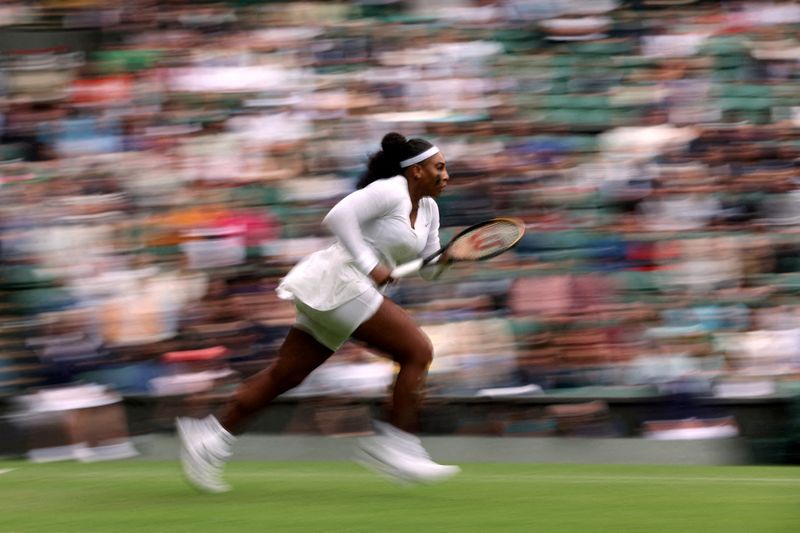
Serena Williams' impending arrival at the All England Club next week has fundamentally shifted the narrative around Wimbledon, even as the women's draw presents one of the most genuinely competitive fields in recent memory. The 23-time Grand Slam champion, now 44 years old, ended a four-year hiatus from competitive singles play when she received the eighth and final wildcard from tournament organisers, immediately transforming what was already shaping up to be an unpredictable fortnight into something far more compelling. Her comeback, which followed an apparent retirement in 2022, has captured the imagination of tennis fans globally and will undoubtedly drive record viewership and social media engagement throughout the championship.
Williams' return comes at a moment when the women's game has fractured into multiple contending forces rather than being dominated by any single player. The past decade has witnessed eight first-time Wimbledon champions since Williams herself claimed her seventh title in 2016, a dramatic testament to the current depth and diversity of talent at the sport's highest level. This unpredictability, while making for compelling tennis, also means that conventional wisdom about who should win has repeatedly failed to materialise. The championship favourite, world number one Aryna Sabalenka, appears vulnerable despite her ranking, having suffered a spectacular collapse at the French Open where she lost the final ten games after being just two points away from the semi-finals. Her recent performance in Berlin, where she surrendered a deciding set 6-0 to Jessica Pegula, further suggests that her emotional intensity, while often an asset, can become a liability at crucial moments.
Among the other serious contenders, Poland's Iga Swiatek carries the burden of defending her back-to-back Wimbledon titles and attempting to become the first player since Williams herself in 2016 to accomplish that feat. The task of repeating on grass is notoriously difficult, particularly in the modern era where serve-and-volley has given way to baseline power and consistency. Russian teenager Mirra Andreeva, who at 19 became the youngest French Open champion in 34 years, brings an audacious and creative style that could thrive on the swift Wimbledon courts, though grass represents uncharted territory for the rising star. American Coco Gauff, despite her talent and Grand Slam pedigree, continues to wrestle with the specific demands of grasscourt tennis, making this another opportunity for her to finally solve what has become a personal puzzle. Elena Rybakina, the 2022 champion, possesses one of the most potent and often unreadable power games in the sport, though her understated demeanour sometimes obscures the consistency she brings to major tournaments.
Yet all of these storylines pale when set against Williams' presence. Having spent the past months re-joining the professional anti-doping pool and training intensively with coach Rennae Stubbs, she has visibly prepared for this moment with surgical precision. Her reported loss of approximately 20 pounds and the reappearance of her legendary 120mph serve, demonstrated during her doubles comeback at Queen's Club, signal that she approaches this undertaking with the same meticulous attention to detail that defined her earlier career. For a player who has won 23 Grand Slam singles titles and spent more than a decade as the sport's most dominant force, the calculated risk of returning at Wimbledon rather than scheduling a series of warm-up events speaks to a confidence that few athletes possess at any stage of their careers.
The logistics of Williams' return carry inherent risk that would deter most players. She has not competed in a singles match in nearly two years, last stepping on court at the 2022 U.S. Open. Grass is notoriously unforgiving for comebacks, as the surface rewards precision and demands explosive movement in ways that other courts do not. The ball skids through quickly and sits low on the bounce, creating an environment that can punish rustiness instantly. Even commentators admiring of her decision acknowledge the difficulty: former world number one Andy Roddick noted that scheduling one's return to singles competition specifically at Wimbledon, rather than building confidence through satellite or lower-tier events, requires a level of self-belief that few athletes ever attain. Yet if anyone possesses the experience and weaponry to overcome these obstacles, Williams' résumé suggests she remains uniquely positioned to do so.
From a strategic standpoint, a Williams appearance creates genuine complications for other competitors, particularly Sabalenka. As tennis analysts have noted, if the two were to meet early in the tournament, the psychological asymmetry would favour Williams almost entirely. Should the American win even a single set or claim a few service holds after such a prolonged absence, she would have exceeded reasonable expectations and gained momentum. For Sabalenka, conversely, there exists no satisfying outcome: victory over a returning 44-year-old would generate criticism rather than praise, while defeat to a player returning from a four-year break would constitute a genuine calamity. This dynamic, peculiar to the Williams situation, adds a layer of psychological complexity that extends beyond normal tournament mathematics.
The championship draw also benefits from a competitive distribution that mirrors developments across professional tennis more broadly. Southeast Asian interest in the tournament has grown considerably, with increasing participation from the region's emerging players and growing viewership among fans seeking exposure to world-class grasscourt competition. The uncertainty surrounding Wimbledon's outcome, combined with Williams' presence, figures to drive engagement across Asia, where her legendary status transcends tennis enthusiasts and extends into broader popular culture. Her return story—focused on longevity, determination, and the possibility of late-career renaissance—resonates particularly with audiences valuing narratives of perseverance and excellence sustained across decades.
Weather and form will ultimately determine outcomes, but Williams has demonstrated throughout her career an almost uncanny ability to elevate her performance when circumstances demand it. Whether she can translate her doubles success and training regiment into meaningful singles victories remains uncertain, but the mere fact of her participation has already accomplished something significant: it has concentrated global attention on Wimbledon in ways that the quality of the draw alone might not have achieved. In transforming the conversation around the championship, she has reminded the sport precisely why she dominated it so completely for so long. Her very presence asks a question that no other player in the current draw can answer: what happens when a generational talent, having apparently stepped away from competition, decides that one more run at tennis' most prestigious venue is worth attempting? For Wimbledon itself, that question has become the championship's central narrative.
The practical reality of Williams' preparation also deserves examination. Her collaboration with coach Rennae Stubbs, herself a former professional and Wimbledon competitor, suggests a focused and realistic approach to the comeback. The weight management protocol, while never discussed in explicit detail by Williams or her team, reflects modern professional approaches to athletic longevity and performance optimisation. Her participation in mixed doubles at Queen's Club in the week preceding Wimbledon provided valuable match exposure and allowed her to gauge her physical responsiveness under competitive conditions. That partnership with Victoria Mboko enabled her to test the serve and baseline play without the full mental and physical demands of singles, a pragmatic preparation strategy that balances confidence-building against overextension.
The historical precedent matters here. Martina Navratilova played competitive Wimbledon tennis at age 47 in 2004, demonstrating that longevity at elite levels remains theoretically possible. However, Navratilova's later-career participation involved lower-profile rounds and lower expectations; Williams, by contrast, will face seeded opponents and have the sport's entire attention focused upon her every match. The gap between playing tennis at 47 and competing meaningfully in Grand Slam tournaments at 44 remains substantial. Yet Williams' prior accomplishments and the evolution of sports science since Navratilova's era suggest that the comparison, while interesting, does not fully capture the contemporary context in which Williams operates.
For Malaysian and Southeast Asian readers, the Williams comeback offers several angles of particular interest. Her dominance across two decades coincided with the professionalisation and expansion of tennis infrastructure throughout the region, introducing millions of viewers to elite-level competition. Her charitable and business interests have extended into Asia, creating personal connections with audiences beyond pure athletics. Furthermore, her career trajectory—defined by comebacks from various injuries and setbacks—mirrors the resilience narratives that resonate across Southeast Asian sporting cultures. The possibility that a player in her mid-40s can still compete meaningfully against the world's best speaks to values around determination and excellence that transcend geographical and cultural boundaries.
Ultimately, Williams' Wimbledon return transforms what might have been a competitive but essentially predictable championship into something far more complex. The woman who won seven Wimbledon titles and defined an entire era of women's tennis has inserted herself back into the conversation, not as a historical figure reviewing the sport's evolution, but as an active participant contending for success. Whether she wins matches or merely provides a stirring few weeks of compelling drama remains to be seen, but her presence has already accomplished what no other storyline could: it has made Wimbledon feel fresh, unpredictable, and genuinely compelling in ways that recent years have not consistently delivered. That, perhaps, represents her most significant victory before a single point has even been played.

