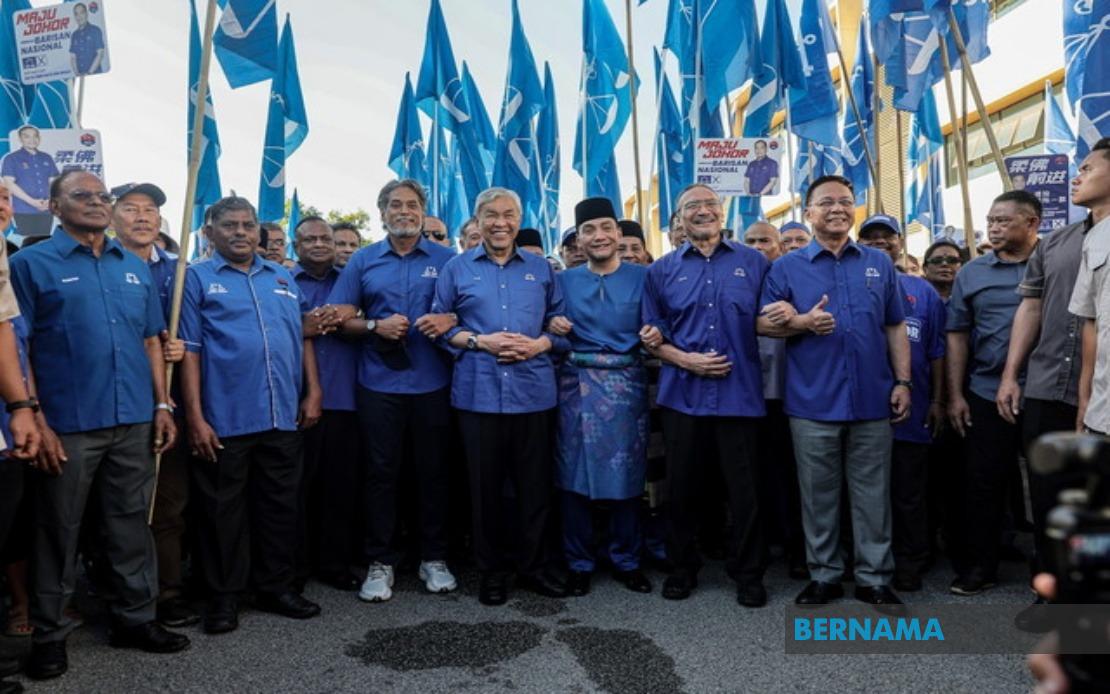
Datuk Onn Hafiz Ghazi, chairman of the Johor Barisan Nasional coalition, formally entered the race for the Johor state election by submitting his nomination papers at the Muafakat Hall in Simpang Renggam on June 27. The incumbent Machap assemblyman filed his candidacy at 9.10 am, making his intentions clear just as the electoral campaign season gained momentum across the southern state.
The high-profile turnout at the nomination centre underscored the significance Umno attached to Onn Hafiz's candidacy. UMNO president Datuk Seri Dr Ahmad Zahid Hamidi made the journey to Simpang Renggam to accompany the Johor leader, a gesture that conveyed the party's commitment to a competitive campaign. Alongside Zahid came Sembrong MP Datuk Seri Hishammuddin Tun Hussein and former minister Khairy Jamaluddin, both seasoned political operators with substantial influence within the party hierarchy. The presence of these figures suggested UMNO intends to mobilise its senior echelon in support of Onn Hafiz's electoral push.
Former Johor Menteri Besar Datuk Seri Hasni Mohammad also lent his presence to the occasion, connecting the current campaign to previous Umno-led administrations in the state. His attendance served as a reminder of the continuity the coalition seeks to establish, linking past governance records with future aspirations under Onn Hafiz's leadership. This intergenerational display of solidarity reflected an attempt to project party cohesion at a moment when internal divisions have occasionally surfaced within Umno over direction and strategy.
The nomination centre at Simpang Renggam transformed into a vivid display of electoral enthusiasm as the day progressed. Supporters in party colours congregated around the venue, brandishing banners and flags to demonstrate backing for candidates contesting the election. The visible energy suggested that campaign machinery on the ground had already mobilised effectively, with grassroots members energised and ready to canvass during the election period. Such scenes, replicated across multiple nomination centres, typically indicate the intensity with which different coalitions are approaching the contest.
Onn Hafiz's filing represents a pivotal moment in Johor's political calendar. As BN chairman in the state, his personal electoral success carries broader implications for how the coalition performs overall in what remains a politically significant contest within Malaysia. The 16th Johor state election holds considerable weight not only for local governance but also for national political positioning, with outcomes often interpreted as barometers of broader sentiment towards the federal government and its coalition partner parties.
The strategic deployment of UMNO's senior leadership to Simpang Renggam communicated several messages simultaneously. To party members and supporters, it reinforced UMNO's determination to retain influence in Johor despite previous electoral reverses. To potential swing voters, the presence of figures like Zahid and Hishammuddin signalled that candidates could access resources and networks that senior federal politicians commanded. Within the intraparty context, the show of unity helped project an image of a leadership united behind shared objectives, even as factional tensions occasionally surfaced within UMNO.
The nomination process itself represents a formal threshold in Malaysia's electoral system. Once candidates submit their papers and these are verified, they become official contenders entitled to conduct campaigns under specific regulations. For Onn Hafiz, successfully navigating this stage without procedural hiccups positioned him to move directly into active campaigning with minimal delay. The ceremony-like nature of nomination submissions, particularly when attended by senior figures, amplifies the political significance and ensures media coverage that extends the campaign's psychological dimension beyond the official announcement period.
Johor's political landscape has undergone substantial shifts in recent years, with electoral fortunes fluctuating between coalitions and independent candidates gaining ground in certain constituencies. Against this backdrop of volatility, Barisan Nasional's determination to project strength through coordinated senior-level appearances attempted to reassure both supporters and undecided voters that the coalition retained organisational capacity and national-level backing. The Johor electorate, accustomed to competitive contests and shifting alliances, would weigh such displays against actual governance records and policy proposals during the campaign proper.
The gathering at Simpang Renggam also served practical organisational purposes. The physical presence of Zahid, Hishammuddin, and Khairy allowed them to assess ground conditions, receive direct briefings from state-level operatives, and signal to local party structures that the centre was engaged and attentive to Johor's campaign. Such visits, multiplied across numerous constituencies, constitute part of the traditional machinery through which established coalitions maintain discipline and coordinate messaging during elections.
As campaigns unfold across Johor's constituencies, the early momentum established through nominations like Onn Hafiz's will be tested against competing narratives from opposition parties and the actual delivery of campaign promises to voters. The next phase will determine whether the show of senior-level unity translates into electoral gains or whether localized issues and candidate quality emerge as decisive factors in determining outcomes.

