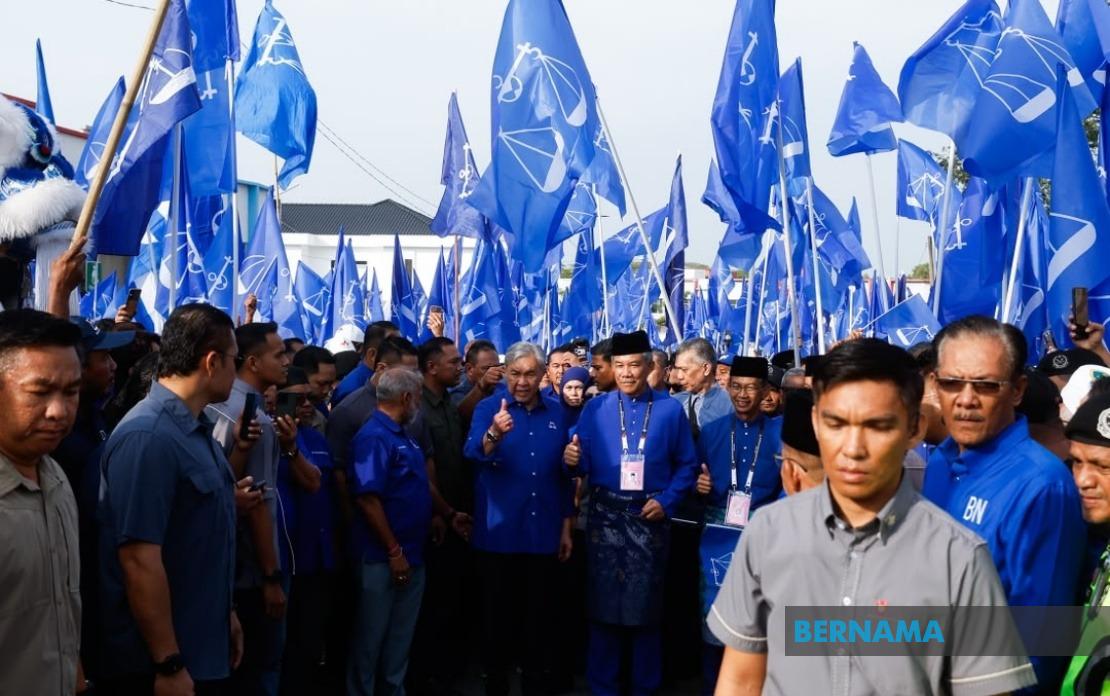
The 16th Negeri Sembilan state election officially entered its campaign phase on Thursday with senior political figures making a show of strength at nomination centres across the state. High-profile attendance by party executives underscored the significance the coalition and opposition parties are placing on the contest, even as voters prepare to cast ballots on August 1.
Barisan Nasional chairman Datuk Seri Dr Ahmad Zahid Hamidi, who also leads UMNO, arrived at the Dewan Seri Rembau nomination centre in Rembau at 8.40 am to accompany his deputy, Datuk Seri Mohamad Hasan. The timing reflected the coalition's coordinated campaign strategy, with Mohamad submitting his nomination papers to defend the Rantau state seat, a position he has represented since 2004. His lengthy tenure in the constituency signals the seat's importance to BN's firewall in the southern Klang Valley region.
All eight nomination centres opened simultaneously at 9 am and wound down operations an hour later, creating a compressed but intensive window for candidates to lodge their candidacies. This tight timeframe meant that orchestrated appearances by party heavyweights required precise coordination, reflecting the hierarchical nature of Malaysian electoral politics where senior endorsements carry symbolic weight with grassroots supporters.
The show of senior leadership extended across multiple constituencies. In Port Dickson, BN secretary-general Datuk Seri Dr Zambry Abd Kadir flanked Datuk Mohd Faizal Ramli, who is seeking to capture the Linggi state seat. UMNO vice-president Datuk Seri Johari Ghani similarly accompanied Suhaimizan Bizar, contesting for the Gemencheh seat within the Tampin parliamentary constituency. These parallel movements reflected the party's determination to project unity and organisational strength across diverse electoral terrain.
The Jempol parliamentary constituency witnessed particularly intensive engagement from the party establishment. UMNO secretary-general Datuk Dr Asyraf Wajdi Dusuki shepherded three candidates representing BN slate in the area. Datuk Mustapha Nagoor seeks the Palong seat, Datuk Mohd Zaidy Abdul Kadir the Jeram Padang seat, and Chong Fui Ming the Bahau seat. This concentration of executive attention on a single parliamentary zone suggests BN considers the area contested territory where momentum-building through senior visits could prove decisive.
The opposition secured its own moments of prominence through high-level participation. PAS president Tan Sri Abdul Hadi Awang appeared at a nomination centre to support Mohd Fairuz Mohd Isa, the party's aspirant for the Serting state seat. For PAS, which has limited representation in Negeri Sembilan compared to its strongholds in the northeast, such contests represent opportunities to build a presence in states where it has historically been marginal. Awang's personal involvement signals the Islamist party's ambitions to expand its peninsular footprint beyond its traditional support zones.
Partially homegrown party ASLI also fielded candidates, with its president Rashid Ka accompanying Dayana Dal, who is contesting the Jeram Padang state seat. ASLI's participation in the Negeri Sembilan contest reflects the broader fragmentation of Malaysia's political landscape, where smaller regional and special-interest parties occasionally contest state elections despite limited resources and minimal representation in most legislative chambers.
The dissolution of the Negeri Sembilan State Legislative Assembly on June 5, following consent from the Yang Dipertuan Besar of Negeri Sembilan, Tuanku Muhriz Tuanku Munawir, formally initiated the electoral process. The subsequent nomination day represents the tangible commencement of campaigning, with early voting scheduled for July 28 preceding main polling on August 1. This calendar compresses the campaign window compared to federal elections, placing a premium on rapid message dissemination and on-ground organisation.
The appearance of multiple senior figures at nomination centres serves practical purposes beyond symbolic reassurance. These visits generate media coverage, allowing parties to frame narratives about momentum and candidate viability to supporters and uncommitted voters alike. In a state election context where regional and factional loyalties remain pronounced, the visible backing of candidates by party presidents and secretaries-general can influence perceptions of their likelihood to win and their standing within party hierarchies. For candidates themselves, such endorsements become valuable currency for mobilising grassroots volunteers and demonstrating access to party resources.
Negeri Sembilan, despite its modest population and smaller number of state seats compared to the major peninsular states, carries strategic importance for coalition building in Malaysia. The state functions as a microcosm of national voting patterns, and results often carry implications for how analysts assess broader electoral trajectories. The relatively high turnout of senior national figures therefore reflects not merely local contest dynamics but also the state's role as a barometer for coalition health and opposition prospects.
The coming weeks will test whether this display of leadership cohesion translates into electoral success. For BN, retaining control remains the paramount objective in a state where the coalition has dominated historically. For PAS and ASLI, the contest offers platforms for demonstrating grassroots appeal and building organisational capacity for potential larger ambitions. Voter response to these competing appeals will crystallise in just weeks, with August 1 marking the culmination of efforts launched on nomination day.

