The Selangor state government has mounted a public awareness campaign to combat rising fraud attempts targeting residents through deceptive short message service communications purporting to be linked to the KitaSelangor Voucher scheme. In a statement released through the State Secretary's Office, authorities cautioned residents against clicking on suspicious hyperlinks and engaging with unverified messages originating from unauthorised sources, underlining the critical importance of digital vigilance as scammers exploit the anticipated launch of the assistance programme.
The official advisory emphasises that the public application window for the KitaSelangor Voucher Programme remains closed, and no resident should assume any communication they receive is legitimate unless it originates directly from verified state government channels. This clarification proves essential as fraudsters routinely impersonate government agencies to harvest personal information or financial details from unsuspecting victims, a tactic that has become increasingly sophisticated throughout Southeast Asia.
According to the state administration, eligible beneficiaries will begin receiving authentic notifications via SMS on a phased basis commencing June 23, enabling them to authenticate their personal records and lodge formal applications through the dedicated KitaSelangor Voucher Portal. The state government has advised all residents to await the official announcement scheduled for June 22 before engaging in any programme-related activities, providing a clear timeline that residents can reference when assessing the legitimacy of messages they receive.
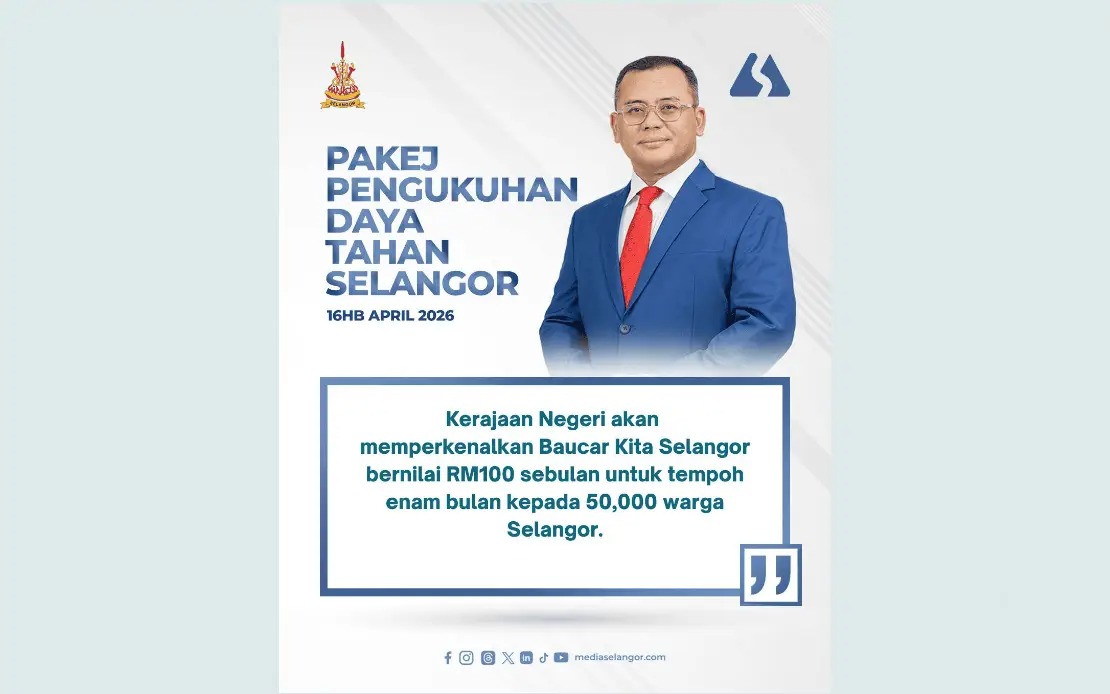
The KitaSelangor Voucher initiative represents a targeted poverty alleviation effort designed to support 50,000 low-income households across the state, providing RM100 monthly support over a six-month duration beginning June 30. This substantial assistance programme forms a cornerstone of the RM140 million Selangor Resilience Strengthening Package Phase 1, which was formally announced on April 16 and responds to multiple economic pressures confronting residents, including elevated living expenses, global supply disruptions, and macroeconomic uncertainty.
The allocation methodology reflects a data-driven approach to social assistance distribution. The state administration will prioritise households recorded in the eKasih poverty database, individuals who have experienced recent job displacement, persons classified as vulnerable populations registered with the Social Welfare Department, and unmarried mothers who satisfy the specified eligibility standards. This categorical framework ensures that assistance reaches those facing the most acute financial hardship, though it also necessitates careful verification processes that scammers frequently attempt to circumvent through fraudulent channels.
The prevalence of SMS-based scam messages exploiting government programme announcements reflects a broader challenge affecting digital governance initiatives throughout Malaysia. Fraudsters monitor media coverage of assistance schemes and subsequently deploy phishing campaigns that closely mimic authentic government communications, often replicating official branding and terminology to enhance credibility. Residents unfamiliar with official notification procedures remain particularly vulnerable, making public education an indispensable component of programme security.
Selangor's experience with voucher-based assistance schemes generates valuable insights for other Malaysian states considering similar initiatives. The sophistication of contemporary fraud operations demands that state governments invest substantively in authentication infrastructure and public communication strategies that exceed traditional awareness campaigns. Implementing clear verification mechanisms—such as official government portals accessible through verified domains and confirmation procedures via independently verified contact information—helps residents distinguish legitimate communications from fraudulent imitations.
The state's emphasis on official announcement timelines serves a dual purpose: it provides residents with a concrete reference point for assessing message authenticity while simultaneously constraining the window during which scammers can exploit uncertainty about programme launch dates. By establishing June 22 as the formal announcement date and June 23 as the SMS notification commencement, the government creates easily verifiable touchstones that residents can use to evaluate unexpected messages they receive.
For Malaysian residents contemplating assistance programme applications, the fundamental principle remains unchanged: avoid clicking links contained in unsolicited messages, refrain from providing personal or financial information via SMS, and instead navigate independently to official government websites using addresses verified through government publications and official statements. The KitaSelangor Voucher Portal will be accessible through the state government's verified digital infrastructure, eliminating any necessity to access applications through links provided in messages.
The broader implications of this fraud warning extend beyond the specific programme. As Malaysian governments increasingly deliver social assistance through digital channels, cybercriminals continuously refine their deception tactics. State and federal authorities must sustain parallel investments in fraud detection, resident education, and secure application platforms to maintain public confidence in legitimate government services and ensure that vulnerable populations receive intended assistance rather than becoming victimised by scammers exploiting their circumstances.
Social Welfare Department officials and community leaders throughout Selangor have been encouraged to amplify this advisory through their networks, particularly targeting populations with limited digital literacy who may struggle to identify fraudulent communications. The government's multi-layered communication approach reflects recognition that combating modern fraud requires coordinated action across governmental departments, civil society organisations, and community structures working in concert to protect vulnerable residents.