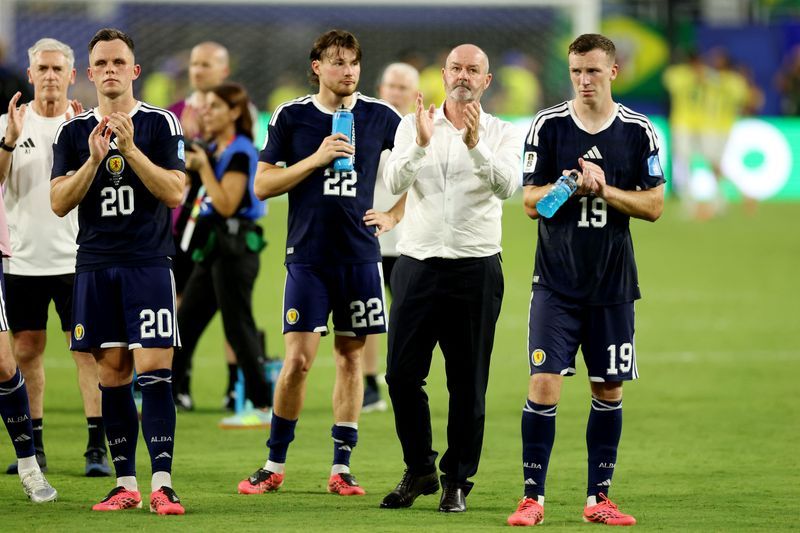
Scotland's first World Cup appearance in 28 years is effectively over after a 3-0 drubbing by Brazil in their final Group C fixture in Miami on Wednesday, with manager Steve Clarke accepting that his side's self-inflicted defensive lapses proved fatal against one of football's most clinical attacking units. The Scottish outfit finished with three points and currently sit in sixth place among the potential third-placed qualifiers, though with only six matches completed in the group stage and 20 still to be played across all 12 groups, a mathematical path to the knockout rounds technically exists for one of eight third-placed teams that will advance. Clarke's pessimism about Scotland's prospects, however, reflects a realistic assessment that at least two other third-placed finishers will leapfrog his team's tally, effectively condemning the Scots to an early exit despite their historic qualification achievement.
The Scotland manager pulled no punches in his post-match analysis, describing the result as fair and attributing the decisive margin directly to his players' profligacy in possession and organisational breakdown. Clarke emphasised that Brazil, a team renowned for converting opportunities in the final third, had been presented with a succession of dangerous chances that should never have materialised, with the Brazilian side converting three of the invitations while also missing additional scoring opportunities. Goalkeeper Angus Gunn's efforts in the Scotland net provided some respite, with the custodian producing several important saves that prevented the scoreline from becoming even more humiliating for the visitors. Yet Clarke acknowledged that his players had created limited attacking opportunities themselves, generating only one or two moments of genuine quality that might have challenged Brazilian goalkeeper Alisson, a stark contrast to the clinical finishing and creative flow Brazil demonstrated throughout the encounter.
Despite the evident frustration evident in Clarke's immediate assessment, he was careful to differentiate between frustration at the tactical and technical failings on display and anger toward the players who had engineered Scotland's qualification for this tournament. The manager stressed that his disappointment stemmed from his team's inability to perform anywhere near the standard they had demonstrated during the qualification campaign, with Clarke suggesting that any observer who had followed Scotland's journey to Qatar would recognise the gulf between the Scots' potential and their actual performance in the United States. This distinction proved important for Clarke, who sought to maintain team morale and squad unity despite the increasingly likelihood that their World Cup adventure would conclude without a knockout stage appearance.
Beyond the immediate match analysis, Clarke identified systemic vulnerabilities within Scottish football that the exposure to elite international opposition at a World Cup had exposed. The encounters with both Morocco and Brazil had illuminated deficiencies in the physical conditioning, raw power, and technical proficiency of Scottish players compared to top-ranked nations, prompting Clarke to advocate for structural changes in how Scotland develops young talent for the global stage. His comments suggested that the pathway from youth development through to professional football needed reassessment, with particular emphasis on creating conditions that would allow young Scottish players to develop the physical attributes and technical sophistication demonstrated by players from the world's elite footballing nations. This broader reflection hinted at systemic issues that transcended individual match performance, touching on academy structures, coaching methodologies, and player development philosophy across Scottish football.
The tournament has nonetheless provided a platform for Scotland's famous travelling support, the Tartan Army, to showcase Scottish culture and passion on the world stage. Clarke recognised the contributions made by Scotland's fans, acknowledging their status as ambassadors for the country and their role in creating a vibrant atmosphere throughout the competition. However, the manager also issued a subtle reminder about maintaining perspective, noting that Scotland's supporters would not have had the opportunity to travel to America were it not for the current group of players who had secured qualification for the tournament. Clarke's comments appeared aimed at ensuring that while the disappointment of early elimination would sting, the achievement of qualifying for the World Cup itself should not be entirely overshadowed by the manner of their group stage exit.
Scotland's journey to Qatar represented a significant milestone given their 28-year absence from a World Cup dating back to France in 1998, making their current participation a validation of the progression achieved under Clarke's management. The manager's willingness to acknowledge both the accomplishment of qualification and the shortcomings in execution suggested a balanced perspective on a campaign that would deliver mixed emotions for Scottish football supporters. With the mathematical possibility of advancing remaining slim and Clarke's own pessimism suggesting he expects at least two other third-placed teams to accumulate superior records, Scotland's thoughts are turning toward post-tournament analysis and the structural reforms Clarke believes necessary to elevate Scottish football to genuine competitiveness among elite nations.

