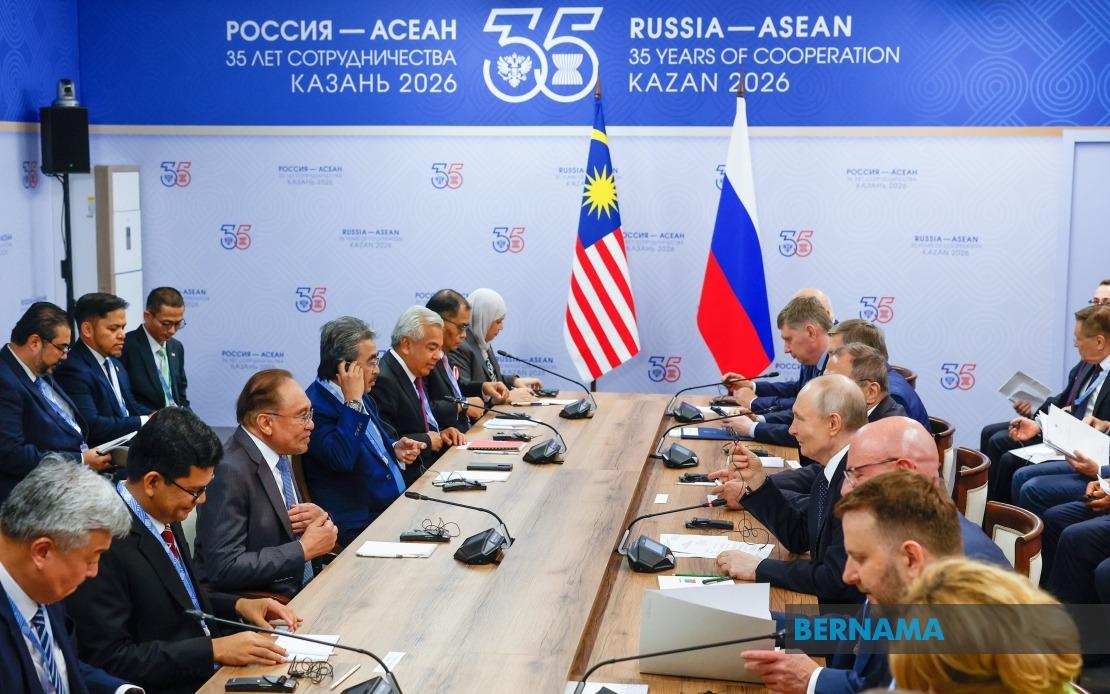
Russian President Vladimir Putin has signalled confidence in Russia and Malaysia's capacity to significantly deepen their bilateral partnership, citing the strong foundation both nations have built over decades of engagement. Speaking with Malaysian Prime Minister Datuk Seri Anwar Ibrahim during the ASEAN-Russia Commemorative Summit in Kazan on June 18, Putin underscored that the upcoming 60th anniversary of diplomatic relations between Moscow and Kuala Lumpur provides an opportune moment to chart ambitious new directions for cooperation.
The timing of Putin's remarks carries particular significance for Malaysia's regional diplomacy. As the country prepares to mark six decades of formal ties with Russia next year, policymakers in Kuala Lumpur are navigating a complex geopolitical environment where maintaining engagement with major powers remains strategically important. Putin's emphasis on the "substantive positive experience" accumulated through mutual cooperation suggests that despite global divisions, the two nations have managed to preserve channels of dialogue and practical collaboration that extend beyond government-to-government relations.
Trade performance forms a cornerstone of the renewed optimism expressed during the bilateral engagement. According to Putin, bilateral commerce expanded by 12.9 per cent during 2025, a trajectory that reflects steady economic integration despite international sanctions and broader geopolitical headwinds facing Russia. For Malaysia, this growth rate demonstrates that diversified economic partnerships with non-traditional Western partners remain viable and contribute meaningfully to overall trade volumes. The expansion comes as Malaysian businesses seek alternative markets and supply chain arrangements in an increasingly multipolar trading landscape.
Beyond commerce, both leaders highlighted the institutional frameworks sustaining their relationship. An intergovernmental commission dedicated to economic, scientific, technical and cultural cooperation provides the operational machinery through which Moscow and Kuala Lumpur translate political goodwill into tangible joint ventures and knowledge exchanges. Regular contact maintained through ministerial channels, government agencies, and parliamentary interactions indicates that relationship-building extends across multiple levels of bureaucracy rather than remaining concentrated at the executive level. This distributed approach to engagement typically proves more resilient when political circumstances shift or particular administrations change priorities.
Education and scientific cooperation emerged as areas of particular importance in Putin's assessment. Russia's historical strength in science and technology continues to appeal to Malaysian institutions and researchers seeking alternatives to traditional Western academic partnerships. Expanded cooperation in these domains could facilitate knowledge transfer in fields ranging from engineering to space science, particularly valuable for Malaysia's aspirations to develop indigenous technological capabilities. Tourism also featured in the discussion, representing an often-underestimated avenue for grassroots people-to-people contact that can sustain diplomatic relationships during periods of official tension.
Putin's recognition of Malaysia's chairmanship of ASEAN during 2025 carries specific diplomatic weight. By commending Malaysian support for strengthening the broader Russia-ASEAN strategic partnership, Putin acknowledged that bilateral ties exist within a regional context shaped by Southeast Asian institutional frameworks and consensus-building traditions. His reference to the first Russia-ASEAN summit held in Malaysia in 2005 served as historical reminder that bilateral relations have consistently operated within multilateral channels, with Malaysia functioning as a bridge facilitating engagement between Russia and the broader ASEAN community. This positioning allows Malaysia to maintain relationships with multiple great powers while leveraging its regional platform.
The personal dimension of diplomacy also featured prominently in the exchange. Putin's specific mention of his previous meetings with Anwar in Malaysia and his extension of best wishes to His Majesty Sultan Ibrahim, King of Malaysia, underscored the relational continuity that characterises bilateral engagement at the highest levels. Such courtesies, while sometimes dismissed as mere protocol, signal respect for Malaysia's institutional structures and recognition of the paramount role the monarchy plays in the nation's political system. These symbolic acknowledgements matter considerably in maintaining the confidence necessary for sustained cooperation.
For regional observers, the Kazan meeting illustrates how Malaysia continues cultivating strategic autonomy through engagement with multiple powers. Unlike some Southeast Asian nations that have aligned more explicitly with Western-led frameworks, Malaysia's approach has consistently emphasised the value of maintaining pragmatic relationships across ideological and geopolitical divides. This stance, rooted in Malaysia's own historical experience as a non-aligned nation, allows the country to pursue economic and diplomatic benefits from partnerships with Russia while simultaneously maintaining ties with Western governments and regional powers.
The 60th anniversary milestone carries psychological and political importance beyond its numerical significance. Reaching this threshold suggests a relationship has transcended temporary alignments or transactional exchanges to achieve enduring institutional and cultural embedding. For Malaysia, the anniversary provides an opportunity to reinforce public and elite awareness of the breadth and depth of Russia engagement, potentially countering perceptions in certain domestic constituencies that Malaysia's foreign policy is excessively Western-oriented. Similarly, for Russia, the anniversary underscores its continued relevance to Southeast Asian calculations despite international isolation and sanctions.
Looking ahead, the expansion trajectory outlined by Putin depends partly on the international environment and Russia's capacity to navigate ongoing economic pressures. However, the emphasis both leaders placed on institutional mechanisms and practical cooperation suggests that bilateral ties need not fluctuate dramatically based on short-term political events. The diversified nature of the partnership—spanning trade, education, science, culture, and humanitarian exchanges—provides multiple channels through which engagement can continue even if particular sectors face disruption.
For Malaysia's policymakers, deepening Russia ties offers tangible benefits across several dimensions. Economically, Russian markets and investment opportunities provide diversification away from traditional partners. Diplomatically, the relationship reinforces Malaysia's narrative of non-alignment and independent foreign policy decision-making. Institutionally, existing cooperation frameworks can be leveraged to address shared challenges in science, education and technology. The bilateral relationship, as Putin and Anwar's exchange in Kazan demonstrated, possesses substantial untapped potential that both nations appear committed to realising in the years ahead.