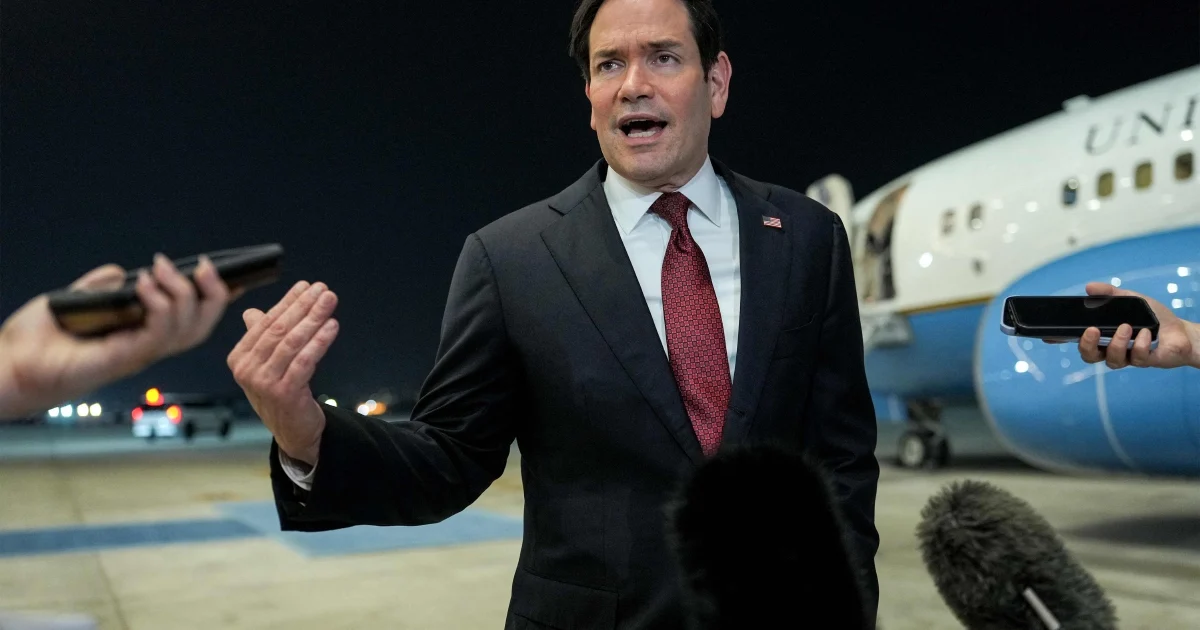
US Secretary of State Marco Rubio has firmly rejected the prospect of Washington accepting Iranian charges or fees levied on vessels transiting the Strait of Hormuz, marking a sharp point of contention as preliminary negotiations to wind down regional conflict encounter mounting complications. Speaking on Tuesday, Rubio signalled that the United States would treat any attempt by Tehran to impose tolls on the critical waterway as a non-starter, underscoring how swiftly the diplomatic process has hit substantive obstacles despite initial statements of willingness to engage.
The Strait of Hormuz represents one of the world's most strategically sensitive shipping lanes, with roughly one-fifth of global petroleum passing through its narrow passage annually. For Malaysia and other Southeast Asian economies heavily dependent on stable energy flows and unimpeded maritime commerce, Iranian attempts to control or monetise traffic through the waterway carry immediate implications. Any disruption to shipping routes or introduction of levies would ripple through regional supply chains and energy markets where Southeast Asia remains a net importer of hydrocarbons. The strait's criticality transcends mere commercial interest—freedom of navigation underpins the maritime security architecture that regional powers, including Malaysia, have built their strategic posture around.
Rubio's hardline stance reflects longstanding American insistence that international waterways remain open to unfettered passage. Tehran has periodically threatened to close or restrict the Hormuz passage during episodes of heightened tension, and the Iranian government has occasionally suggested that shipping nations should compensate it for security provision through the waterway. The Trump administration's position categorically forecloses such arrangements, signalling that the diplomatic pathway forward must respect existing international maritime law rather than establish new precedents for regional actors to extract revenue from commerce.
Beyond the immediate dispute over Hormuz, the negotiations have surfaced disagreements concerning Iran's nuclear programme and missile development. Nuclear inspections remain a central pillar of any durable accord, with international monitors requiring unrestricted access to Iranian facilities to verify compliance with agreed limitations. This touchstone issue has proven contentious in previous negotiations, and early indications suggest Tehran and Washington hold fundamentally different expectations regarding the scope and intrusiveness of oversight mechanisms. For Southeast Asian observers, the nuclear dimension carries significance extending beyond the Middle East—stability of the broader international non-proliferation regime ultimately supports regional security.
The missile dimension adds another layer of complexity. Iran's ballistic and cruise missile capabilities have expanded considerably over the past decade, and these systems constitute a source of concern for multiple parties, including American allies in the Gulf region. Any comprehensive settlement would likely require constraints on Iranian missile development, yet Tehran views these weapons as integral to its deterrence posture and has historically resisted external limitations on this domain. The gap between Washington's requirements and Tehran's red lines remains substantial, suggesting negotiations will prove protracted and demanding.
These early strains in diplomatic efforts illustrate the inherent difficulty of constructing settlements in deeply adversarial relationships. The issues dividing the parties are not peripheral—they touch upon core security concerns and fundamental questions about Iran's regional role and weaponry. Each side enters negotiations from entrenched positions forged through years of confrontation and mutual mistrust. Building common ground requires not merely technical compromise but shifts in the underlying threat perceptions that animate each actor's strategic calculus.
The timing of these disputes carries regional significance as well. Southeast Asian governments, including Malaysia, maintain careful diplomatic balances in the Middle East, sustaining relationships with both American-aligned states and Iran. Escalation of tensions or failure of negotiations could push regional actors toward uncomfortable choices regarding alignment and security partnerships. Conversely, a successful negotiated settlement could reduce the likelihood of military confrontation and restore stability that benefits global commerce and regional economies reliant on predictable energy supplies.
For Malaysia specifically, the Strait of Hormuz situation warrants close monitoring given the nation's role as a major shipping hub and energy consumer. Disruptions to the waterway would directly impact Malaysia's petrochemical industries, refineries, and broader economic activity dependent on stable fuel supplies. Maritime security in the Indian Ocean and beyond depends substantially on freedom of navigation principles that American policy seeks to preserve.
The broader context of these negotiations encompasses the question of whether diplomatic channels can effectively manage great power competition and regional conflicts in an era of heightened geopolitical tension. Success requires both sides to move beyond maximalist positions and identify genuine areas of mutual interest—principally, avoiding military escalation that would prove catastrophically costly. Whether Rubio's early firmness on issues like Hormuz tolls presages genuine negotiating flexibility on other fronts, or whether it signals a hardening of positions, will become clearer in coming weeks as formal talks progress.

