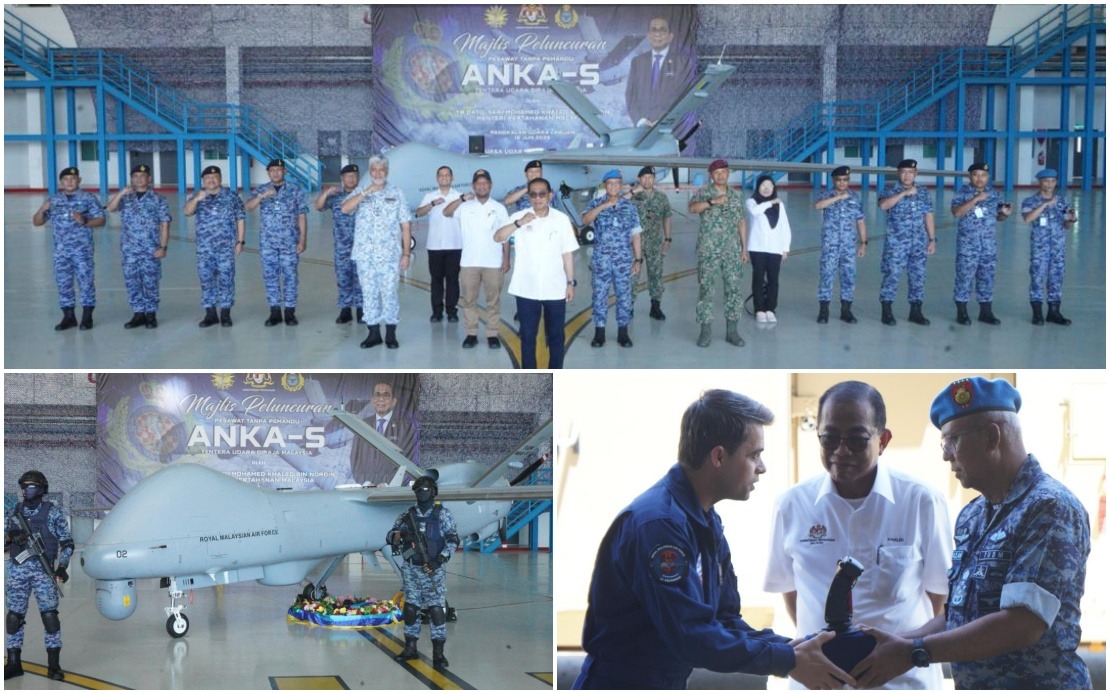
Malaysia has taken a significant step forward in modernising its maritime security apparatus with the operationalisation of the ANKA-S Unmanned Aircraft System by the Royal Malaysian Air Force. Defence Minister Datuk Seri Mohamed Khaled Nordin unveiled the capability at RMAF Labuan Air Base, describing the development as a transformative leap in the country's capacity to monitor and protect contested waters in Southeast Asia. The introduction of this advanced surveillance platform addresses a longstanding gap in Malaysia's defensive posture over one of the world's busiest and most disputed maritime zones.
The three ANKA-S aircraft, designated as No 11 Squadron assets, arrived following an investment of RM423.8 million that encompassed the aerial platforms themselves, complete ground control infrastructure, and a two-year comprehensive training programme for operational personnel. This substantial financial commitment reflects the Malaysian government's determination to establish indigenous capability rather than rely exclusively on external security partnerships for maritime awareness. The system's basing at Labuan positions it strategically to monitor the South China Sea, where Malaysia maintains significant exclusive economic zone claims and where maritime tensions periodically escalate between regional powers.
The ANKA-S belongs to the Medium Altitude Long Endurance category of unmanned systems, a classification that denotes its capacity for extended operational duration and elevated flight profiles. Each aircraft can remain aloft for more than 24 hours continuously, operating at altitudes reaching 30,000 feet, capabilities that fundamentally alter Malaysia's surveillance envelope. This endurance profile means the system can maintain persistent watch over maritime approaches without the operational interruptions that plagued earlier surveillance methodologies. The technological specifications translate into practical advantages: the ANKA-S can loiter over areas of interest, track vessel movements with precision, and generate actionable intelligence without the visibility and noise signatures of manned aircraft.
From an operational perspective, the ANKA-S addresses efficiency concerns that have constrained Malaysia's maritime security posture for years. Previously, monitoring contested waters required deploying expensive fighter jets or large patrol vessels on extended missions with uncertain payoff. These manned platforms consume fuel, require crew rotation, and generate costs that accumulate rapidly when applied to vast ocean expanses. The unmanned alternative reduces this financial burden substantially while paradoxically improving surveillance effectiveness. With accurate vessel identification and tracking capabilities, the system enables the Royal Malaysian Air Force to direct available assets—whether naval vessels or aircraft—directly to locations where intrusions occur, eliminating wasteful search patterns and concentrating resources where intelligence confirms actual threats.
Defence Minister Mohamed Khaled emphasised a deliberate strategic choice regarding the ANKA-S's weaponisation potential. Although the platform possesses the structural and systems capacity to carry ordnance, Malaysia has chosen not to equip the aircraft with weapons. This decision reflects a carefully calibrated messaging strategy: by deploying an armed capable but unarmed surveillance system, Malaysia signals to regional neighbours and international observers that its defence modernisation programme aims at protection rather than aggression. This posture carries particular weight in the South China Sea context, where accusations of militarisation frequently generate diplomatic friction. The choice to emphasise surveillance over strike capability allows Malaysia to strengthen security without triggering the escalatory rhetoric that armed capability deployments typically provoke.
The government has already begun considering an expansion of this surveillance capability through a proposed second-phase acquisition of three additional ANKA-S aircraft. This expansion proposal awaits submission within Malaysia's national development planning framework, suggesting confidence in the initial platform's performance and recognition that comprehensive coverage of Malaysia's claimed maritime zones requires greater asset density. Six operational aircraft would enable overlapping patrol patterns, reducing coverage gaps and providing redundancy should individual systems require maintenance. The second phase would essentially double Malaysia's unmanned surveillance capacity and represent a commitment to sustained, systematic intelligence gathering across disputed waters.
The technical specifications of the ANKA-S platform provide Malaysia with capabilities previously unavailable. The system's Intelligence, Surveillance and Reconnaissance functionality, demonstrated at the Labuan launch through live operational trials, generates real-time data that flows to ground exploitation centres where analysts process raw imagery into actionable intelligence. This data pipeline—from airborne sensor through processing stations to decision-makers—substantially compresses the decision cycle when maritime intrusions occur. Personnel can identify vessel types, track courses, monitor activities, and provide precise positioning information that enables rapid response without the guesswork that characterised earlier detection methods.
For Malaysia's strategic position in Southeast Asia, the ANKA-S acquisition carries implications beyond immediate surveillance benefits. The system demonstrates that Malaysian defence planners are investing in indigenous capability development rather than accepting permanent technological dependence on external powers. While the ANKA-S itself represents Turkish technology, the acquisition and operation of such systems builds institutional knowledge and operational expertise within the Malaysian defence establishment. This gradual capability accumulation strengthens national autonomy in security decision-making and reduces vulnerability to external pressure or supply chain disruptions.
The South China Sea context makes this development particularly resonant. Malaysia's claims in the region remain contested by larger powers, and the ability to conduct continuous, systematic surveillance enhances the factual basis for Malaysian assertions about activities in its waters. Documented evidence of intrusions, backed by credible sensor data from modern platforms like the ANKA-S, carries greater diplomatic and legal weight than unsupported assertions. As maritime law continues evolving and as international mechanisms for adjudicating competing claims develop, nations with robust documentation of their enforcement activities gain negotiating advantages.
The launch of the ANKA-S system at Labuan also reflects broader regional trends toward unmanned surveillance capabilities. Several Southeast Asian nations have acquired or are evaluating similar systems, and Malaysia's move positions it competitively within this emerging security paradigm. The technology itself represents a democratisation of capability—smaller nations can now deploy surveillance assets that rival those of larger powers at fractions of historical costs. This shift particularly benefits maritime states like Malaysia, which face vast ocean zones requiring constant monitoring.
Operational effectiveness will ultimately determine whether the RM423.8 million investment yields anticipated returns. The system's success depends on integration with existing naval and air force operations, adequate personnel training, and sustained political commitment to continuous operations. The two-year training programme embedded in the acquisition contract suggests recognition of these integration requirements. Going forward, data on intrusion detection rates, response effectiveness, and operational costs will indicate whether the ANKA-S fundamentally transforms Malaysia's maritime security posture or represents incremental improvement within existing constraints.
The government's willingness to invest substantially in surveillance capability, while deliberately avoiding weaponisation, reflects a nuanced understanding of regional security dynamics. Malaysia seeks enhanced defensive awareness without triggering security dilemmas or escalatory responses. This calibrated approach—technological strengthening paired with reassuring strategic signalling—may offer lessons for other Southeast Asian nations balancing security improvement with regional stability concerns. The ANKA-S deployment represents not merely an equipment acquisition but a statement about how Malaysia intends to secure its interests in contested waters.