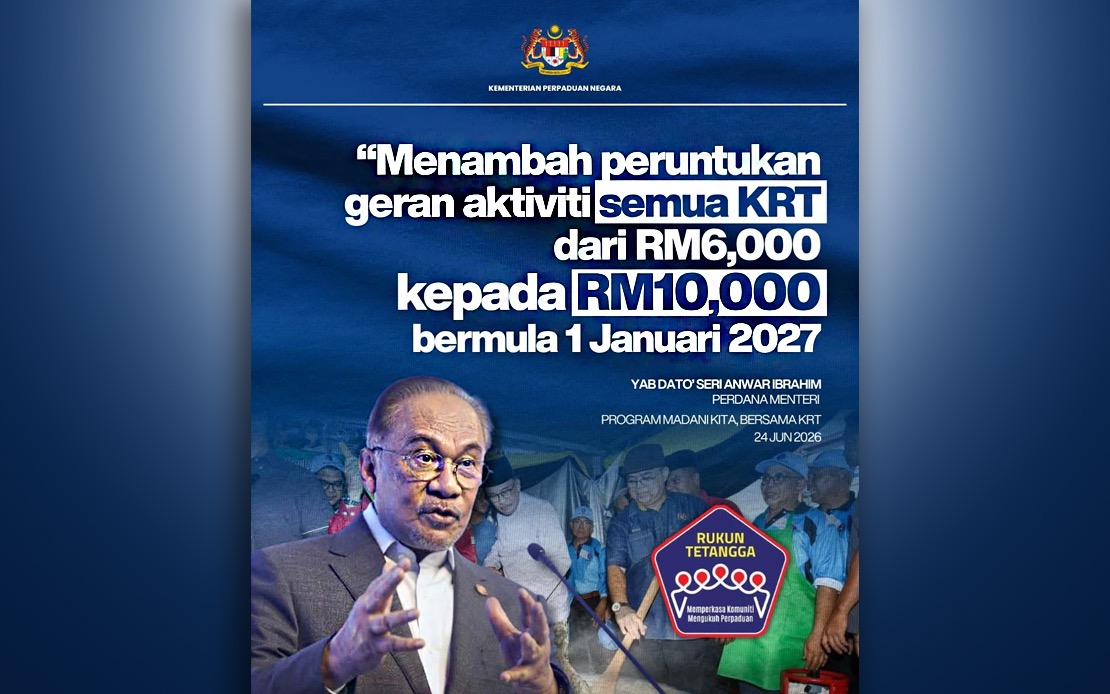
The Malaysian government has significantly enhanced support for the nation's neighbourhood watch movement, raising the annual operational grant for all 8,615 registered KRT (Kawasan Rukun Tetangga) groups from RM6,000 to RM10,000. Prime Minister Datuk Seri Anwar Ibrahim made the announcement during the MADANI KITA programme in Dataran Segamat, Johor, on June 24, with disbursements scheduled to commence from January 1, 2027. This 67 percent increase underscores the government's recognition of neighbourhood watch organisations as fundamental institutions that have sustained social cohesion and grassroots development across Malaysia for more than five decades.
National Unity Minister Datuk Aaron Ago Dagang characterised the funding boost as emblematic of the MADANI administration's broader vision to strengthen community-driven initiatives at the grassroots level. According to the minister, the enhanced grants directly reflect the government's commitment to empowering localised movements that serve as cornerstones for building a cohesive and forward-looking society. The framing of this initiative within the MADANI framework—the government's overarching development philosophy emphasising inclusivity and prosperity—signals that neighbourhood watch groups are positioned as instrumental to achieving national development objectives beyond traditional security concerns.
The scale of KRT's grassroots reach is substantial. The Ministry of National Unity oversees approximately 250,000 KRT members operating across the country, collectively serving more than 12 million Malaysians. Throughout the past year alone, these neighbourhood organisations conducted over 100,000 community activities, demonstrating the depth of engagement and the volume of direct service delivery happening at the hyperlocal level. This extensive network means the funding increase will have multiplicative effects, touching millions of households and neighbourhoods where these groups function as primary connectors between government policy and community implementation.
The additional funding is intended to expand and deepen the scope of programmes that KRT organisations can deliver. Aaron outlined several priority areas for utilisation of these enhanced grants, including unity-focused activities designed to strengthen inter-community relations, formal community development projects, welfare and social support services, educational initiatives, neighbourhood security operations, volunteer mobilisation efforts, and local economic empowerment schemes. By broadening the financial capacity available to each KRT unit, the government expects these grassroots organisations to move beyond basic operational requirements and invest in higher-impact, multi-dimensional programming that addresses interconnected social challenges.
The emphasis on unity-building activities reflects deeper strategic thinking about Malaysia's pluralistic society. Aaron stressed that neighbourliness transcends ethnic, religious, and cultural boundaries, positioning the foundation of good neighbour relations as the true bedrock of national unity. In a nation as diverse as Malaysia, where communities are often stratified by ethnicity, faith, and socioeconomic status, the KRT system serves as an institutional mechanism to cultivate trust and solidarity across these dividing lines. The increased funding acknowledges that fostering these relationships requires sustained investment and organised effort, not merely goodwill.
KRT organisations have already demonstrated their capacity to serve as trust-building platforms. The ministry credits these groups with establishing environments where diverse communities interact regularly, breaking down mutual suspicions and solidifying the social fabric that underpins national stability. This track record suggests that expanded funding will enable KRT to formalise and scale successful practices, implementing more structured programmes that deliberately bring neighbours together and create opportunities for meaningful interaction beyond casual encounters.
The timing of this announcement, coupled with the phased implementation beginning in 2027, suggests careful fiscal planning within the government's budget cycle. By communicating the initiative with a lead time of several months, the government allows KRT organisations to plan programming and administrative adjustments in anticipation of the increased funding. This approach differs from immediate disbursement and reflects recognition that effective utilisation of resources requires preparation and strategic thinking at the grassroots level.
For Southeast Asian readers observing Malaysia's approach, this initiative offers insights into how a developing nation is operationalising community engagement in service of national cohesion. Many countries in the region grapple with balancing rapid modernisation with maintenance of social bonds, particularly in ethnically diverse societies. Malaysia's investment in strengthening neighbourhood-level organisations—institutions that predate modern governance infrastructure—demonstrates one model for preserving and formalising traditional community structures within contemporary administrative frameworks.
The funding increase also reflects broader recognition that Malaysia's development trajectory depends not solely on economic growth metrics or infrastructure projects, but on the quality of social relationships and the capacity of communities to address their own challenges collectively. By increasing resources available to KRT, the government signals that it views grassroots social capital as a strategic asset worthy of direct investment, comparable to allocations for physical infrastructure or economic development.
Local implementation will be crucial to the initiative's success. KRT leaders and volunteers will need to translate increased funding into programmes that genuinely resonate with their communities and address locally-identified priorities. The government's confidence in devolving this discretion to neighbourhood units suggests trust in grassroots decision-making, though guidance on best practices and coordination mechanisms will likely emerge as groups begin planning for 2027 expenditures.
The announcement also carries implicit messaging about the government's approach to inclusive development. Rather than concentrating resources in major urban centres or economically strategic zones, the decision to increase grants uniformly across all 8,615 KRT units—spanning both developed and less-developed areas—emphasises equitable resource distribution. This approach acknowledges that social cohesion and community wellbeing are national priorities that deserve investment across the entire geography.
Looking ahead, the success of this funding initiative will be measurable through both quantitative indicators—numbers of activities conducted, participation rates, programmes launched—and qualitative assessments of whether neighbourhoods genuinely experience strengthened social bonds and improved collective problem-solving capacity. As Malaysia implements the MADANI vision, neighbourhood watch organisations funded at enhanced levels will serve as visible manifestations of the government's commitment to grassroots empowerment and community-centred governance.
The RM10,000 annual grant, while a significant operational increase for most neighbourhood units, also highlights the resource-constrained environment in which KRT operates. Even with this enhancement, individual groups remain relatively modestly funded compared to many formal institutions, underscoring the remarkable impact these volunteer-driven organisations achieve with limited means and the latent potential for expanded impact with marginal increases in resources.

