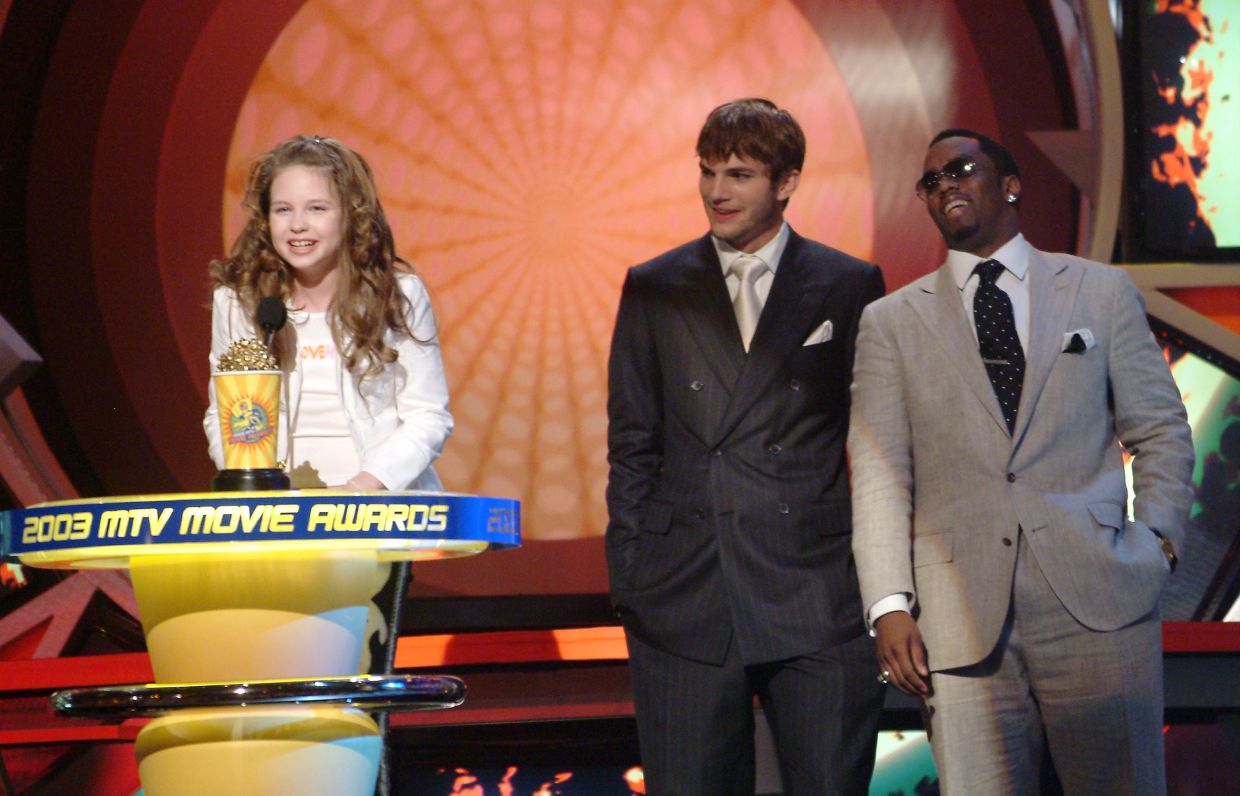
An archival video from the 2003 MTV Awards has resurfaced online in the wake of actress Daveigh Chase's death, capturing a moment between the preteen performer and Sean 'Diddy' Combs that has taken on troubling new dimensions given the music mogul's recent criminal convictions. The brief exchange, filmed during the awards ceremony where Chase received the Best Villain trophy for her haunting performance as Samara Morgan in The Ring, shows Combs approaching the child with a drink in hand and casually asking whether she planned to attend his after-party.
Chase, who achieved early prominence through her role in the 2002 horror film and subsequent television appearances, passed away on June 16 at a Los Angeles hospital at the age of 35. Her father, John Schwallier, disclosed that his daughter had struggled with severe health complications in her final years, including bacterial meningitis, blood infection, and acute malnutrition. The circumstances surrounding her death underscored a difficult period in which the former child star battled addiction and homelessness, living on the streets near the very hospital where she ultimately succumbed to her ailments.
The video's sudden circulation carries particular weight in light of Combs' spectacular downfall over the past year. The 55-year-old entertainment executive was taken into custody in September 2024 at the Park Hyatt Hotel in Manhattan following a federal investigation that would ultimately expose the systematic nature of his alleged misconduct. Prosecutors alleged that Combs orchestrated what they termed 'freak-off' parties, which were characterized as multi-day events featuring extensive drug use and commercial sexual activity, frequently involving individuals working in the sex trade.
In the specific moment captured from the 2003 MTV Awards, presenter Ashton Kutcher stands beside Chase as Combs extends his invitation to the pre-adolescent actress. Chase's apparent acquiescence—a simple nod of the head—prompted an enthusiastic response from Combs, who declared 'Yeah!' with visible satisfaction. Kutcher's reaction to the exchange, captured in the footage, was to laugh off what appeared at the time to be an innocuous interaction between industry figures and a young performer at a high-profile entertainment event.
The significance of this footage lies not in any single conversation but in the broader pattern of behaviour that has since emerged through legal proceedings. In July 2025, Combs was found guilty of two counts related to transportation for purposes of engaging in prostitution following a comprehensive federal sex trafficking trial conducted in New York. The conviction resulted in a substantial prison sentence of 50 months, positioning Combs among the highest-profile entertainment figures to receive such a custodial term in recent memory.
Currently detained at FCI Fort Dix, a federal correctional facility located in New Jersey, Combs faces an expanding legal reckoning that extends far beyond his criminal conviction. The disgraced producer has become the defendant in more than 100 civil lawsuits, with claimants alleging various forms of misconduct spanning years of his career. These civil actions represent a secondary wave of accountability that frequently proves more devastating to public perception and financial security than criminal proceedings, as they often result in substantial monetary judgments and permanent reputational harm.
The resurfacing of this particular video exemplifies how historical documentation can acquire entirely new meaning when subsequent events reveal patterns of behaviour. What appeared at the time as merely an eccentric interaction between industry personalities and a child performer now reads as emblematic of a culture that permitted powerful figures considerable latitude in their treatment of younger, less protected individuals. The entertainment industry's historical reluctance to scrutinize such moments, or to recognize them as potentially problematic, has come under intensified examination following the recent surge in accountability movements.
For Malaysian audiences and Southeast Asian observers, this case represents a cautionary examination of celebrity power imbalances and institutional failures in the entertainment sector globally. The trajectory from Combs' public prominence and unchecked influence to his conviction and imprisonment demonstrates the eventual, if delayed, mechanisms through which accountability can be enforced through legal systems. However, the concurrent death of Chase under tragic circumstances underscores the human cost of these systemic failures, particularly for vulnerable individuals who entered the industry at young ages.
The emergence of such footage also raises broader questions about historical documentation and digital archives in an age of rapid technological change. Videos that were briefly viewed and forgotten during their original broadcast now circulate globally within hours, reaching audiences and interpretive frameworks entirely different from those present in 2003. This phenomenon has both negative aspects—as in the potentially exploitative resharing of content involving a deceased minor—and accountability benefits, as it prevents powerful figures from fully escaping the visual record of their actions.
As Combs serves his sentence and faces the mounting civil litigation that will likely occupy him for years to come, this 2003 video serves as a historical marker of a moment before accountability mechanisms began functioning, however imperfectly. The image of the young actress and the confident predator stands as documentation of a systemic problem that has finally begun to receive serious consequences, though not before significant human damage had occurred.

