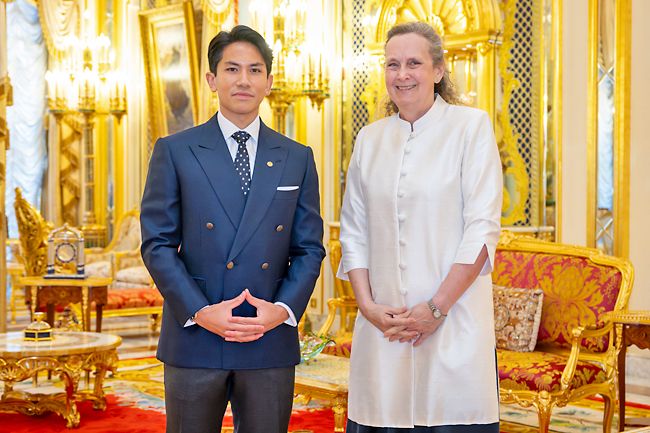
His Royal Highness Prince 'Abdul Mateen, who serves as Brunei Darussalam's Minister of Foreign Affairs, received outgoing United States Ambassador Caryn R McClelland for a formal audience on Saturday, June 20, at Istana Nurul Izzah in Bandar Seri Begawan. The reception marked the conclusion of McClelland's posting to the sultanate and underscored the significance Brunei places on its relationship with Washington at the ministerial level.
During the audience, Prince 'Abdul Mateen extended formal gratitude to the departing envoy for her work in reinforcing ties between the two nations. His remarks reflected the importance both governments attach to their bilateral partnership, which has evolved considerably over recent years as regional geopolitical dynamics shift throughout Southeast Asia. The recognition of McClelland's contributions signals Brunei's commitment to maintaining robust relations with the United States during a period of significant regional transformation.
McClelland's tenure in Brunei encompassed a substantive expansion of cooperation across multiple domains. The countries advanced their strategic alignment through enhanced defence collaboration, reflecting broader regional security concerns. Educational exchanges between institutions in both nations were strengthened, facilitating greater mobility of students and scholars and deepening cultural understanding between American and Bruneian societies.
Trade and investment initiatives formed another pillar of deepened engagement during McClelland's time in the sultanate. Both governments worked to facilitate commercial links and create frameworks for American businesses to engage with Brunei's economy, particularly in sectors aligned with the sultanate's long-term development vision. Such economic cooperation extends beyond mere commercial transactions, serving as a foundation for sustained political dialogue and mutual prosperity.
People-to-people exchanges accelerated under McClelland's ambassadorship, encompassing cultural programmes, business delegations, and academic partnerships. These grassroots connections complement official state-level relations and generate sustained public interest in bilateral affairs. By fostering direct contact between citizens of both nations, such initiatives create constituencies within each country invested in maintaining positive relations.
The timing of McClelland's departure comes as Brunei continues to navigate its regional role within the Association of Southeast Asian Nations and broader Indo-Pacific geopolitics. The sultanate, while modest in size, occupies a strategically significant position along major maritime lanes and maintains important energy resources. Brunei's relationship with the United States forms part of its broader balancing act between major powers, ensuring the small nation maintains relevant partnerships without compromising its autonomy.
McClelland formally presented her credentials to His Majesty Sultan Hassanal Bolkiah, Sultan and Yang Di-Pertuan of Brunei Darussalam on May 24, 2022, initiating her tenure in the role. The duration of her posting reflected the standard diplomatic rotation cycles, during which ambassadors typically serve between three and four years before reassignment or completion of their foreign service careers.
For Malaysia and other Southeast Asian nations, Brunei's partnership with Washington carries indirect implications. The bilateral relationship between Brunei and the United States demonstrates how smaller ASEAN members engage major powers, balancing security concerns with economic interests while maintaining strategic autonomy. The patterns of cooperation developed during McClelland's tenure may inform similar approaches taken by other regional states navigating comparable strategic challenges.
The departure of experienced ambassadors often prompts reflection on the state of bilateral relations and priorities for incoming representatives. McClelland's successor will inherit established frameworks for cooperation while potentially introducing fresh perspectives on regional developments. The transition presents an opportunity for both governments to reassess strategic objectives and identify emerging areas of mutual concern or opportunity.
Brunei's willingness to host the formal farewell at the ministerial level demonstrates the importance it attaches to the American partnership. Rather than relegating the ceremony to a lower diplomatic rank, the involvement of the Foreign Minister signals that bilateral relations remain a priority for the sultanate's leadership. This attention to diplomatic protocols and personal recognition of departing officials reflects Brunei's understanding of relationship maintenance in international affairs.
The ceremonial aspects of diplomatic transitions, though often overlooked in news coverage, serve important symbolic functions in international relations. By publicly acknowledging an ambassador's contributions, the host nation reinforces the legitimacy and value of the bilateral relationship to domestic and international audiences. For Brunei, such recognition demonstrates its commitment to sustaining partnerships that have historically underpinned its security and economic wellbeing.

