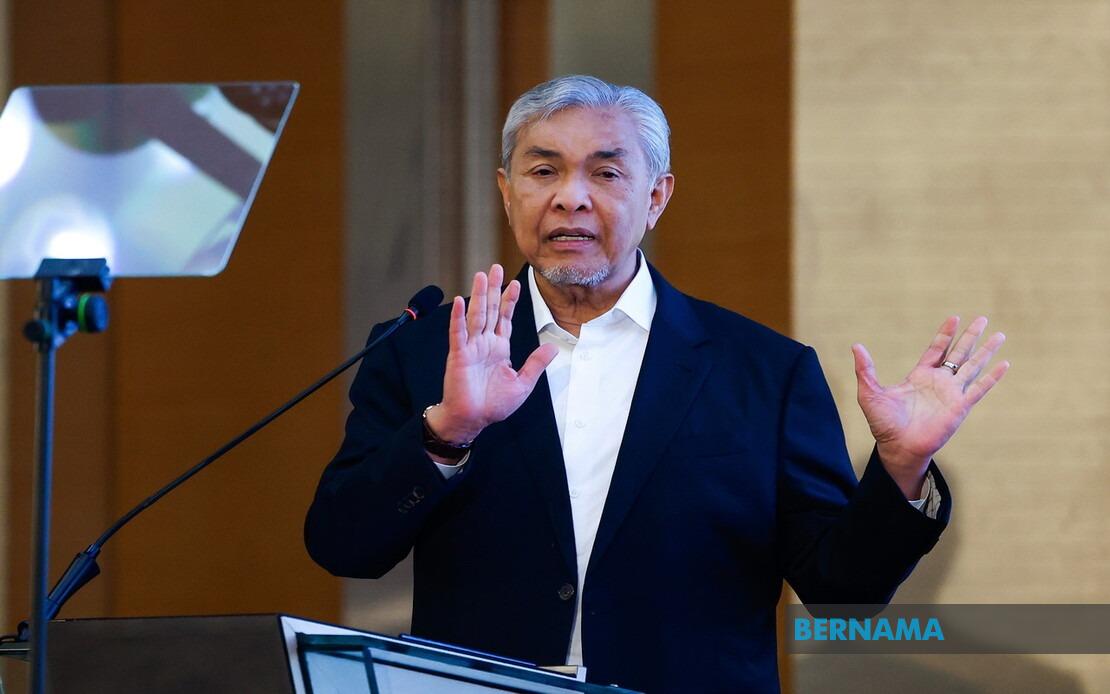
Deputy Prime Minister Datuk Seri Dr Ahmad Zahid Hamidi has urged all political parties contesting the forthcoming Negeri Sembilan state election to demonstrate respect for the monarchy and steer clear of divisive matters involving race, religion and royalty throughout their campaign activities. The appeal, made in Seremban on July 27, followed guidance issued by the Negeri Sembilan Palace that had specifically advised contesting parties to refrain from involving the royal institution in their ceramah and electoral strategies.
Ahmad Zahid emphasised that the directive from the Palace merited serious consideration and compliance from all quarters. He underscored the critical importance of safeguarding the institution of the Malay Rulers, stating that this constitutional pillar required unwavering defence and protection from political actors. The Deputy Prime Minister extended this principle specifically to Negeri Sembilan, highlighting the significance of preserving the institution of the Undang Yang Empat, the state's paramount ruler.
In articulating Barisan Nasional's position, Ahmad Zahid asserted that the coalition had consistently maintained a principled stance by never weaponising 3R matters for electoral advantage. This commitment, he suggested, reflected a broader philosophy of respecting constitutional institutions and the sensitivities bound up with questions of identity, faith and sovereignty. By publicly reaffirming this position, the BN leader sought to position his coalition as a custodian of institutional integrity during the electoral process.
The Deputy Prime Minister's remarks carried an implicit cautionary message directed at rival political formations, particularly those inclined to exploit divisive themes for political mobilisation. Without naming specific parties, Ahmad Zahid suggested that the temptation to raise such issues was unnecessary and potentially counterproductive. He framed the Palace's guidance as a constructive reminder that transcended party lines and served the broader national interest in maintaining social cohesion.
The context of Ahmad Zahid's intervention reflects the intensifying sensitivity surrounding electoral conduct in Malaysia. State elections have increasingly become flashpoints where opposition parties test messaging strategies that push against established boundaries. The 3R framework—encompassing race, religion and royalty—represents a foundational consensus in Malaysian politics that nominally unites diverse actors across the ideological spectrum. Yet in practice, enforcement of this understanding remains inconsistent, and election campaigns frequently witness rhetorical transgressions that test the limits of accepted discourse.
Negeri Sembilan's proactive stance through its Palace represents an effort to establish clear expectations before the campaign enters full swing. By issuing guidance well in advance, the state's royal institution sought to forestall potential controversies and preserve the dignity of the electoral process. This preemptive approach contrasts with reactive interventions that emerge after offensive statements have already circulated, thereby amplifying their reach.
In a separate development addressed during the same occasion, Ahmad Zahid dismissed suggestions of substantive discord between Barisan Nasional and Perikatan Nasional that might have obstructed collaborative arrangements between the two coalitions. He characterised the relationship between BN and PN as fundamentally sound, grounded in mutual understanding and cooperative spirit. This clarification was significant given occasional media speculation about tensions that might have prevented formal pacts during electoral contests.
The Deputy Prime Minister's remarks occurred during his attendance at the Negeri Sembilan Entrepreneurs Gathering Programme, an event that brought together business leaders and government officials. The setting underscored the integration of electoral politics with broader governance and economic agendas. Deputy Rural and Regional Development Minister Datuk Rubiah Wang and MARA chairman Datuk Dr Asyraf Wajdi Dusuki were also present, indicating high-level official engagement with the business community ahead of the state election.
The emphasis on respecting institutional boundaries during electoral campaigns carries particular resonance in Malaysia's political culture, where the monarchy occupies a constitutionally protected and symbolically elevated position. Unlike many democracies where executive authority and popular mandate might suffice as sources of legitimacy, Malaysia's system incorporates the institution of hereditary rulers as co-equal stakeholders in governance. This structural feature requires that campaigns navigate carefully around issues touching royal prerogatives, state autonomy and the constitutional settlement underpinning federalism.
For Malaysian observers and regional analysts monitoring the country's electoral dynamics, Ahmad Zahid's intervention exemplifies how established political frameworks seek to maintain discipline over campaign conduct. Whether such appeals prove effective depends on the degree to which contesting parties internalise these norms or perceive electoral advantage in their violation. The coming weeks of the Negeri Sembilan campaign will provide a practical test of whether the Palace's guidance influences actual campaign behaviour or merely establishes a baseline standard against which transgressions can be measured and criticised.
The Deputy Prime Minister's framing of institutional respect as fundamental to BN's political identity represents an effort to position the ruling coalition as the custodian of established order and constitutional propriety. This narrative positioning, if successfully communicated to voters, might reinforce existing partisan loyalties while potentially attracting swing voters concerned about political stability and institutional degradation. Conversely, opposition parties contesting the election must calibrate their messaging to challenge incumbent governance without crossing rhetorical lines that invite accusations of institutional disrespect.

