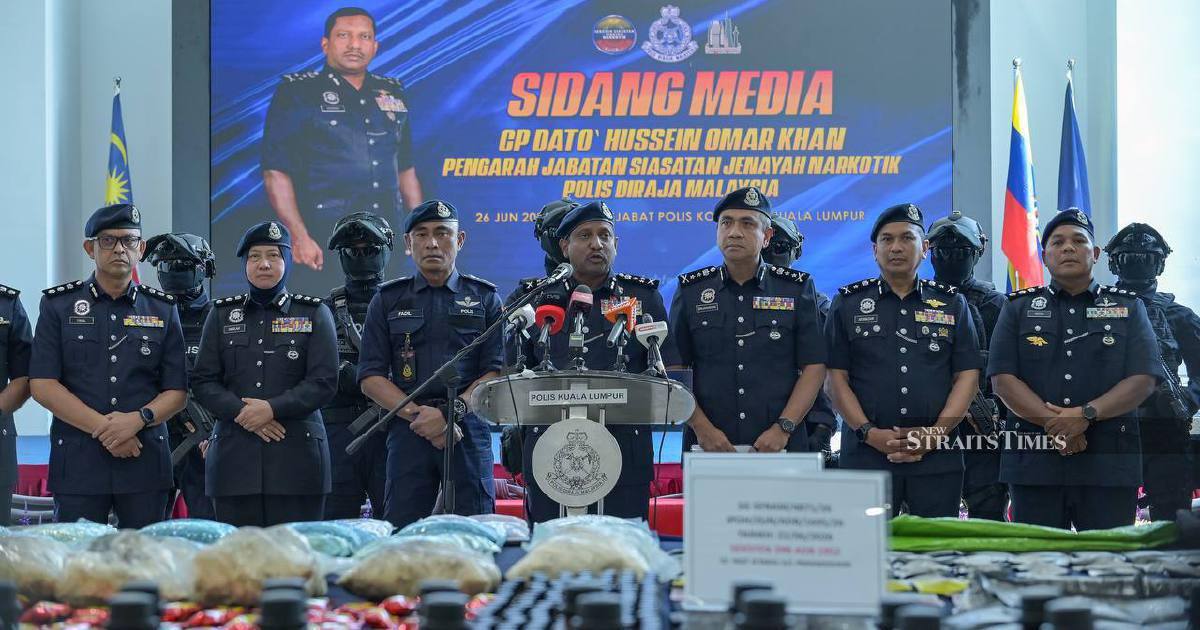
Malaysian law enforcement successfully disrupted a large-scale drug trafficking operation on June 20, seizing narcotics worth an estimated RM135.63 million across three coordinated raids conducted in Cheras. The action culminated in the arrest of seven suspects, marking a substantial victory against organised crime networks operating within the country's commercial capital. The operation underscores ongoing efforts by police to intercept shipments before illicit substances penetrate deeper into Malaysian communities.
The timing and precision of the three-pronged raid suggest that intelligence gathering and surveillance work had preceded the enforcement action. Such coordinated operations require meticulous planning and cross-departmental cooperation, involving uniformed personnel, specialised drug enforcement units, and intelligence analysts. The deployment of resources across multiple simultaneous locations reflects a tactical approach designed to prevent suspects from warning associates or destroying evidence. In Kuala Lumpur's urban landscape, where commercial spaces often conceal illegal operations, such comprehensive sweeps are crucial to disrupting criminal supply chains at crucial junctures.
The value of the seized consignment—approaching RM136 million—positions this seizure among notable drug enforcement successes in recent years. To contextualise, such quantities typically represent shipments intended for distribution across multiple states rather than for localised street-level sale. The scale suggests involvement of higher-tier trafficking organisations with access to significant capital, international supply routes, and established distribution networks within Malaysia. For authorities tracking drug flows, individual seizures of this magnitude provide valuable intelligence about shifting smuggling patterns and emerging trafficking hubs.
The location of Cheras, a mixed residential and commercial district in southeast Kuala Lumpur, reflects how trafficking operations have increasingly embedded themselves within urban areas rather than remaining confined to peripheral regions. The area's accessibility via major arterial roads, proximity to transportation hubs, and concentration of small businesses and warehouse spaces create an environment where suspicious activity can blend into ordinary commercial activity. This urban penetration represents a growing challenge for law enforcement seeking to identify and interdict contraband moving through densely populated localities.
The arrest of seven individuals provides investigators with potential leverage for uncovering broader criminal networks. In drug trafficking hierarchies, individuals apprehended during on-ground operations often possess knowledge of supply lines, financial arrangements, and downstream distribution channels. Enhanced interrogation and forensic analysis of communications and transaction records can yield intelligence extending beyond the immediate operation, potentially identifying foreign suppliers, local distribution coordinators, and downstream retailers. Such investigations frequently lead to subsequent arrests and asset seizures as authorities work upward through criminal networks.
Drug trafficking remains a persistent governance challenge across Southeast Asia, with Malaysia occupying a geographically critical position along established smuggling routes. The region experiences transshipment of narcotics originating from production zones in the Golden Triangle and Golden Crescent, destined for Australian and international markets. Malaysia's developed port infrastructure, air connectivity, and road networks make it an attractive transit point for trafficking syndicates, while domestic demand from an estimated 600,000 drug users creates additional market opportunities for traffickers.
The attempted saturation of local markets, as referenced in initial assessments of this operation, indicates trafficking groups' deliberate strategies to expand consumption and establish dependency within Malaysian populations. Public health implications extend beyond individual addiction, encompassing associated crime, family disintegration, and strain on rehabilitation services. The drug epidemic in Malaysia continues placing pressure on health systems, correctional facilities, and law enforcement resources. Prevention of market saturation therefore represents a public health imperative alongside criminal justice imperatives.
Police capabilities in interdicting narcotics have strengthened through technological adoption, including surveillance systems, financial transaction analysis, and controlled substance tracking. Intelligence sharing with international partners—particularly through Interpol and bilateral arrangements with neighbouring nations—has enhanced capacity to identify smuggling patterns and coordinate cross-border enforcement. Nevertheless, traffickers continuously adapt methodologies, utilising encrypted communications, cryptocurrency transactions, and decentralised distribution models to evade detection.
The Cheras operation illustrates that despite these adaptive criminal strategies, coordinated, intelligence-led enforcement actions remain effective at disrupting major trafficking enterprises. The seizure removes substantial quantities from circulation and generates investigative opportunities. However, law enforcement officials acknowledge that successful long-term reduction of drug trafficking requires complementary demand reduction strategies, including treatment access, community education, and rehabilitation support for dependent users.
This operation also highlights resource allocation considerations within Malaysian law enforcement. Sophisticated drug investigations demand substantial investigative capacity, advanced forensic capabilities, and sustained surveillance operations. Balancing anti-trafficking efforts with other policing priorities remains an ongoing challenge for police leadership. The June 20 operation demonstrates commitment to major trafficking disruption, yet sustainability of such efforts depends on adequate budgeting and personnel allocation.
The investigation into the seven arrested individuals continues, with prosecutors preparing cases for court proceedings. Trafficking convictions under Malaysia's harsh drug laws carry substantial penalties, including lengthy imprisonment and asset forfeiture. The criminal justice process will determine whether arrested individuals face charges as trafficking organisers or lower-tier operatives, distinctions carrying significant sentencing implications. Beyond immediate prosecutions, the intelligence gathered informs ongoing police operations against remaining members of trafficking networks.

