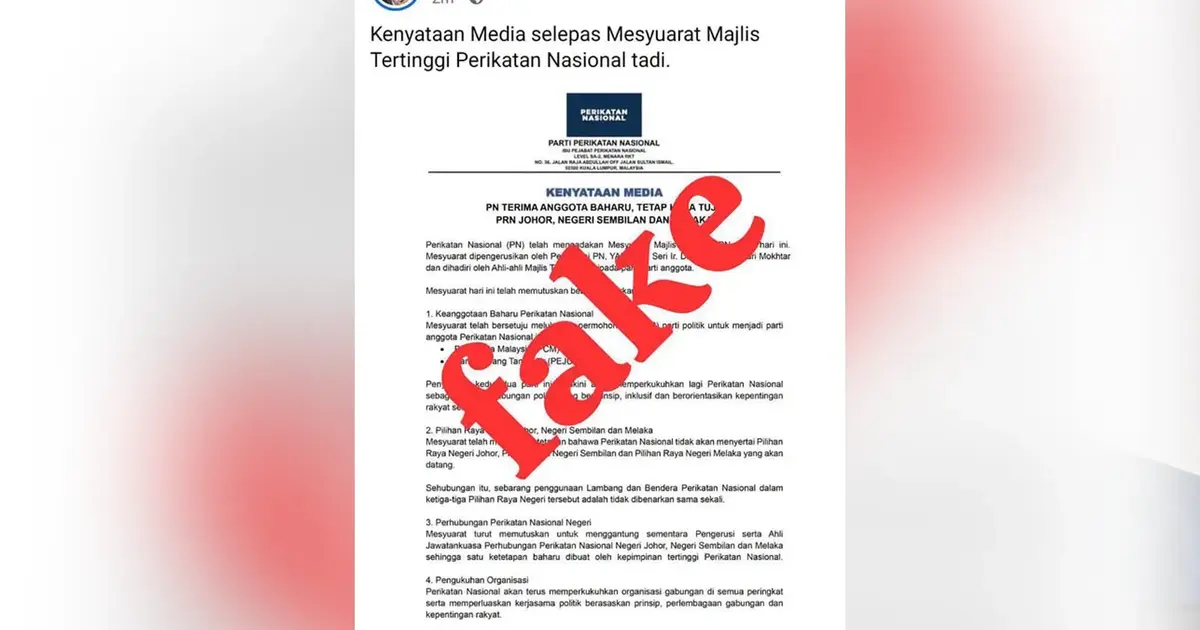
Perikatan Nasional moved swiftly to counter misinformation on Monday, categorically denying allegations contained in a fabricated statement that suggested the opposition coalition would abstain from participating in three forthcoming state elections. The coalition's firm rejection of the false claims underscores growing concerns about the circulation of misleading political narratives in the digital sphere, a challenge that has become increasingly prominent across Malaysian politics.
The emergence of such fabricated statements reflects the broader landscape of political communication in Malaysia, where online platforms have become vectors for spreading unverified claims about major political coalitions and their strategic decisions. PN's swift response demonstrates the coalition's commitment to addressing misinformation head-on, particularly when such claims could potentially influence public perception of its political positioning and electoral intentions.
The timing of the fake statement's circulation raises questions about the mechanisms through which false political narratives gain traction in Malaysian discourse. In an environment where state elections carry significant implications for the overall political balance of power, the potential impact of deliberately misleading information cannot be understated. Such falsehoods, if left unchallenged, can distort public understanding of opposition strategies and undermine informed democratic participation.
State elections in Malaysia serve as crucial indicators of shifting voter sentiment and regional political dynamics. They often function as bellwethers for broader national political trends, making them targets for those seeking to manipulate the narrative surrounding political coalitions. By promptly refuting the allegations, PN has sought to maintain clarity regarding its participation and engagement in these electoral contests.
The coalition's explicit characterization of the statement as "false and inaccurate" reflects standard practice among Malaysian political organizations responding to unverified claims. Such direct denials are necessary to preserve organizational credibility and ensure that supporters and the general electorate receive accurate information about party positions and intentions.
The incident illustrates the vulnerability of the political information ecosystem to deliberate disinformation campaigns. Whether originating from rival political actors, foreign interference, or other actors seeking to destabilize political confidence, such fake statements can quickly propagate through social media networks before fact-checkers and official organizations can respond. This temporal advantage enjoyed by misinformation creators presents an ongoing challenge for Malaysian democracy.
For voters seeking to make informed decisions about state elections, distinguishing between authentic political communications and fabricated statements has become an essential but often difficult task. The absence of centralized, easily accessible verification mechanisms means that citizens frequently encounter competing narratives without clear pathways to determine their veracity. PN's public denial serves as one data point in this larger information landscape, but the burden of verification ultimately rests upon individual voters and media organizations.
The circulation of such false claims also has implications for electoral legitimacy. When fictional narratives about major coalitions' electoral participation circulate widely, they can undermine public confidence in the accuracy of political information more broadly. This erosion of trust in political communication channels affects not only the specific elections in question but also the broader quality of democratic discourse in Malaysia.
Regional observers of Malaysian politics continue to monitor how the country's political coalitions navigate challenges posed by misinformation and deliberate disinformation. As state elections become increasingly significant in determining the composition of state governments and their policy directions, the ability of political organizations to communicate clearly and counter false narratives becomes ever more consequential. PN's handling of this particular incident reflects its strategy for maintaining its credibility as a major political force.
Moving forward, the incident highlights the necessity for both political organizations and media entities to invest in robust fact-checking infrastructure and public education initiatives. As digital communication platforms continue to evolve, the sophistication of disinformation tactics will likely increase, requiring correspondingly more advanced approaches to verification and public communication. The stakes for Malaysian democracy depend significantly on how effectively these challenges can be addressed.
The broader context of rising misinformation in Southeast Asian political environments suggests that Malaysia's experiences are not isolated. Countries throughout the region face similar challenges, with fabricated political statements regularly circulating ahead of major electoral events. International organizations and academic researchers have increasingly focused on understanding and countering these trends, recognizing their potential to undermine democratic institutions and processes.

