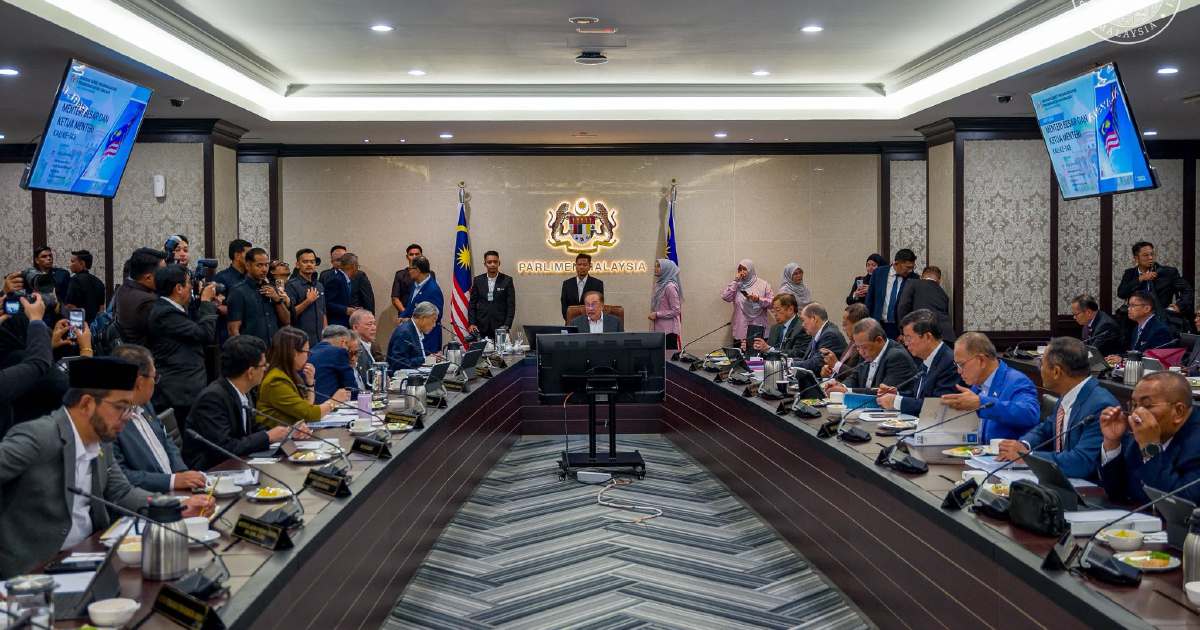
Prime Minister Datuk Seri Anwar Ibrahim assembled state leaders from across Malaysia at a high-level gathering at the Parliament building today to forge a coordinated approach to economic restoration, with international geopolitical instability emerging as a key concern shaping policy discussions. The 149th Meeting of Menteris Besar and Chief Ministers, presided over by the Prime Minister himself, underscores the administration's determination to position Malaysia as a resilient economy capable of weathering external shocks while positioning the nation competitively in Southeast Asia's evolving economic landscape.
The timing of this convocation reflects mounting apprehension about how conflicts in the Middle East might ripple through global supply chains, financial markets, and commodity prices—considerations that hold particular relevance for a Southeast Asian economy dependent on international trade and investment flows. Malaysia's manufacturing sectors, tourism industry, and export-oriented businesses face potential headwinds if regional instability constrains economic activity worldwide. By bringing together the chief executives of all states and federal territories under one forum, the Prime Minister signals recognition that economic recovery cannot be achieved through federal policies alone, but requires coordinated action from state administrations that directly oversee local commerce, infrastructure, and business development.
The convergence of Menteris Besar and Chief Ministers represents a crucial institutional mechanism for translating national economic priorities into ground-level action. These officials oversee state-level implementation of development projects, coordinate with local business communities, manage infrastructure investments, and navigate the regulatory environments that either facilitate or hinder private sector expansion. By directly engaging them in strategizing economic revival, the Prime Minister ensures that recovery initiatives account for regional variations in economic structure, unemployment patterns, and sectoral strengths across Malaysia's diverse states.
Economic revival efforts at this juncture must address several intersecting challenges confronting Malaysian growth. Domestically, the economy requires sustained stimulus to combat inflation pressures, maintain employment levels, and encourage private investment in capital-intensive sectors. Internationally, the nation must insulate itself from shocks originating in volatile geopolitical hotspots. The Middle East tensions referenced in today's discussions carry particular weight given Malaysia's energy imports, shipping routes through key waterways, and financial exposure to regional markets. Any escalation could drive up energy costs, disrupt maritime trade corridors vital to Southeast Asia, and heighten risk premiums that Malaysian companies face when accessing international credit.
The gathering also reflects a broader recognition that sub-national governments possess critical levers for economic stimulus that federal authorities cannot manipulate alone. State governments control land-use policies affecting industrial park development, influence investment promotion efforts to attract multinational corporations and regional headquarters, and direct procurement spending toward local enterprises. When functioning as coordinated partners rather than isolated fiefdoms, state administrations can amplify the impact of national economic policies while tailoring them to local contexts.
Malaysia's experience with coordinated federal-state economic initiatives carries mixed lessons. Past success stories, particularly in developing strategic manufacturing clusters and special economic zones through state-federal collaboration, demonstrate the potential for synchronized action. Conversely, instances where state governments pursued parochial interests at the expense of broader economic integration highlight the difficulties inherent in achieving meaningful coordination across thirteen state-level administrations with varying political complexions and development priorities.
The emphasis on economic revival during the 149th meeting likely encompasses discussion of several specific policy domains. Infrastructure investment remains critical, particularly in transportation networks, digital connectivity, and industrial facilities that undergird productive capacity. State leaders probably explored mechanisms for accelerating project implementation and reducing bureaucratic delays that often impede development initiatives. Additionally, human capital development and workforce reskilling initiatives require coordinated implementation across states to ensure that Malaysian workers possess capabilities demanded by emerging industries.
The global uncertainty emanating from Middle East conflicts introduces an unpredictability that complicates medium-term economic planning. Malaysia's policymakers must simultaneously prepare contingency responses should geopolitical tensions intensify while maintaining confidence among international investors and trading partners that Malaysia offers stable commercial conditions. Today's meeting signals that the government is actively monitoring external threats and mobilizing institutional resources to manage them, a message intended to reassure businesses and investors that policy responses will be swift and coordinated.
Looking forward, the 149th Meeting likely establishes frameworks through which state leaders can communicate economic concerns, share best practices in attracting investment and fostering entrepreneurship, and collectively advocate for federal policy adjustments required to support state-level recovery efforts. The gathering demonstrates that Malaysia's constitutional federalism, when properly leveraged, can convert what might otherwise be fragmented state administrations into a coherent network advancing shared prosperity objectives.
As Malaysia navigates turbulent global conditions, the coordination demonstrated at today's parliamentary assembly will prove essential in determining whether the nation emerges from current uncertainties with momentum intact or staggers under accumulated external pressures. The Prime Minister's personal chairing of proceedings underscores the political importance attached to economic recovery, signalling that this agenda commands top-level attention and resources necessary for meaningful implementation across all territorial jurisdictions.

